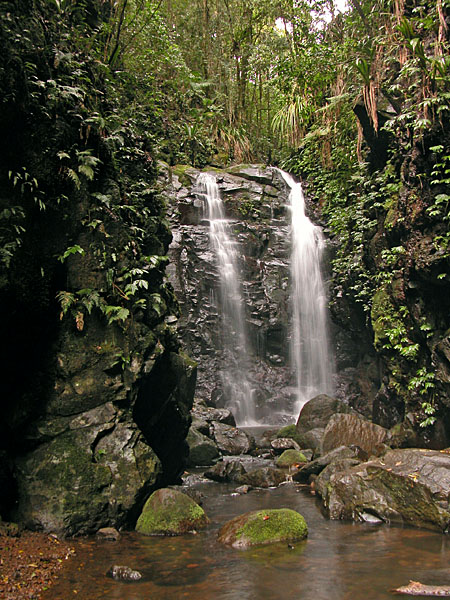
Gondwana Rainforests
29.6000° S · 149.6000° E · World Heritage Site
Photo: Malcolm Jacobson · CC BY-SA 2.0 · Wikimedia Commons
Gondwana Rainforests is an area of subtropical rainforest in Australia. World Heritage Area spanning northern New South Wales and Queensland. The free Lokali audio guide runs 7 minutes.
✓ Published October 2026 · how we write these guides
Visitor facts
| Lokali audio guide | 7 min · free |
|---|---|
| Type | World Heritage Site |
| Location | New South Wales, Australia |
| Coordinates | -29.6000, 149.6000 |
| Languages | 50+, in the Lokali app |
The story
Listen first. Somewhere above you, water drips from leaf to leaf, slowly working its way down to the forest floor. The air is cool and damp, and it smells of wet soil, moss and rotting wood. Underfoot, the path is soft with fallen leaves. Light reaches you only in green fragments, filtered through layer after layer of canopy. You are standing inside one of the oldest kinds of forest on Earth, and almost everything around you has a family tree that reaches back to the age of dinosaurs.
The Gondwana Rainforests of Australia are not one single park. They are a chain of protected areas scattered along the Great Dividing Range, stretching across northern New South Wales and into southeast Queensland. Together they form a World Heritage Area, first listed in the 1980s and later extended. Names you may know belong to it — Dorrigo, New England, Border Ranges, Nightcap, Barrington Tops, and Lamington across the Queensland border. Each patch is different, but they share one remarkable thread.
That thread is in the name. Gondwana was a giant southern supercontinent. Long ago, Australia, Antarctica, South America, Africa and India were joined together as one landmass. Much of it was covered in cool, wet forest. Over many millions of years, Gondwana broke apart, and Australia drifted north, slowly drying out. Most of its ancient rainforest shrank and vanished. But in these damp mountain pockets, fragments survived. What you see here is a living record of that older world.
Here is something most visitors miss. Some trees in these forests have relatives in South America and New Zealand. The best example is the Antarctic beech. It grows in the cooler, higher parts of the region, often wrapped in thick green moss. Its close cousins grow in Chile, Argentina and New Zealand. These trees did not travel across oceans. They are simply what remains of forests that once grew across a single, connected continent... including Antarctica itself.
Look at the shapes around you. Rainforest trees here often stand on wide buttress roots, flaring out like the fins of a rocket. These roots help tall trees stay upright in shallow soil. You may also see strangler figs. A fig begins life as a seed dropped high in another tree, often by a bird. It sends roots down to the ground, wraps around its host, and over many years can replace it entirely. Sometimes only a hollow lattice of fig roots remains.
Now look higher, into the branches. Many plants here never touch the soil at all. Large ferns sit in the forks of trees, collecting fallen leaves and rainwater in their centres. Staghorn and elkhorn ferns cling to trunks. Orchids, mosses and lichens cover almost every surface that stays damp. These plants are called epiphytes, which simply means plants that grow on other plants without feeding on them. In places, a single old tree can carry a whole garden.
The ground has its own story. Much of the northern part of this World Heritage Area sits on the remains of an enormous ancient volcano. Scientists call it the Tweed Volcano. Over millions of years, erosion wore it down, leaving a vast ring of cliffs around a central peak. That peak is known as Wollumbin, also called Mount Warning. Wollumbin is a place of deep cultural significance for local Aboriginal people, and they ask visitors to respect it.
That connection to Country runs through the whole region. Aboriginal peoples have lived with these forests for many thousands of years. Different nations hold different parts of this landscape, each with their own languages, stories and responsibilities. Many places here carry Aboriginal names alongside English ones. When you see signs acknowledging Traditional Custodians, they are not decoration. They mark a living relationship with the land that is far older than any national park.
Now — that sound. If you hear what seems like a whipbird, then a kookaburra, then something like a camera shutter, all from the same bush, you may be listening to a lyrebird. Lyrebirds are famous mimics. They copy the calls of other birds and sometimes other sounds from their surroundings. Two species live in these forests. The males perform elaborate displays on cleared patches of ground, spreading their long, lace-like tail feathers. You will hear them far more often than you see them.
The forest is full of quieter life too. Pademelons, small forest wallabies, often feed near track edges in the early morning. Brightly coloured fruit doves move through the canopy. Some birds here belong to very old lineages, including the rufous scrub-bird, a shy and secretive species. And on damp nights, certain fungi on rotting wood give off a faint green glow. Locals sometimes call this foxfire. It is real, and on a moonless night it can be surprisingly clear.
These forests are old, but they are not untouchable. During the severe bushfire season of 2019 and 2020, fire reached parts of the World Heritage Area. Rainforest normally stays too wet to burn, so this was a serious shock. Some areas are still recovering, and track conditions can change. Logging and clearing also removed much of the surrounding rainforest in earlier generations. What is protected today is precious partly because so much else is already gone.
A few practical notes as you explore. Tracks can be slippery after rain, so sturdy shoes matter. Leeches are common in wet weather — a normal part of the rainforest, and harmless, if a little unwelcome. Stay on marked paths, because the forest floor is fragile and easy to damage. Carry water, even on cool days. And before you set out, check the national parks website for closures, since fire recovery and storms can shut sections without much warning.
Before you move on, stand still for one more moment. Notice how many shades of green surround you. Notice the moss on the nearest trunk, the drip of water, the cool air on your skin. The forest around you did not begin with roads or maps. It began on a continent that no longer exists. As you walk back along the path, listen once more for the lyrebird... and for the quiet sound of a very old world, still growing.
Key facts
What to look for
Practical tips
Common questions
Is there a free audio guide to Gondwana Rainforests?
Yes — the Lokali app narrates Gondwana Rainforests free of charge in 50+ languages. The guide runs about 7 minutes, covers the history, what to look for on site and practical tips, and works offline once downloaded.
Where is Gondwana Rainforests?
Gondwana Rainforests is near New South Wales, Australia, at -29.6000, 149.6000. Tap the map link on this page for directions from where you are.
What is Gondwana Rainforests known for?
World Heritage Area spanning northern New South Wales and Queensland. Made up of many separate national parks and reserves.
What should you look for at Gondwana Rainforests?
Wide buttress roots flaring out from the base of tall trees. Strangler fig roots wrapped around or replacing a host tree. Large nest-shaped ferns sitting in high tree forks.
What should you know before visiting Gondwana Rainforests?
Check national parks alerts for track closures before setting out. Wear sturdy, grippy shoes for wet and slippery tracks.
When is the best time to visit Gondwana Rainforests?
Come early morning to hear birds and spot pademelons.
On the map
Opens directions to Gondwana Rainforests from your location.
Hear Gondwana Rainforests in your language
The full story, narrated, in 50+ languages. Download it before you go and it plays offline, at your own pace, with no ticket and no tour group.