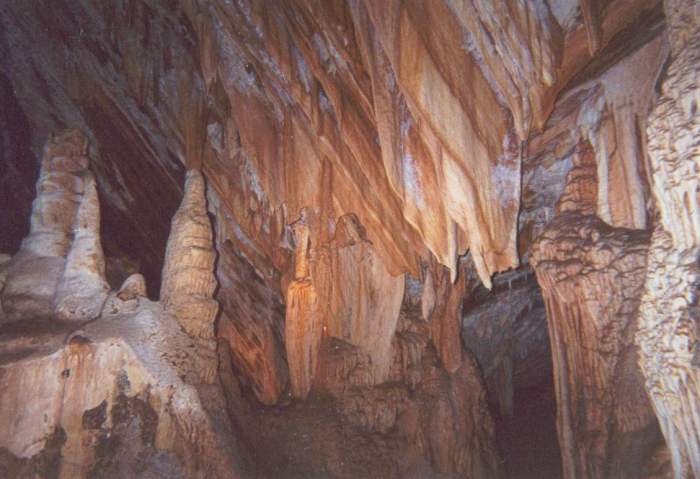
Photo: No machine-readable author provided. Roo72 assumed (based on copyright claims). · CC BY-SA 3.0 · Wikimedia Commons
Jenolan Caves is a karst (cave system) in New South Wales, Australia. Located in the Blue Mountains of New South Wales. The free Lokali audio guide runs 7 minutes.
✓ Published October 2026 · how we write these guides
Visitor facts
| Lokali audio guide | 7 min · free |
|---|---|
| Type | Cave |
| Location | New South Wales, Australia |
| Coordinates | -33.8206, 150.0214 |
| Languages | 50+, in the Lokali app |
The story
Listen first. Somewhere close by, water is dripping, slow and steady, onto stone. The air at the cave mouth is cool and damp, and it carries a faint mineral smell, like wet chalk. Above you, a vast arch of grey limestone curves overhead. Light falls in from both ends, and the road you arrived on runs straight through the rock. Welcome to Jenolan Caves, deep in the Blue Mountains of New South Wales.
That great opening above you is the Grand Arch. It is one of the most unusual arrivals of any cave system in the world. Most caves hide their entrances in scrub or behind boulders. Here, the cars, the buses and the walkers all pass through a natural tunnel in the hillside. The arch was carved by water over an enormous span of time. Stand still for a moment and look up at the ceiling. You can see smooth, scooped surfaces where an ancient river once flowed.
Long before any road existed, this valley belonged to the Gundungurra people. The name often given for this place in their language is Binoomea, usually translated as dark places. The Gundungurra tell a creation story about Gurangatch, a great eel-like creature, and Mirragan, a hunter who pursued him across the country. In that tradition, their struggle shaped the rivers and valleys of this region. It is a reminder that this landscape carried meaning for thousands of years before it carried tourists.
The European story begins in the nineteenth century, and it is wrapped in a colourful tale. Locals say that a settler named James Whalan tracked a bushranger, an escaped convict turned outlaw, into these hills. According to the story, the outlaw was using the caves as a hideout. Historians treat parts of this account with caution. What is clear is that news of the caves spread, and curious visitors soon followed the rough tracks into the valley.
Here is the first surprise. Jenolan was protected remarkably early. In the 1860s, the colonial government set the caves aside as a reserve. That makes this one of the earliest places anywhere set aside partly for its natural value. Today it sits within the Greater Blue Mountains World Heritage Area. That listing recognises the wider region, with its eucalyptus forests, deep gorges and remarkable range of plant life.
Now for the second surprise, and it concerns time. Scientists who studied clay deposits inside the caves suggested that the system may be around 340 million years old. If that research holds, Jenolan is among the oldest known open caves on Earth. To put that in perspective, these passages may have existed before the first dinosaurs walked. The limestone itself is older still. It formed from the remains of sea creatures, laid down on an ancient ocean floor.
The cave system is enormous. Explorers have mapped many kilometres of passages, and cavers are still finding more. Only a portion is open to visitors on guided tours. Each show cave has its own character. There is Lucas Cave, with its large chambers. There is the Temple of Baal, known for its tall, draped formations. There is the Orient Cave, famous for delicate white crystal. Each tour follows lit pathways and stairways through the dark.
Much of that early exploration is linked to the caretakers who lived here. One of the best known was Jeremiah Wilson. He spent years pushing into new passages by candlelight, often squeezing through tight gaps. Later guides continued that work. Electric lighting arrived in the late nineteenth century, very early for a cave anywhere in the world. Before that, visitors carried candles and magnesium flares, and soot from that era still marks some ceilings.
Inside the caves, the formations grow with extreme patience. Water seeps through the rock and picks up dissolved limestone. When each drop reaches the open air of a chamber, it leaves behind a tiny film of mineral. Stalactites hang down from the ceiling. Stalagmites rise up from the floor. Thin, folded curtains called shawls form where water runs along a sloping roof. Many formations grow so slowly that a lifetime adds almost nothing. That is why the guides ask you never to touch them. The oils from one hand can stop the growth for good.
Back outside, walk a short distance from the arch and you reach the Blue Lake. The water here often shows a clear, milky blue-green. That colour comes from fine particles of limestone suspended in the water, which scatter the light. The lake was created by a small weir built long ago. On quiet evenings, patient visitors sometimes spot a platypus, the egg-laying mammal with a duck-like bill. Stay still and watch for rings spreading across the surface.
Nearby is the Devil's Coach House, another huge open cavern. Unlike the dark show caves, daylight pours into it. You can walk in without a tour and feel the scale of the place. The walls rise high above you, streaked with orange, cream and grey. Birds nest in the ledges, and their calls echo around the chamber. Swallows dart across the opening in warmer months.
Then there is Caves House, the tall guesthouse near the arch. It was built in stages from the late nineteenth century into the early twentieth. Its steep roofs and timbered gables follow a Tudor revival style, a design that copies old English country houses. For generations, travellers arrived by horse and coach after a long, rough journey. They stayed for days, exploring the caves by lamplight and dressing for dinner in the evening.
The road that brought you here is part of the experience too. It winds and drops steeply through forest into this narrow valley. For early visitors, the descent was slow and sometimes frightening. Even today, the drive forces you to slow down. By the time you reach the arch, the noise of the city feels very far away. That isolation is part of what has kept this valley so quiet.
Before you move on, take one more look around. Notice the cool air flowing out of the rock beside you. Notice the soft drip of water, which is still building formations you will never see finished. The same slow process has continued here for hundreds of millions of years. As you walk back through the Grand Arch, look up once more at that smooth stone ceiling... and listen to your footsteps echo off it.
Key facts
What to look for
Practical tips
Common questions
Is there a free audio guide to Jenolan Caves?
Yes — the Lokali app narrates Jenolan Caves free of charge in 50+ languages. The guide runs about 7 minutes, covers the history, what to look for on site and practical tips, and works offline once downloaded.
Where is Jenolan Caves?
Jenolan Caves is in New South Wales, Australia, at -33.8206, 150.0214. Tap the map link on this page for directions from where you are.
What is Jenolan Caves known for?
Located in the Blue Mountains of New South Wales. Research suggests the caves may be 340 million years old.
What should you look for at Jenolan Caves?
Smooth scooped ceiling of the Grand Arch above the road. Milky blue-green water of the Blue Lake. Orange and cream streaks on Devil's Coach House walls.
What should you know before visiting Jenolan Caves?
Book guided cave tours in advance, especially on weekends. Wear shoes with good grip for damp stairways.
When is the best time to visit Jenolan Caves?
Linger at Blue Lake near dusk for platypus sightings.
On the map
Opens directions to Jenolan Caves from your location.
More to see in New South Wales

Hear Jenolan Caves in your language
The full story, narrated, in 50+ languages. Download it before you go and it plays offline, at your own pace, with no ticket and no tour group.