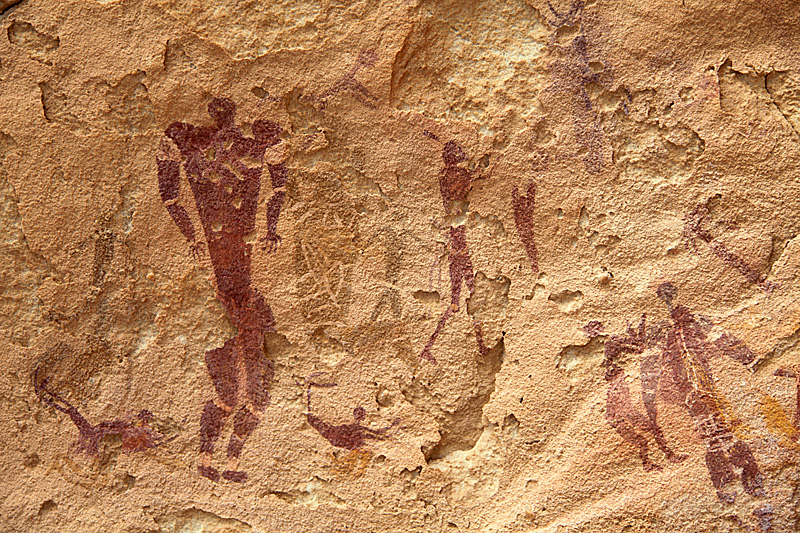
Cave of Swimmers
23.5947° N · 25.2335° E · Archaeological Site
Photo: Roland Unger · CC BY-SA 3.0 · Wikimedia Commons
Cave of Swimmers is a cave with ancient rock art in Egypt. Almásy's expedition found the cave in October 1933. The free Lokali audio guide runs 6 minutes.
✓ Published October 2026 · how we write these guides
Visitor facts
| Lokali audio guide | 6 min · free |
|---|---|
| Type | Archaeological Site |
| Location | New Valley Governorate, Egypt |
| Coordinates | 23.5947, 25.2335 |
| Languages | 50+, in the Lokali app |
The story
Sand hisses softly against sandstone. The air is dry enough that your lips tighten after a few minutes. In front of you is a shallow rock shelter in the cliff, more of an overhang than a deep cave. Its ceiling is low and its walls are the colour of old honey. Look closely at the rock, at about the height of your shoulders. Small reddish figures float there, with arms stretched out and legs bent, as if they are moving through water.
This is the Cave of Swimmers. It sits in Wadi Sura, a valley at the edge of the Gilf Kebir plateau, in the far southwest of Egypt. The name Gilf Kebir means roughly the great barrier, and the plateau rises out of the desert like a wall. Around you, in every direction, is one of the driest places on Earth. Rain here can fail for years at a time. That dry silence makes the swimming figures feel even stranger.
The journey here is part of the story. There is no town nearby and no paved road. Visitors usually come by four-wheel-drive convoy across hundreds of kilometres of open desert, often starting from the oases of the New Valley. Travel in this region requires official permits, and expeditions usually move with a security escort. So if you are standing here, you have already crossed a landscape that very few people ever see.
The modern discovery came in October 1933. The Hungarian explorer László Almásy led desert expeditions across this region in the late 1920s and 1930s. He was searching for lost oases and old caravan routes. His party found this shelter and its paintings. Almásy described the swimming figures and suggested an idea that still surprises people today. Perhaps, he thought, this desert was once green, with lakes where people could swim.
In the 1930s, many people found that idea hard to accept. Today, scientists broadly agree that the Sahara went through long wet phases. After the last Ice Age, rains moved north into this region for thousands of years. Grasslands spread across the land. Seasonal lakes and rivers formed in low ground. Animals such as giraffes, cattle and antelope lived where now there is only sand and stone. Researchers often call this period the Green Sahara.
The paintings belong to that distant world. Their exact age is difficult to fix, because rock paintings are hard to date directly. Many researchers place them in the early to middle Holocene, the warm period after the Ice Age, often several thousand years before the first Egyptian pharaohs. That means people were painting here long before anyone built a pyramid on the Nile. Treat any precise figure you hear with some caution.
Now look again at the swimmers themselves. They are small and simple, painted mostly in red and yellow earth pigments, with some white. The bodies are thin. Heads are round. Limbs reach out in different directions. Some appear to float horizontally, which gives the scene its sense of movement. Nearby you can also see other human figures, some standing and some in groups, and painted hand marks in places on the rock.
Here is a surprise that many visitors miss. Not every expert agrees that these figures are really swimming. Some scholars suggest they may show something spiritual instead, such as souls, dreams, or figures floating in another world. Similar floating figures appear in other rock art of the region, sometimes linked with strange creatures. So the name Cave of Swimmers is a modern label. The people who made these images may have meant something quite different.
The second surprise is about fame. Millions of people know this place without knowing they know it. Michael Ondaatje's novel The English Patient, published in 1992, uses a cave of swimmers in the Gilf Kebir as a central setting. The story draws loosely on Almásy and his circle. The 1996 film made the cave famous around the world. However, the film scenes were not shot here. A copy of the cave was used for filming instead.
That fame brought visitors, and visitors brought problems. These paintings have survived for thousands of years because the desert is so dry. Yet in recent decades some figures have faded or been damaged. One reported cause is people splashing water on the rock to make the colours brighter for photographs. Touching the paint also harms it, because skin carries oils and salts. Egypt later protected this wider area as the Gilf Kebir National Park.
A short distance away in the same region is another shelter, often called the Cave of Beasts. It was found much later, in 2002, by a small private expedition. Its walls carry thousands of painted figures, including many hand stencils and unusual headless creatures. The two sites are often visited together. Seeing both helps you understand that this valley was an important place for painting, perhaps over a long stretch of time.
Take a moment to notice the setting beyond the art. The shelter faces out over a sandy valley floor, with dark rocks scattered across it. Wind has smoothed the cliff in long curves. In the morning the stone looks pale and cool. Later in the day it turns orange and warm. Listen, too. Out here there is often no engine, no bird and no voice except your own group. The silence is part of the experience.
Before you walk away, look one last time at a single small swimmer. Someone mixed that colour from earth, and pressed it onto this rock with their hand or a simple tool. Around them, perhaps, there was grass, water and the sound of animals. Now there is only sand and light. Step back gently, keep your hands away from the wall, and let the figures go on floating in the stone after you leave.
Key facts
What to look for
Practical tips
Common questions
Is there a free audio guide to Cave of Swimmers?
Yes — the Lokali app narrates Cave of Swimmers free of charge in 50+ languages. The guide runs about 6 minutes, covers the history, what to look for on site and practical tips, and works offline once downloaded.
Where is Cave of Swimmers?
Cave of Swimmers is near New Valley Governorate, Egypt, at 23.5947, 25.2335. Tap the map link on this page for directions from where you are.
What is Cave of Swimmers known for?
Almásy's expedition found the cave in October 1933. Located in Wadi Sura on the Gilf Kebir plateau.
What should you look for at Cave of Swimmers?
Small red figures floating with arms and legs outstretched. Red, yellow and white earth pigments on honey-coloured sandstone. Painted hand marks among the human figures.
What should you know before visiting Cave of Swimmers?
Arrange permits and an escort well before your trip. Travel with an experienced desert operator and 4x4 convoy.
When is the best time to visit Cave of Swimmers?
Visit early morning for cooler air and softer light.
On the map
Opens directions to Cave of Swimmers from your location.
Hear Cave of Swimmers in your language
The full story, narrated, in 50+ languages. Download it before you go and it plays offline, at your own pace, with no ticket and no tour group.