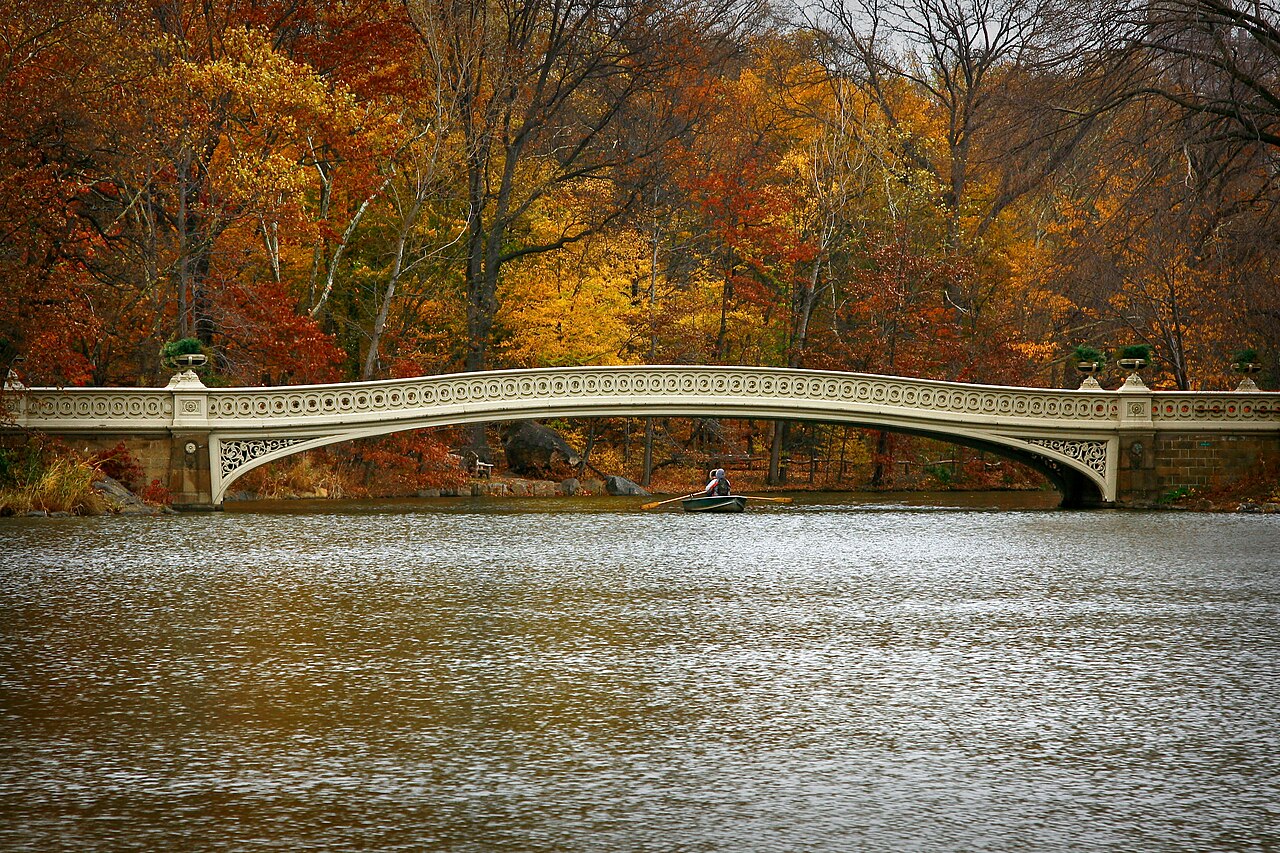
Bow Bridge is an iconic cast-iron bridge spanning the lake in Central Park, designed by Jacob Wrey Mould in 1862. It is in New York, United States. Most visitors spend 15–30 min here. The free Lokali audio guide runs 5 minutes.
✓ Verified August 2026 · how we write these guides
Visitor facts
| Time needed | 15–30 min |
|---|---|
| Lokali audio guide | 5 min · free |
| Type | Bridge |
| Best for | Photography |
| Location | New York, United States |
| Coordinates | 40.7749, -73.9707 |
| Languages | 45, in the Lokali app |
The story
You come around a bend in the path, and the bridge appears across the water. It is low and graceful, a long curve of pale cast iron resting above the lake. The surface of the water holds its reflection, so the bridge seems to form a full circle with its own image. Boats drift beneath it. People stop at its center and grow quiet. This is one of the loveliest spots in Central Park.
The bridge is called Bow Bridge. The name comes from its shape. It curves gently upward in the middle, like an archer's bow, or the bow a musician draws across the strings of a violin. The span is long and shallow, not steep. This soft curve is what gives the bridge its calm and balanced look, whether you see it up close or from far across the water.
Bow Bridge was designed by Calvert Vaux, one of the two men who planned all of Central Park, working with the architect Jacob Wrey Mould. It was built between 1859 and 1862. That makes it one of the oldest cast-iron bridges in the United States. At the time, cast iron was a new and modern material, strong enough to span the water with a thin, light frame.
The iron was made by a foundry called Janes, Kirtland and Company. The same firm helped cast parts of the great dome of the United States Capitol in Washington. So the metal under your feet shares its makers with one of the most famous buildings in the country. Look at the ironwork closely. You will see fine patterns, circles, and flowing lines repeated along the rail.
The bridge crosses the lake at a narrow point. On one side lies an open lawn and the wide water. On the other side rises the Ramble, a wild and wooded part of the park, full of winding paths and tall trees. Bow Bridge is the link between the two. Crossing it, you move from open sky into deep green shade in just a few steps.
Stand at the center and look down. The water is usually calm here, and on a still day it works like a mirror. The arch of the bridge meets its reflection to form a smooth oval. This is why so many photographs are taken from this exact place. Morning light and evening light are softest, and the reflection is clearest when the wind is low.
Look along the rail and you will see decorative urns set at intervals. These hold planters, and in warm months they spill over with flowers and green leaves. The urns are part of the original design. They soften the iron and add a touch of the garden to the engineering. Small details like these show how much care went into a structure that simply carries a path over water.
The bridge you see has been repaired and renewed many times over its long life. Iron rusts, planking wears, and a busy park is hard on its structures. In the nineteen seventies, the bridge went through a major restoration that brought it back to its early form. The work kept the original design while making the old iron safe and strong for new generations of walkers.
Bow Bridge has appeared in many films and photographs. Directors love its clean shape and its setting between water and woods. You may feel that you have seen it before, even on a first visit. Couples come here to mark important moments. It is a frequent place for proposals, where one person kneels at the center while the city waits beyond the trees.
Look up and out from the bridge. The towers of the buildings along the park rise above the treeline in the distance. The contrast is sharp. Here you stand on a quiet, curving span above still water, surrounded by leaves. There, the hard edges of the city wait. The park was designed to give exactly this feeling, a soft world set inside a hard one.
Cross slowly to the far side and step into the Ramble. The light changes at once. The open glare of the lake gives way to cool shade. Birds move in the branches above. The Ramble was planted to feel like wild forest, and many birds rest here during their long migrations. Bow Bridge is the calm threshold between the two worlds.
Before you leave, turn and look back at the bridge one more time. Notice how light it seems, how it barely touches the water it crosses. More than a century and a half of feet have passed over it. Yet it still looks new and graceful in the morning light. Take your time here. A place this calm, in a city this large, is worth a quiet pause.
Key facts
What to look for
Practical tips
Common questions
How long do you need at Bow Bridge?
Plan 15–30 min. That is the time most visitors spend at Bow Bridge. The free Lokali audio guide adds about 5 minutes of narration you can listen to as you walk, so it fits inside your visit rather than adding to it.
Is there a free audio guide to Bow Bridge?
Yes — the Lokali app narrates Bow Bridge free of charge in 50+ languages. It covers the history, what to look for on site and practical tips, and it works offline once downloaded.
Where is Bow Bridge?
Bow Bridge is in New York, United States, at 40.7749, -73.9707. Tap the map link on this page for directions from where you are.
What should you know before visiting Bow Bridge?
Visit at dawn for still, mirror-like water.
What is Bow Bridge known for?
Designed by Calvert Vaux with Jacob Wrey Mould.
What is the best time to visit Bow Bridge?
Visit in early morning or after 5 p.m.
On the map
Opens directions to Bow Bridge from your location.
Reference
More to see in New York


Hear Bow Bridge in your language
The full story, narrated, in 50+ languages. Download it before you go and it plays offline, at your own pace, with no ticket and no tour group.