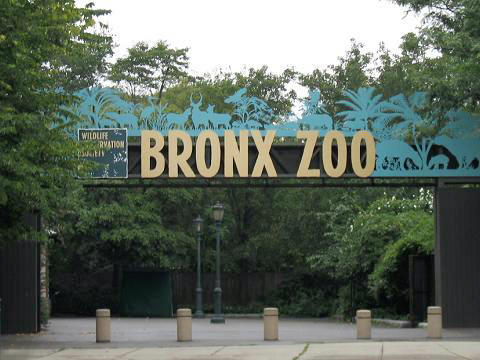
Photo: Stavenn · CC BY-SA 3.0 · Wikimedia Commons
Bronx Zoo is a metropolitan zoo in the Bronx, New York City, New York, USA. The Bronx Zoo first opened to visitors in 1899. The free Lokali audio guide runs 7 minutes.
✓ Published October 2026 · how we write these guides
Visitor facts
| Lokali audio guide | 7 min · free |
|---|---|
| Type | Zoo |
| Location | New York, United States |
| Coordinates | 40.8503, -73.8783 |
| Official website | bronxzoo.com |
| Languages | 50+, in the Lokali app |
The story
Listen for a moment. Under the traffic hum of the Bronx, there is another layer of sound. A peacock calls from somewhere behind the trees. Leaves move over the paths. Further off, a sea lion barks. You are standing in one of the largest green spaces in New York City, and it is full of animals from every continent. Welcome to the Bronx Zoo. Let's walk it together.
The zoo opened its gates in 1899. It was created by the New York Zoological Society, a group of wealthy and scientific New Yorkers who wanted more than a menagerie. They wanted a place for study, for education, and for saving species that were vanishing. Today that same organisation is called the Wildlife Conservation Society. It runs this zoo, several others in the city, and conservation projects around the world.
The land itself shapes everything you see. The zoo sits inside Bronx Park, and the Bronx River runs right through it. This is the only true freshwater river in New York City. Look for rocky outcrops along the paths — grey stone, scraped smooth by ancient glaciers. The planners kept much of this natural ground. They built the exhibits around the hills, ponds, and woods instead of flattening them. That is why the zoo feels more like a wooded park than a city block.
If you came in near Fordham Road, you may have passed the Rainey Memorial Gates. These are bronze gates, designed by the sculptor Paul Manship and dedicated in the 1930s. Look closely at them. They are covered with animals — birds, deer, lions, and many more — set among stylised trees. They are a fine example of Art Deco design, the sleek, geometric style of that era. Many visitors walk straight through without noticing them. Pause and look up.
Nearby is Astor Court, the oldest and most formal part of the zoo. Here the buildings look like small palaces. They follow the Beaux-Arts style, a grand French tradition of symmetry and decoration. Look for carved stone animals on the facades: elephants, bears, birds, and big cats. In the early years, these buildings held most of the collection. Animals lived indoors, in cages, on display. It was the standard idea of a zoo at the time.
Here is our first surprise. This zoo helped save the American bison. By the late nineteenth century, hunting had pushed the animal close to extinction. The zoo's first director, William Hornaday, became a fierce campaigner for the species. In 1907, the zoo shipped a group of bison by train to a protected reserve in Oklahoma. Those animals helped rebuild wild herds on the open plains. Some of today's bison may trace their ancestry back to animals raised right here.
The zoo also has a dark chapter, and it is honest to name it. In 1906, a young Congolese man named Ota Benga was put on display in the Monkey House. Many people protested, especially Black ministers in New York, and the display ended. He died ten years later, far from home. In 2020, the Wildlife Conservation Society formally apologised. As you walk through this place, it is worth remembering how much our ideas about people, and animals, have changed.
Those changing ideas show in the newer exhibits. Over the twentieth century, the zoo moved away from bars and toward landscapes. Walk to JungleWorld, an indoor Asian rainforest. It opened in the 1980s and was one of the first exhibits of its kind. Inside, the air is warm and wet. Mist drifts between the trees. Gibbons may call above you, and you might need a moment to spot the animals in the leaves.
Then there is the Congo Gorilla Forest, which opened in 1999. You walk on winding trails through thick planting, as if moving into a central African forest. The highlight is a large window into the gorilla habitat. The glass is all that separates you from the troop. Watch how the gorillas behave. A young one might wrestle with a sibling. An older male might sit quietly, eating leaves, ignoring everyone. These small moments often stay with visitors longest.
Here is our second surprise. In April 2020, a Malayan tiger at this zoo named Nadia tested positive for the virus that causes COVID-19. She was among the first animals in the United States known to have caught it. Several other big cats here showed symptoms too. Keepers believed an infected staff member passed it on. The tigers recovered. The case helped scientists learn how the virus could move between people and animals.
You can see those tigers at Tiger Mountain, where large windows look into a wooded, rocky habitat with a pool. Not far away, the Himalayan Highlands is home to snow leopards and red pandas. The snow leopard's thick, pale coat and long tail help it survive on cold mountain slopes. The red panda, despite the name, is not a close relative of the giant panda. It spends much of its time curled up in the trees.
The zoo is large, so plan to move slowly. There is too much to see in one visit, and that is fine. Pick a few areas and give them time. In warmer months, the Wild Asia Monorail carries visitors above open fields where Asian animals roam. Children often head for the Bug Carousel, where you ride giant insects instead of horses. The paths are long, with shade under old trees, and benches to rest along the way.
Before you leave, stop wherever you are and look around once more. Notice the mix of sounds — birds, children, the wind in the trees, a distant train. Notice how the stone outcrops and the river were here long before the zoo. More than a century of ideas about wild animals is written into these paths, from the carved stone of Astor Court to the glass of the gorilla forest. As you walk out, listen again. The peacocks might still be calling.
Key facts
What to look for
Practical tips
Common questions
Is there a free audio guide to Bronx Zoo?
Yes — the Lokali app narrates Bronx Zoo free of charge in 50+ languages. The guide runs about 7 minutes, covers the history, what to look for on site and practical tips, and works offline once downloaded.
Where is Bronx Zoo?
Bronx Zoo is in New York, United States, at 40.8503, -73.8783. Tap the map link on this page for directions from where you are.
What is Bronx Zoo known for?
The Bronx Zoo first opened to visitors in 1899. Run by the Wildlife Conservation Society, formerly the Zoological Society.
What should you look for at Bronx Zoo?
Bronze animals covering the Art Deco Rainey Memorial Gates. Carved stone animals on the Astor Court building facades. Glacier-smoothed grey rock outcrops beside the walking paths.
What should you know before visiting Bronx Zoo?
Pick a few zones rather than trying to see everything. Wear comfortable shoes for long, hilly walking paths.
When is the best time to visit Bronx Zoo?
Arrive early when many animals are more active.
On the map
Opens directions to Bronx Zoo from your location.
More to see in New York


Hear Bronx Zoo in your language
The full story, narrated, in 50+ languages. Download it before you go and it plays offline, at your own pace, with no ticket and no tour group.