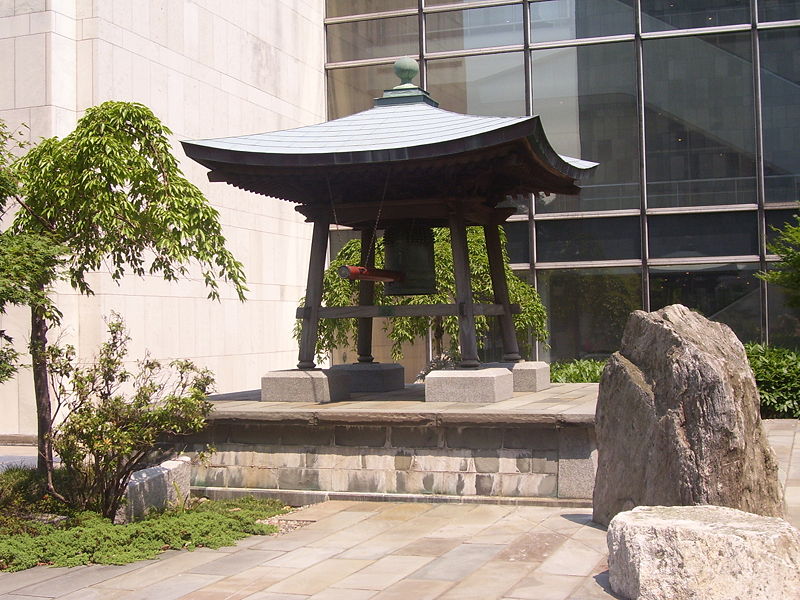
Photo: The original uploader was Rodsan18 at English Wikipedia. · CC BY-SA 2.5 · Wikimedia Commons
Japanese Peace Bell is a Peace Bell at the United Nations. It is in New York, United States. Gift from the United Nations Association of Japan in 1954. The free Lokali audio guide runs 6 minutes.
✓ Published October 2026 · how we write these guides
Visitor facts
| Lokali audio guide | 6 min · free |
|---|---|
| Type | Monument |
| Location | New York, United States |
| Coordinates | 40.7494, -73.9678 |
| Official website | un.org |
| Languages | 50+, in the Lokali app |
The story
Listen for a moment. Behind the hum of First Avenue traffic and the snap of flags along the plaza, there is a small pocket of stillness. In it hangs a dark bronze bell under a little wooden roof. It does not swing. It waits. Most days it is silent. When it is struck, the sound is low and long, a deep tone that lingers in the air well after the beam has stopped moving.
This is the Japanese Peace Bell, on the grounds of United Nations Headquarters in New York. It was a gift from the United Nations Association of Japan, presented in 1954. That date matters. Less than a decade had passed since the end of the Second World War. Japan had only recently regained its sovereignty. And yet a Japanese group chose to give the world body an object meant entirely for peace.
Here is the first detail many visitors miss. This bell was not cast only from new metal. It was made, in part, from coins and medals donated by people from many different countries, often described as around sixty nations. Ordinary pocket change from across the world went into the furnace. When you look at the bronze, you are looking at small gifts from many hands, melted into one shape.
The man most closely linked to that collection was Chiyoji Nakagawa, a member of the United Nations Association of Japan. He believed that a bell could carry a message across languages. So he gathered coins from delegates, visitors and supporters, and he carried the idea forward until the bell was cast in Japan. Then it crossed the Pacific, and then the continent, to arrive here on the East River.
Now look at the shape. This is a Japanese temple-style bell, very different from the bells of European churches. It has no clapper inside. Instead, it is struck from the outside with a horizontal wooden beam that hangs beside it. The beam is pulled back on its ropes and swung forward against the bronze. That method gives the bell its rounded, soft attack and that long, slow fade of sound.
The bell hangs inside a small structure built from Japanese cypress, a pale, fine-grained wood. In Japan this timber is often used for shrines and temples, because it is durable and has a gentle scent. The design of the shelter echoes a traditional shrine. Notice how modest it is. In a place of glass towers and concrete plazas, this little roof of wood keeps a very human scale.
Step a little closer, if you are able, and look at the surface of the bronze. Japanese characters are cast into it. They are usually translated as "Long live absolute world peace." The phrase is direct, almost plain. There is no decoration in the words, no names of donors, no grand claims. Just a wish, cast in metal, facing the building where nations meet to argue, negotiate and vote.
Here is the second surprise. The bell is rung only on a few special occasions each year. One is the first day of spring, at the vernal equinox, when day and night are roughly equal in length. Another is the International Day of Peace in September. On these days, a senior United Nations official, often the Secretary-General, swings the beam. The rest of the year, the bell stays quiet.
That silence is part of its meaning. A bell that rings every hour becomes background noise. A bell that rings rarely becomes an event. People gather. Diplomats and staff stand in a small crowd. Then one strike sounds across the grounds, and many listeners stay quiet until the tone fades away. It is one of the few ceremonies at the United Nations where no one needs a translator.
Think about where you are standing. The headquarters complex rises around you, with the slab of the Secretariat Building and the low curve of the General Assembly. Beyond them runs the East River, carrying barges and ferries past Queens. This land is international territory, administered by the United Nations rather than the city. The bell sits inside that unusual space, a piece of Japan given to everyone.
Access to the grounds is usually through the official visitor entrance and security screening. The bell is not always open to close viewing, and guided tours are often the best way to see it. Even from a distance, though, the wooden roof and the dark bronze stand out. Against the modern lines of the campus, they read like a quiet sentence in an older language.
Over the decades, other peace bells have appeared in cities around the world, many of them also linked to Japan and to the memory of war. This one in New York is among the earliest of that wider movement. It set a pattern. A bell, rather than a statue or a monument, became a way to mark hope. Something you hear, not only something you look at.
Before you move on, take one more look. Notice the rope, the worn wooden beam, the curve of the bronze lip. Notice the city sounds that surround this small corner — sirens, voices, footsteps on stone. Imagine the single deep tone breaking through all of it on a spring morning. Then, as you walk back toward First Avenue, listen to the city again. Somewhere in its noise, the idea of that quiet bell remains.
Key facts
What to look for
Practical tips
Common questions
Is there a free audio guide to Japanese Peace Bell?
Yes — the Lokali app narrates Japanese Peace Bell free of charge in 50+ languages. The guide runs about 6 minutes, covers the history, what to look for on site and practical tips, and works offline once downloaded.
Where is Japanese Peace Bell?
Japanese Peace Bell is in New York, United States, at 40.7494, -73.9678. Tap the map link on this page for directions from where you are.
What is Japanese Peace Bell known for?
Gift from the United Nations Association of Japan in 1954. Partly cast from coins donated by people worldwide.
What should you look for at Japanese Peace Bell?
Japanese characters cast into the bronze wishing for world peace. Horizontal wooden beam used to strike the bell from outside. Shrine-style roof made of pale Japanese cypress wood.
What should you know before visiting Japanese Peace Bell?
Join an official guided tour for the best chance to see it. Bring photo ID for security screening at the visitor entrance.
On the map
Opens directions to Japanese Peace Bell from your location.
More to see in New York


Hear Japanese Peace Bell in your language
The full story, narrated, in 50+ languages. Download it before you go and it plays offline, at your own pace, with no ticket and no tour group.