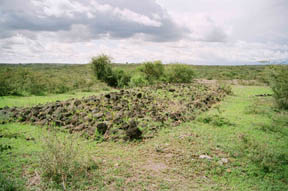
Photo: Guston Sondin-Klausner · CC BY-SA 3.0 · Wikimedia Commons
Laetoli is a footprints site. It is near Ngorongoro, Tanzania. Hominin footprints at Laetoli are about 3.6 million years old. The free Lokali audio guide runs 6 minutes.
✓ Published October 2026 · how we write these guides
Visitor facts
| Lokali audio guide | 6 min · free |
|---|---|
| Type | Archaeological Site |
| Location | Ngorongoro, Tanzania |
| Coordinates | -2.9962, 35.3524 |
| Languages | 50+, in the Lokali app |
The story
Feel the ground under your boots. It is dry, grey-brown, and crumbly, scattered with small stones and tufts of tough grass. The wind moves across open country with almost nothing to stop it. Somewhere close by, beneath a protective covering of earth, lies one of the oldest records of walking ever found. You cannot see it. But you are standing very near the place where it was found.
Welcome to Laetoli, in the highlands of northern Tanzania, inside the Ngorongoro Conservation Area. The name is usually said to come from a Maasai word for a red lily that grows here. This is Maasai land, and you may share the road with herders, cattle, and goats. Laetoli lies south of Olduvai Gorge, the other great name in the search for human origins. Together, these two places have changed how we understand our own beginnings.
To understand what happened here, picture this landscape millions of years ago. To the east stood the volcano Sadiman, now a quiet, worn-down peak. Researchers think it erupted again and again, dropping fine ash across the plain. Then light rain fell. The wet ash became soft, like fresh cement. Animals walked across it. So did something else. When the sun dried the surface and more ash fell on top, every step was sealed in.
Now the first surprise. The discovery began with a joke. In 1976, members of a team led by the archaeologist Mary Leakey were walking back to camp. According to the story the team members later told, they were throwing dried elephant dung at each other for fun. One of them, Andrew Hill, fell to the ground while dodging. Lying there, he noticed strange marks in the hardened ash. They were animal tracks, frozen in stone.
Those first finds were mostly animal prints. Over the following seasons, the team recorded tracks from many creatures. There were ancient relatives of elephants, giraffes, rhinos, hares, and birds. There were even raindrop marks, the small dents left by a passing shower. Imagine that for a moment. A few seconds of weather, preserved for millions of years. The whole surface works like a single photograph of one ordinary afternoon on the plain.
Then, in 1978, came the find that made Laetoli famous. The team uncovered a trail of footprints made by upright walkers on two legs. The prints are around 3.6 million years old. They run in a line for more than twenty metres. Most researchers link them to a species called Australopithecus afarensis — an early human relative, best known from the skeleton nicknamed Lucy, found in Ethiopia.
Why does this matter so much? Before Laetoli, scientists argued about which came first: a big brain or walking upright. These prints gave a clear answer. Creatures with small, ape-sized brains were already walking on two legs, with a heel strike and a forward push from the big toe, much like ours. Walking came long before the large brain. That was a major shift in the story of human evolution.
Here is the second surprise. You will not see the real footprints today. After study, the trackway was carefully covered again to protect it from rain, erosion, and plant roots. In the 1990s, Tanzanian authorities worked with the Getty Conservation Institute to clean, record, and rebury the site in layers of soil and protective material. The prints are safer underground than they would ever be in the open air.
The story did not end in the twentieth century. In 2016, researchers described new footprints found at a second spot nearby. These prints came from the same time and seem to show a group walking together, including one very large individual. Then, in 2021, scientists looked again at a set of prints first found in the 1970s. Those prints had once been linked to a bear. The new study argued that a different kind of upright walker made them.
That second idea is still debated. And this is worth remembering as you stand here. Science at Laetoli is not finished. Every new season of fieldwork can change the picture. Researchers still ask how many species walked these plains, how they moved, and how they lived. The ground under your feet is still a working laboratory, not a closed chapter of history.
Laetoli has also given scientists fossil bones, not only footprints. Jaws and teeth from early human relatives were found in the old sediments here. One jaw from Laetoli became the reference specimen for Australopithecus afarensis — the official example that defines the species. So Lucy's species carries a quiet connection to this hillside, even though Lucy herself was found far to the north.
Near the site, a small museum displays a cast of the famous trackway. Take a moment with it. Look at the shape of each print, the rounded heel, the line of the big toe. Notice how close together some of the steps are. Then look up at the landscape outside. The plain, the far hills, the old volcano. The view has changed, but the shape of the land still matches the story.
As you leave, listen to the wind again, and feel the dry earth crunch under your feet. Every step you take here leaves a print, just like theirs did. Most of those prints will vanish by tomorrow. A few, long ago, were lucky. Ash, rain, and sun held them in place. Walk slowly. You are walking where some of the first walkers walked.
Key facts
What to look for
Practical tips
Common questions
Is there a free audio guide to Laetoli?
Yes — the Lokali app narrates Laetoli free of charge in 50+ languages. The guide runs about 6 minutes, covers the history, what to look for on site and practical tips, and works offline once downloaded.
Where is Laetoli?
Laetoli is near Ngorongoro, Tanzania, at -2.9962, 35.3524. Tap the map link on this page for directions from where you are.
What is Laetoli known for?
Hominin footprints at Laetoli are about 3.6 million years old. Mary Leakey's team found the upright trackway in 1978.
What should you look for at Laetoli?
The rounded heel shape on the trackway cast. The worn peak of Sadiman volcano on the horizon. Grey volcanic soil crumbling underfoot across the open plain.
What should you know before visiting Laetoli?
Combine your visit with nearby Olduvai Gorge on the same trip. Visit the small site museum to see the trackway cast.
On the map
Opens directions to Laetoli from your location.
More to see near Laetoli

Hear Laetoli in your language
The full story, narrated, in 50+ languages. Download it before you go and it plays offline, at your own pace, with no ticket and no tour group.