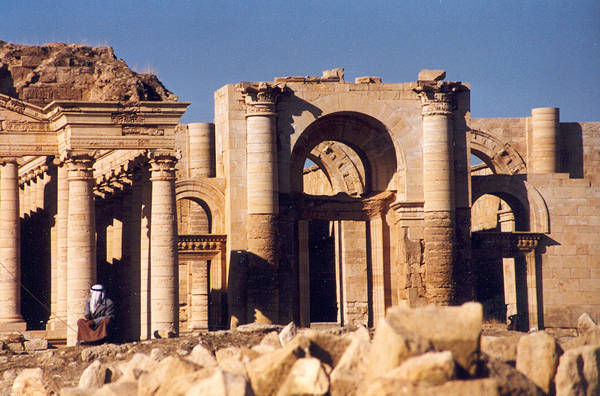
Photo: en:User:Victrav · Copyrighted free use · Wikimedia Commons
Hatra is an ancient city in northern Iraq. It is near Nineveh Governorate, Iraq. Hatra flourished during the Parthian era, around two thousand years ago. The free Lokali audio guide runs 7 minutes.
✓ Published October 2026 · how we write these guides
Visitor facts
| Lokali audio guide | 7 min · free |
|---|---|
| Type | Archaeological Site |
| Location | Nineveh Governorate, Iraq |
| Coordinates | 35.5881, 42.7183 |
| Languages | 50+, in the Lokali app |
The story
Listen first. Out here, the wind moves across a flat plain of pale earth and low scrub, and there is almost nothing to stop it. The ground under your feet is hard and dusty, scattered with fragments of stone. Then the walls appear ahead of you. Tall arches of honey-coloured limestone rise out of the open desert. They look too large for this empty place, and that is the first thing to notice about Hatra.
You are standing in the Jazira, the high steppe between the Tigris and the Euphrates rivers. Mosul lies to the north. Baghdad is far to the south. Today this land feels remote, but two thousand years ago it sat on caravan routes that linked Mesopotamia with Syria and the Mediterranean. Traders, pilgrims and soldiers all passed through. Hatra grew rich because it stood where those roads met.
The city flourished in the first and second centuries of the common era, during the age of the Parthian Empire. The Parthians were an Iranian dynasty who ruled a large part of the Near East and stood as Rome's great rival in the east. Hatra was not simply a Parthian town, though. It had its own rulers, its own gods and its own proud identity. In time, it became one of the most powerful small kingdoms of the desert.
Take a moment to picture the shape of the city. Hatra was built as a rough circle, roughly two kilometres across. A strong inner wall surrounded it, and dozens of towers stood along that wall. Outside it ran a ditch and a second, outer line of earthworks. Seen from above, the plan looks almost like a target. In the very centre — the bullseye — stands the sacred heart of the city, where you are heading now.
That centre is a vast walled enclosure, a holy precinct full of temples. The largest buildings use a form called the iwan. An iwan is a tall vaulted hall that is closed on three sides and completely open on the fourth. Stand in front of one and look up. The great arch frames the sky like a doorway into shade. This style became a lasting feature of Iranian and later Islamic architecture, and Hatra holds some of its early, grand examples.
Now look closely at the stone itself. The builders cut neat, squared blocks and laid them in tight courses. Around the arches and along the walls, you can find carved faces, masks and human heads looking out from the masonry. Some are serious. Some are strange. Here is something many visitors miss: the decoration mixes Greek-style columns and mouldings with eastern faces and dress. Hatra stood between worlds, and its walls show both of them.
The main god of the city was Shamash, the sun god, honoured across Mesopotamia for many centuries. Inscriptions also name a divine family, often described as Our Lord, Our Lady and the Son of Our Lords. The city was sometimes called the house of the god. Pilgrims came here from across the region. So when you walk through this precinct, imagine it filled with smoke from offerings, the noise of crowds, and the bright desert sun on carved stone.
The people of Hatra wrote in a local form of Aramaic, the language family that once linked much of the Near East. Hundreds of their inscriptions survive. They record names, prayers and the titles of rulers. Early leaders carried the title of lord. Later, the rulers of Hatra called themselves king of the Arabs. That title is a second surprise for many visitors. It shows that Arab communities played a central part in the life of this city long before the rise of Islam.
Hatra's wealth and position brought danger. Rome wanted control of this frontier. In the early second century, the emperor Trajan marched here and laid siege to the city. He failed. Near the end of that century, the emperor Septimius Severus tried as well, and again the city held. Ancient historians describe defenders pouring fire down from the walls, a lack of water for the attackers, and heat that wore the Roman army down. The desert you feel around you was part of Hatra's defence.
Rome never took Hatra. The end came from the east instead. In the third century, a new Persian dynasty, the Sasanians, replaced the Parthians. Around the middle of that century, the Sasanian king Shapur the First captured the city. After that, Hatra slowly emptied. Sand and silence settled over the temples. Arab poets and storytellers kept its memory alive, even as the stones fell quiet.
One of those stories is pure legend, so take it as a tale. According to a popular Arabic story, the king's daughter fell in love with the Persian king outside the walls. She showed him a secret way to break the city's defences. In the tale, Shapur rewarded her betrayal with a cruel end rather than with marriage. Historians treat this as folklore. Still, it shows how strongly later generations remembered the fall of this city.
The modern story of Hatra is also hard. The site was listed as a UNESCO World Heritage Site in the 1980s. Then, in 2015, the armed group known as ISIS occupied the area. They filmed themselves damaging statues and carvings here. As you walk, you may see marks of that damage, along with signs of later survey and repair. Many of the finest statues from Hatra are now kept in museums, and conservation work continues.
Before you leave, stand still in the centre and turn slowly in a full circle. Notice how the great arches hold the light, and how the shadows move across the carved faces. Feel the wind again — the same wind that blew across the Roman camps outside these walls. When you walk back across the plain, look over your shoulder once. The arches will grow smaller, but they will stay in view for a long time.
Key facts
What to look for
Practical tips
Common questions
Is there a free audio guide to Hatra?
Yes — the Lokali app narrates Hatra free of charge in 50+ languages. The guide runs about 7 minutes, covers the history, what to look for on site and practical tips, and works offline once downloaded.
Where is Hatra?
Hatra is near Nineveh Governorate, Iraq, at 35.5881, 42.7183. Tap the map link on this page for directions from where you are.
What is Hatra known for?
Hatra flourished during the Parthian era, around two thousand years ago. Roman emperor Trajan besieged Hatra and failed to capture it.
What should you look for at Hatra?
Tall open-fronted iwan halls inside the central sacred precinct. Carved human faces and masks set into the temple walls. Greek-style columns and mouldings beside eastern-style carvings.
What should you know before visiting Hatra?
Check current security conditions and access permissions before travelling. Arrive early in the morning to avoid the strongest desert heat.
When is the best time to visit Hatra?
Arrive early in the morning to avoid the strongest desert heat.
On the map
Opens directions to Hatra from your location.
Hear Hatra in your language
The full story, narrated, in 50+ languages. Download it before you go and it plays offline, at your own pace, with no ticket and no tour group.