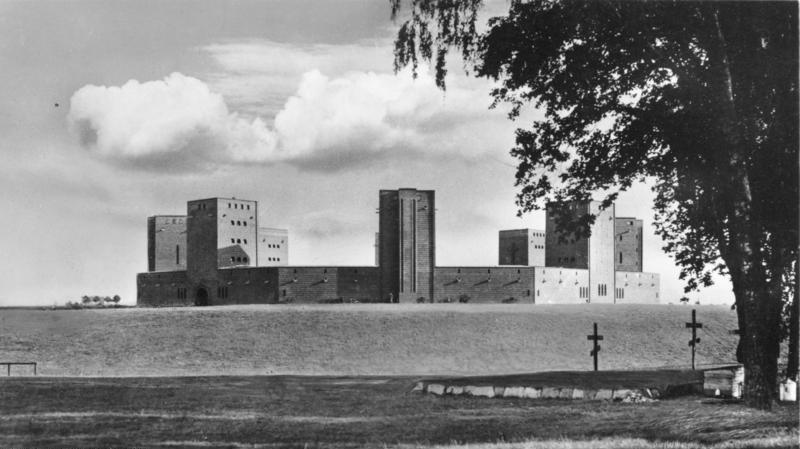
Photo: Unknown authorUnknown author · CC BY-SA 3.0 de · Wikimedia Commons
Tannenberg Memorial is a former German monument in East Prussia. Commemorated the German victory over Russia in August 1914. The free Lokali audio guide runs 6 minutes.
✓ Published October 2026 · how we write these guides
Visitor facts
| Lokali audio guide | 6 min · free |
|---|---|
| Type | Monument |
| Location | Olsztynek, Poland |
| Coordinates | 53.5814, 20.2608 |
| Languages | 50+, in the Lokali app |
The story
Listen for a moment. Wind moves through pine and birch. Somewhere a bird calls, and the ground underfoot is soft with needles and moss. There is no grand gate here, no tower against the sky. Only uneven earth, a few broken blocks of stone, and the quiet of a Masurian forest edge. And yet this patch of land just outside Olsztynek once held one of the largest war memorials in Europe.
To understand what stood here, we need to go back to late August 1914. In the first weeks of the First World War, a Russian army pushed into East Prussia, which was then the eastern edge of the German Empire. Around these lakes, woods and small towns, German forces encircled it. The Russian Second Army was largely destroyed. Its commander, General Alexander Samsonov, took his own life in the forests nearby.
Here is the first surprise. The battle did not take place mainly at a village called Tannenberg. Most of the fighting happened closer to towns like Olsztynek, which the Germans then called Hohenstein. The name Tannenberg was chosen deliberately. In 1410, near that village, the Teutonic Knights, a German crusading order, lost a famous battle to a Polish and Lithuanian army. Poles call it the Battle of Grunwald. By naming the 1914 victory Tannenberg, German leaders presented it as revenge, five centuries later.
The victory made two men famous across Germany. One was Paul von Hindenburg, the commanding general. The other was his chief of staff, Erich Ludendorff. Historians still argue about who deserves the most credit. But in public memory, Hindenburg became the hero of Tannenberg. That reputation later carried him all the way to the presidency of the German republic in the 1920s.
After the war, Germany had lost territory, and East Prussia was cut off from the rest of the country by a strip of Polish land. Many people in the region felt isolated. A memorial to the 1914 victory became a symbol of pride and of defiance. Construction ran through the mid-1920s, and the monument was formally opened in 1927, with Hindenburg himself present.
The design came from the architect brothers Walter and Johannes Krüger. They did not build a single column or statue. Instead, they built a vast octagon, a ring of thick brick walls with eight tall, square towers spaced around it. Inside lay an open courtyard. Contemporaries compared it to a medieval castle. Some also compared it to Stonehenge, the ancient stone circle in England. That is the second surprise. A modern war memorial was meant to feel prehistoric, as if it had always stood on this ground.
Each tower had its own function and its own dedication. Inside the walls, in the centre of the courtyard, there was a burial place for unknown German soldiers who fell in the battle. The whole structure was built to hold large ceremonies. Crowds gathered here for anniversaries, speeches and parades. The architecture was designed for marching feet, flags and loud voices.
Then, in August 1934, Hindenburg died. He had asked to be buried at his family estate. The new Nazi government had other plans. Hitler gave a funeral speech here, and Hindenburg was laid to rest at the memorial. The following year, his coffin and that of his wife were moved into a new crypt beneath one of the towers. The site was renamed the Reich Memorial of Tannenberg. A monument to fallen soldiers had become a stage for the regime.
The end came quickly. In January 1945, the Soviet army was advancing into East Prussia. Retreating German troops removed the coffins of Hindenburg and his wife and took them west. Then they blew up parts of the memorial so it would not fall into Soviet hands. After a long journey, the coffins were eventually reburied in the German city of Marburg, where they remain today.
After the war, this region became part of Poland. For Polish authorities, the ruined memorial stood for German militarism and for the Nazi years. The remaining walls and towers were demolished. According to widely repeated accounts, some of the stone was reused in buildings and monuments elsewhere in Poland, including in Warsaw. Treat the exact destinations with some caution, but the idea is striking. Pieces of this structure may now stand in places their builders never imagined.
So what are you looking at today? Mostly, the forest has returned. Low rises in the ground, scattered fragments and old foundations hint at the lines of the octagon. If you walk slowly, you can sometimes sense the geometry. A straight edge where nature would not make one. A mound that is too regular to be natural. Locals say a stone lion from the memorial survives in Olsztynek itself, and it is worth asking about in town.
This place asks an unusual question. How should a country remember a monument that it chose to erase? Here, there is no great museum or visitor centre at the ruins. There is only the land, and the stories that people carry to it. Some visitors come for military history. Others come because their families once lived in East Prussia. Many simply come because the emptiness is more powerful than any tower.
Before you leave, stand still once more. Notice the light between the trunks, the smell of resin, the softness of the ground. Picture eight brick towers rising above these trees, and crowds filling the courtyard. Then let the picture fade. What remains is a quiet clearing on the edge of a small Polish town... and the reminder that even the heaviest stone can disappear.
Key facts
What to look for
Practical tips
Common questions
Is there a free audio guide to Tannenberg Memorial?
Yes — the Lokali app narrates Tannenberg Memorial free of charge in 50+ languages. The guide runs about 6 minutes, covers the history, what to look for on site and practical tips, and works offline once downloaded.
Where is Tannenberg Memorial?
Tannenberg Memorial is near Olsztynek, Poland, at 53.5814, 20.2608. Tap the map link on this page for directions from where you are.
What is Tannenberg Memorial known for?
Commemorated the German victory over Russia in August 1914. Designed by architect brothers Walter and Johannes Krüger.
What should you look for at Tannenberg Memorial?
Straight edges in the ground marking the old octagon. Scattered brick and stone fragments among the trees. Unnaturally regular mounds hinting at former foundations.
What should you know before visiting Tannenberg Memorial?
Wear sturdy shoes for uneven, overgrown forest ground. Visit Olsztynek town afterwards to ask about the lion.
On the map
Opens directions to Tannenberg Memorial from your location.
Hear Tannenberg Memorial in your language
The full story, narrated, in 50+ languages. Download it before you go and it plays offline, at your own pace, with no ticket and no tour group.