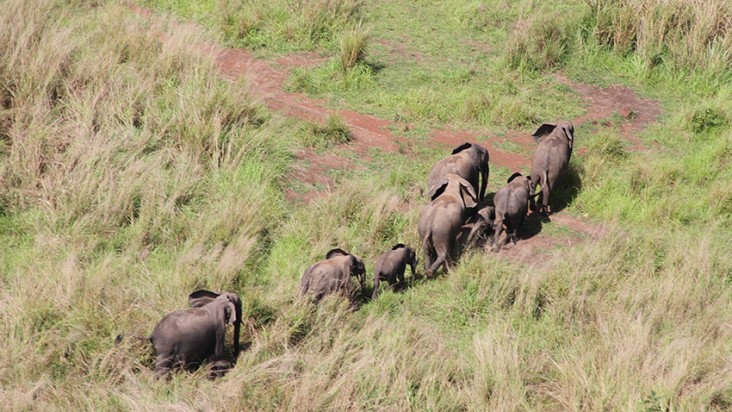
Garamba National Park
4.0000° N · 29.2500° E · National Park
Photo: USAID · Public domain · Wikimedia Commons
Garamba National Park is a national park in DR Congo. Created in 1938, one of Africa's oldest parks. The free Lokali audio guide runs 7 minutes.
✓ Published October 2026 · how we write these guides
Visitor facts
| Lokali audio guide | 7 min · free |
|---|---|
| Type | National Park |
| Location | Orientale, Democratic Republic of the Congo |
| Coordinates | 4.0000, 29.2500 |
| Official website | garambanationalparkcongo.com |
| Languages | 50+, in the Lokali app |
The story
Listen first. A low wind moves through grass taller than a person. Somewhere a hornbill calls, and the sound carries a long way over open ground. The air is warm and heavy with the smell of earth and dry stems. Out here, in the far north-east of the Democratic Republic of the Congo, the horizon feels very wide. This is Garamba National Park, and it is one of the most remote protected landscapes on the African continent.
Garamba sits close to the border with South Sudan. The old regional name was Orientale Province, and today the park lies within Haut-Uele, one of the provinces created when the old province was divided. The nearest towns are small, and the roads are rough for much of the year. Most visitors arrive by light aircraft. That remoteness has shaped everything about this place: its wildlife, its troubles, and the quiet you hear around you right now.
The park was created in 1938, during the Belgian colonial period. That makes it one of the oldest national parks in Africa. In 1980 it was added to the UNESCO World Heritage List, the international register of places considered important to all of humanity. The listing recognised its great savannas and the rare animals that lived on them. The protected core covers roughly five thousand square kilometres, and hunting reserves surround it on several sides as a buffer.
Look at the land itself. Much of Garamba is open savanna, a sea of tall grass broken by scattered trees. Toward the south, the savanna mixes with woodland and strips of gallery forest. A gallery forest is a narrow band of trees that grows along a riverbank, fed by the water. Papyrus swamps fill the low ground. The Garamba and Dungu rivers cross the region, and in the wet season the grass grows thick and green.
Here is something many visitors do not know. Garamba was once the last place on Earth where the northern white rhinoceros lived in the wild. This large, square-lipped grazer survived here after it had vanished from the rest of its range. Through the late twentieth century, the population was tiny and closely watched. But poaching continued, and by the late 2000s, no wild northern white rhinos could be found. Today the subspecies survives only in captivity, and scientists are working on assisted reproduction to save it.
The park holds another rare animal. The Kordofan giraffe, a subspecies of the giraffe, lives here in the savanna. In the Democratic Republic of the Congo, Garamba is the only place where wild giraffes still survive. Their numbers have been small, and rangers monitor them closely. If you see one, notice the pattern on its coat. The patches are a warm brown, and the lines between them are pale and fine.
Elephants are central to the story of Garamba. The park has long been home to large herds, and some of these elephants show traits of both savanna and forest types. That mix reflects the meeting of habitats here, where grassland meets woodland. Elephant tusks also made the park a target. For decades, armed poaching gangs crossed the borders to hunt for ivory. The herds today are much smaller than they once were, and protecting them is the daily work of the park.
There is a surprising chapter from the colonial era. Near the park, at a place called Gangala-na-Bodio, Belgian authorities ran a centre to train African elephants for work. African elephants are usually considered very difficult to tame, unlike their Asian cousins. Yet the centre trained elephants to carry loads and help with farm work. The programme continued for many decades of the twentieth century. It remains one of the very few serious attempts to domesticate the African elephant anywhere.
The late twentieth and early twenty-first centuries were hard for Garamba. Wars in neighbouring countries spilled across the borders. Refugees, armed groups, and poachers all passed through this region. Because of these threats, UNESCO placed the park on its List of World Heritage in Danger, and it has remained there for a long time. In the late 2000s, the armed group known as the Lord's Resistance Army operated in the area, and it attacked the park headquarters at Nagero.
Through all of this, rangers stayed. Many of them come from the communities around the park. Their work is dangerous, and over the years a number of rangers have lost their lives protecting the wildlife here. Since 2005, the park has been managed by African Parks, a conservation organisation, together with the Congolese Institute for the Conservation of Nature. Together they have rebuilt ranger teams, aerial patrols, and community programmes. When you meet a ranger, you are meeting someone at the centre of this effort.
Now look around you again. Notice the colour of the grass. In the dry season it turns gold and pale brown, and fires sometimes move across the plains. These fires are part of savanna life, and fresh green shoots often appear in the burned areas. Grazing animals follow that new growth. Watch for buffalo in dark groups, hippos in the deeper river pools, and antelope standing still at the edge of the trees.
The birds deserve your attention too. Raptors circle high above the open plains, using the warm rising air. Near the water, you may hear the loud calls of fish eagles. Smaller birds move quickly through the grass and the reeds. Early morning and late afternoon are the best times to watch and listen. The light is softer then, and the animals are more active before and after the heat of the day.
Take a moment before you move on. Feel the warmth of the ground and the wind on your face. The grass you are looking at has covered these plains for thousands of years. The animals here have survived war, poaching, and long periods of neglect. And still, the elephants walk, the giraffes feed, and the rangers keep watch. As you leave this spot, listen once more to the wind in the grass, and to the long silence beyond it.
Key facts
What to look for
Practical tips
Common questions
Is there a free audio guide to Garamba National Park?
Yes — the Lokali app narrates Garamba National Park free of charge in 50+ languages. The guide runs about 7 minutes, covers the history, what to look for on site and practical tips, and works offline once downloaded.
Where is Garamba National Park?
Garamba National Park is near Orientale, Democratic Republic of the Congo, at 4.0000, 29.2500. Tap the map link on this page for directions from where you are.
What is Garamba National Park known for?
Created in 1938, one of Africa's oldest parks. Inscribed as a UNESCO World Heritage Site in 1980.
What should you look for at Garamba National Park?
Kordofan giraffes with fine pale lines between patches. Narrow gallery forests tracing the line of rivers. Tall golden grass that can hide a standing elephant.
What should you know before visiting Garamba National Park?
Arrange your visit in advance through the park management. Plan for light aircraft travel; roads are often impassable.
On the map
Opens directions to Garamba National Park from your location.
Hear Garamba National Park in your language
The full story, narrated, in 50+ languages. Download it before you go and it plays offline, at your own pace, with no ticket and no tour group.