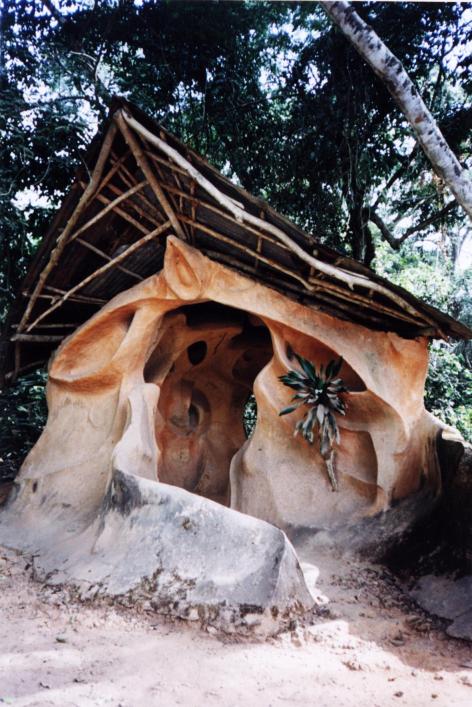
Osun-Osogbo Sacred Grove
7.7556° N · 4.5522° E · Monument
Photo: Alex Mazzeto - Jurema Oliveira (talk) 18:15, 16 November 2009 (UTC) · CC BY-SA 3.0 · Wikimedia Commons
Osun-Osogbo Sacred Grove is a sacred forest along the bank of Osun river in Osogbo. Inscribed as a UNESCO World Heritage Site in 2005. The free Lokali audio guide runs 7 minutes.
✓ Published October 2026 · how we write these guides
Visitor facts
| Lokali audio guide | 7 min · free |
|---|---|
| Type | Monument |
| Location | Osogbo, Nigeria |
| Coordinates | 7.7556, 4.5522 |
| Languages | 50+, in the Lokali app |
The story
Listen first. Before you look at anything, listen. Somewhere beneath the canopy, the Osun River moves slowly over sand and stone. Birds call from high branches. Leaves shift overhead, and the light reaches the ground in small, broken patches of green and gold. The air is heavier here than in the town outside, damp and cool, with the smell of wet earth and old wood. You are standing in a forest that people have protected for generations, because they believe it belongs to a goddess.
This is the Osun-Osogbo Sacred Grove, on the edge of the city of Osogbo in southwestern Nigeria. It is one of the last large areas of dense, original forest in this part of the country. Much of the land around it was cleared long ago for farms and for the growing town. But this stretch along the river survived. UNESCO added the grove to its World Heritage List in 2005, recognising both the forest itself and the living religious tradition inside it.
The goddess is Osun. In the Yoruba religion, the traditional faith of the Yoruba people of this region, Osun is one of the orishas, the divine beings who act between people and the creator. She is linked with fresh water, with beauty, and above all with fertility. Many people come here to ask her for children. The river that runs beside you carries her name. To her followers, the water is not a symbol of the goddess. It is her presence.
The grove and the town are tied together by a story. Legend has it that the founders of Osogbo first settled close to the river. According to the popular tale, a hunter and the early leader of the people received a message from the goddess. She asked them to move to higher ground and leave the riverbank to her. In return, she would protect them. Locals say this agreement is the reason the forest was never cleared. Whether you read it as history or as faith, the forest is still here.
That agreement is renewed every year. The Osun-Osogbo Festival takes place in August and runs for around two weeks. The most important moment comes at the end. A young woman called the Arugba, the votive maiden, carries a covered calabash on her head from the palace to the river. Crowds walk beside her, singing and drumming. The Ataoja, the traditional king of Osogbo, takes part, and offerings are made to the goddess at the water's edge.
Now look around at the shapes among the trees. As you walk the paths, you will see sculptures that seem to grow out of the forest. Some are tall and thin. Some curve and twist like roots. Some have many faces, open arms, or wide staring eyes. They are made of cement, iron, wood, and mud, and many are now covered in moss and lichen. These are not ancient. Most of them were made in the second half of the twentieth century.
Here is the first surprise. Much of this art was led by a European woman. Susanne Wenger was an Austrian artist who came to Nigeria around 1950. She became deeply involved in Yoruba religion and was initiated as a priestess. Over time, local people came to call her Adunni. At a moment when the grove was under threat from logging, farming, and neglect, she began to repair the shrines and to build new ones.
She did not work alone. Wenger worked with a group of local artists and builders, often called the New Sacred Art movement. Together they made shrines and figures that drew on Yoruba belief but looked like nothing else. Their work helped to give the grove a new public identity, and it helped to protect the forest at a difficult time. Wenger lived in Osogbo for the rest of her life. She died in 2009, in her nineties, and her house in the town is still remembered.
The grove holds dozens of shrines, sanctuaries, and sculptures spread across its paths. The whole site covers about seventy-five hectares, so you will see only a part of it on one visit. Some places are open to visitors. Others are reserved for worship and for priests and priestesses. If a guide asks you to stop, to remove your shoes, or to put away your camera, please follow that request. This is an active religious site, not a museum.
Here is the second surprise. Pay attention to the trees as well as to the sculptures. The grove is also a home for wildlife, and many visitors meet monkeys along the paths. Local tradition treats the animals and plants of the grove as part of the goddess's domain. For a long time, hunting and fishing in the grove were forbidden by custom. So the forest's survival depends on ecology and belief at the same time.
Walk down toward the river if the path allows. The water is often brown and slow, and the banks are thick with roots and leaves. During the festival, this calm place fills with thousands of people. On an ordinary day, it can feel almost empty. You may see a worshipper in white cloth, or a small offering left on a stone. Watch quietly, and give people their space.
Think about what this place shows. Around the world, many sacred forests have disappeared. They were cut for timber, cleared for crops, or swallowed by growing cities. This grove survived because a community decided it mattered. That decision was carried by a legend, by an annual festival, by a king and his people, and by artists who chose to work with the forest rather than against it. Faith became a form of conservation.
Before you leave, stand still for one more minute. Notice the green light on the path, the moss on the nearest sculpture, and the sound of the river behind the leaves. As you walk back toward the road, listen for the moment when the traffic of Osogbo begins to replace the birdsong. That edge, where the town ends and the forest begins, is the line the founders promised to respect. You are crossing it now.
Key facts
What to look for
Practical tips
Common questions
Is there a free audio guide to Osun-Osogbo Sacred Grove?
Yes — the Lokali app narrates Osun-Osogbo Sacred Grove free of charge in 50+ languages. The guide runs about 7 minutes, covers the history, what to look for on site and practical tips, and works offline once downloaded.
Where is Osun-Osogbo Sacred Grove?
Osun-Osogbo Sacred Grove is in Osogbo, Nigeria, at 7.7556, 4.5522. Tap the map link on this page for directions from where you are.
What is Osun-Osogbo Sacred Grove known for?
Inscribed as a UNESCO World Heritage Site in 2005. Dedicated to Osun, Yoruba goddess of fertility and water.
What should you look for at Osun-Osogbo Sacred Grove?
Moss and lichen growing across the cement sculptures. Multi-faced figures with outstretched arms beside the paths. Small offerings left on stones near the riverbank.
What should you know before visiting Osun-Osogbo Sacred Grove?
Hire a local guide at the entrance for shrine context. Ask before photographing worshippers, shrines, or rituals.
On the map
Opens directions to Osun-Osogbo Sacred Grove from your location.
Hear Osun-Osogbo Sacred Grove in your language
The full story, narrated, in 50+ languages. Download it before you go and it plays offline, at your own pace, with no ticket and no tour group.