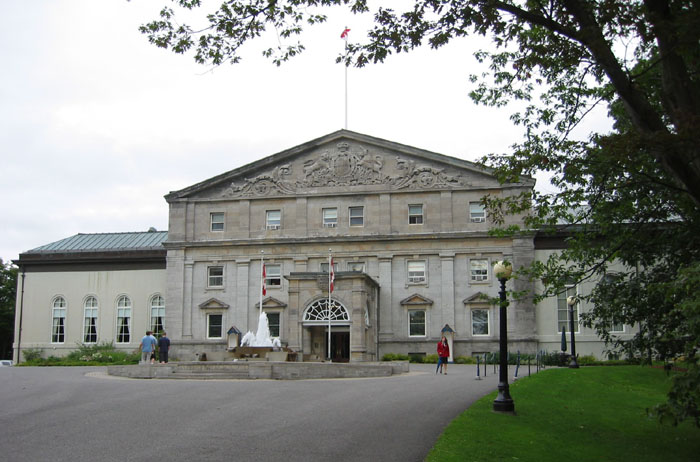
Photo: Peregrine981 · Public domain · Wikimedia Commons
Rideau Hall is a (officially Governor House) is the official residence of the Canadian monarch. Stonemason Thomas MacKay built the original villa in 1838. The free Lokali audio guide runs 7 minutes.
✓ Published October 2026 · how we write these guides
Visitor facts
| Lokali audio guide | 7 min · free |
|---|---|
| Type | Palace |
| Location | Ottawa, Canada |
| Coordinates | 45.4438, -75.6856 |
| Official website | ccn-ncc.gc.ca |
| Languages | 50+, in the Lokali app |
The story
Listen for a moment. Gravel crunches under your shoes, and wind moves through old maples and oaks. A flag snaps on its pole somewhere ahead. For a building at the centre of a nation's ceremonies, Rideau Hall feels surprisingly quiet. It feels more like a country estate than a seat of state. That contrast is the first thing worth noticing here, and it shapes almost everything else about this place.
Rideau Hall is the official residence and workplace of the Governor General of Canada. That office represents the Crown, Canada's head of state, inside the country. In practice, this means the house is a working building. Prime ministers are sworn in here. Ambassadors present their credentials here. Canadians receive national honours in its rooms, including the Order of Canada. Every Canadian government begins, in a formal sense, somewhere inside these walls.
The story starts with a man who built things with his hands. Thomas MacKay was a Scottish-born stonemason who came to Canada and helped build the Rideau Canal. That waterway still cuts through the middle of Ottawa today. With the money he earned, MacKay built himself a stone villa in 1838. He chose this rise of land above the Rideau River. He named the house for the river, and the name stayed.
MacKay also founded the small village that grew up around his mills and his house. He called it New Edinburgh, after the capital of his homeland. Walk a few streets from the gates and you will still find that name on the map. The neighbourhood keeps a calm, residential feel. Wooden porches, brick houses and tall trees line its streets. It is easy to imagine MacKay's world here, even now.
When Ottawa became the capital, the new government needed a home for the Queen's representative. Officials rented MacKay's villa in the 1860s. The Crown bought it outright soon after Confederation in 1867. It was meant as a temporary solution. Instead, the house became permanent, and each new occupant added rooms, wings and personal touches. What you see today is not one design. It is several generations of building, stacked one on top of another.
The front you are probably facing is one of the newest parts. It was added in the early twentieth century to give the house a more official face. Look up at the pediment, the triangular section above the entrance. It carries the royal coat of arms. Behind this formal front, the older stone villa of MacKay still survives, wrapped inside later additions. The building is a bit like a set of nested boxes.
One Governor General left an especially strong mark. Lord Dufferin arrived in the 1870s and loved to entertain. He added a ballroom for dances and state dinners. He also built the Tent Room, a space designed to look like the inside of a striped canvas tent. Dufferin was a keen supporter of winter sports, too. He encouraged skating and curling on the grounds, and that habit shaped a famous Canadian story.
Here is the first surprise. A later Governor General, Lord Stanley, watched hockey with his family during his years in Canada. His sons played the game with real enthusiasm. In the early 1890s, Lord Stanley donated a silver bowl as a trophy for the best amateur hockey team in the country. Today it is the Stanley Cup, the oldest trophy in North American professional sport. An outdoor rink still appears on these grounds in winter.
Now look at the trees around you. Many of them were planted by visiting kings, queens, presidents and prime ministers. It is a long tradition here. Small plaques at the base of certain trees name the person who planted them. The second surprise involves President John F. Kennedy. During his visit in 1961, he planted a red oak here. He strained his back with the shovel, and that injury troubled him for months afterward.
The grounds cover a large area of lawns, woods and gardens. Most of the estate is open to the public. Paths wind past flower beds, a greenhouse area and open fields. There is even a cricket pitch, used by a local club. On a summer afternoon you may hear the knock of bat on ball. It is a reminder of the British traditions that shaped early Ottawa.
Tucked among the trees is a smaller building called Rideau Cottage. It was built as a residence for staff and secretaries. In 2015, Prime Minister Justin Trudeau and his family moved into it. During the early months of the pandemic in 2020, he spoke to the country from its front steps almost every day. Millions of Canadians saw this modest doorway on their screens. Few of them knew exactly where it stood.
In summer, the ceremonial guard adds colour to the grounds. Soldiers in red tunics and tall black bearskin hats stand at their posts. A changing of the guard takes place near the main gate during the season. The guard comes from regiments with long ties to the Governor General. It is formal and precise, but the grounds stay relaxed around it. Families picnic just a short walk away.
Inside, guided tours take visitors through the public rooms. You may see the ballroom with its chandeliers, the Tent Room, and halls filled with Canadian art. The house also displays works by Indigenous artists, and these pieces carry real weight in a building like this. They raise a simple question. Whose country is being represented in these rooms? Rideau Hall has been part of that conversation in recent decades.
Before you leave, stand still for a moment on the path. Listen again to the gravel, the leaves, the distant traffic of Sussex Drive. A stonemason built a house here for his family. It became a stage for a nation's ceremonies, but it never lost the feel of a home in the trees. As you walk back towards the gates, look for one of those small plaques by a trunk. Someone, once, dug a hole right there.
Key facts
What to look for
Practical tips
Common questions
Is there a free audio guide to Rideau Hall?
Yes — the Lokali app narrates Rideau Hall free of charge in 50+ languages. The guide runs about 7 minutes, covers the history, what to look for on site and practical tips, and works offline once downloaded.
Where is Rideau Hall?
Rideau Hall is near Ottawa, Canada, at 45.4438, -75.6856. Tap the map link on this page for directions from where you are.
What is Rideau Hall known for?
Stonemason Thomas MacKay built the original villa in 1838. Official residence of the Governor General of Canada.
What should you look for at Rideau Hall?
Royal coat of arms in the pediment above the entrance. Small plaques naming dignitaries at the base of trees. Kennedy's red oak among the commemorative trees.
What should you know before visiting Rideau Hall?
Come in summer to see the ceremonial guard change. Join a guided tour to see the interior rooms.
When is the best time to visit Rideau Hall?
Come in summer to see the ceremonial guard change.
On the map
Opens directions to Rideau Hall from your location.
Hear Rideau Hall in your language
The full story, narrated, in 50+ languages. Download it before you go and it plays offline, at your own pace, with no ticket and no tour group.