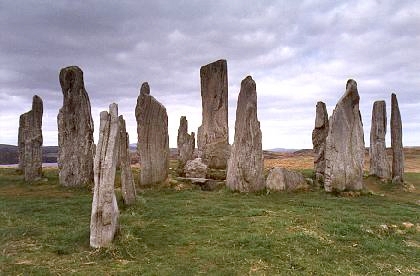
Callanish Stones
58.1976° N · 6.7451° W · Archaeological Site
Photo: Wikimedia Commons contributor · CC BY-SA 2.5 · Wikimedia Commons
Callanish Stones are neolithic standing stones near Calanais, Scotland. Main stone setting raised roughly five thousand years ago. The free Lokali audio guide runs 6 minutes.
✓ Published October 2026 · how we write these guides
Visitor facts
| Lokali audio guide | 6 min · free |
|---|---|
| Type | Archaeological Site |
| Location | Outer Hebrides, United Kingdom |
| Coordinates | 58.1976, -6.7451 |
| Languages | 50+, in the Lokali app |
The story
Listen first. The wind comes in off the Atlantic and moves through the stones with a low, steady rush. Underfoot, the grass is short and springy, and the ground beneath it is soft with peat. Reach out and touch the nearest pillar. The surface is cold, grained and rippled, banded with pale grey, black and white. You are standing on a low ridge above Loch Roag, on the Isle of Lewis, among some of the oldest standing stones in Britain.
This is the Callanish Stones, or Calanais in Gaelic. Archaeologists date the main setting to the Neolithic period, the age of the first farmers in these islands. The stones went up roughly five thousand years ago. That makes the central circle older than the great sarsen ring at Stonehenge. Think about that for a moment. People here were raising these slabs before the pyramids of Giza were built.
Now look at the stone itself. It is Lewisian gneiss, a rock formed deep inside the earth under enormous heat and pressure. Geologists count it among the oldest rocks in Europe, close to three billion years old. So the monument is ancient twice over. The builders were young compared with their material. Those twisting stripes you can see are mineral bands, folded long before any life walked on land.
Step back and try to read the shape. At the heart is a small ring of thirteen stones. From it, lines of stones run outwards. A long double row, like an avenue, stretches north. Shorter single rows reach east, west and south. Seen from above, the plan looks like a rough cross, or perhaps a Celtic cross. But that resemblance is pure coincidence. The design is thousands of years older than Christianity.
In the middle of the ring stands the tallest stone of all. It rises close to five metres, a thin blade of gneiss that seems far too slender to have survived so long. Walk around it slowly. From one side it looks like a narrow fin. From another it fills your view like a wall. The builders chose stones with flat faces and sharp edges, and they set them with care.
Here is something many visitors miss. At the foot of that central stone, inside the circle, lies a small chambered tomb. It was added later, after the ring was already standing. Excavations found traces of human remains there, along with pottery. So the place changed over time. One generation built a circle. Later people used it for the dead. The monument was not finished on one day. It grew and shifted across centuries.
Then the land itself moved in. As the climate grew colder and wetter, peat slowly built up across this ridge. Over the centuries it swallowed the lower parts of the stones. By the nineteenth century, much of each pillar lay buried under a deep layer of brown, wet earth. In 1857 the landowner, Sir James Matheson, ordered the peat to be cut away. Only then could people see how tall the stones really were.
Why build this here? Nobody knows for certain, and you should be wary of anyone who claims to. One idea, supported by many researchers, connects the site to the moon. Roughly every eighteen and a half years, the moon reaches a point called a major standstill. At that time, seen from here, it rises very low and skims along the southern hills before it sets.
Those hills have a name. Look south across the moorland. Locals call the ridge the Sleeping Beauty, and in Gaelic it is the Old Woman of the Moors. From the right angle, the outline looks like a woman lying on her back. During a standstill, the moon appears to roll gently along her body. Watchers have reported seeing it reappear among the stones themselves. Whether the builders planned this is still debated.
The islanders have their own explanations, and they are very old. Legend has it that the stones were giants who refused to accept Christianity. A saint turned them to stone as a punishment. In Gaelic they are sometimes called the false men. Another tale, told locally, speaks of a magical white cow. During a famine, she is said to have appeared here and given milk to anyone who came. These are stories, not history. But they show how long people have wondered about this ridge.
Callanish is not alone. Look around the landscape and you may spot other groups of stones on nearby knolls. Archaeologists have recorded many smaller circles and single standing stones around Loch Roag. Some are visible from here on a clear day. Together they suggest that this whole stretch of coast was a special place. People did not build one monument. They marked an entire landscape with stone.
Today the village of Callanish sits quietly beside the site. You will see croft houses, sheep grazing on the slopes, and the grey water of the loch below. There is a visitor centre close by, with displays about the stones and the people who built them. But the stones themselves stay open to the sky, with no roof, no glass and no barrier between you and them.
Before you leave, stand still for one more minute. Notice the light on the gneiss as the clouds move across the sun. Watch how the shadows of the stones stretch and shrink on the grass. Feel the wind again on your face. People have stood exactly where you are standing for five thousand years, asking the same questions. As you walk away, turn back once. The stones will still be there, holding their shape against the sky.
Key facts
What to look for
Practical tips
Common questions
Is there a free audio guide to Callanish Stones?
Yes — the Lokali app narrates Callanish Stones free of charge in 50+ languages. The guide runs about 6 minutes, covers the history, what to look for on site and practical tips, and works offline once downloaded.
Where is Callanish Stones?
Callanish Stones is near Outer Hebrides, United Kingdom, at 58.1976, -6.7451. Tap the map link on this page for directions from where you are.
What is Callanish Stones known for?
Main stone setting raised roughly five thousand years ago. Older than the sarsen circle at Stonehenge.
What should you look for at Callanish Stones?
Folded pale and dark mineral bands in the gneiss. Small chambered tomb at the foot of the central stone. Sleeping Beauty hill outline on the southern horizon.
What should you know before visiting Callanish Stones?
Walk the full avenue northward to see the cross plan. Bring windproof layers; the exposed ridge catches Atlantic gusts.
When is the best time to visit Callanish Stones?
Come early or late to share the stones with fewer people.
On the map
Opens directions to Callanish Stones from your location.
Hear Callanish Stones in your language
The full story, narrated, in 50+ languages. Download it before you go and it plays offline, at your own pace, with no ticket and no tour group.