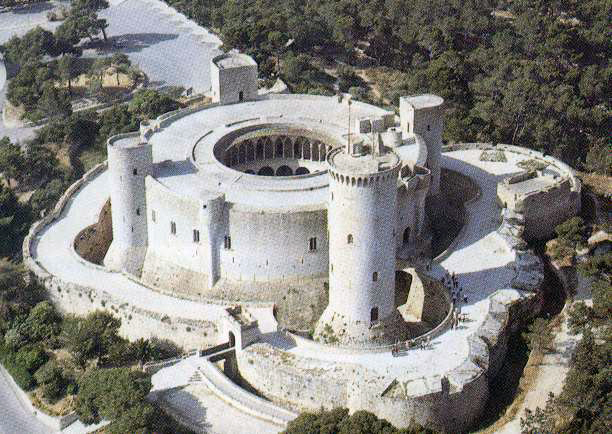
Photo: Poniol60 · Public domain · Wikimedia Commons
Bellver Castle is a castle in Mallorca. Built in the early fourteenth century for King James II. The free Lokali audio guide runs 7 minutes.
✓ Published October 2026 · how we write these guides
Visitor facts
| Lokali audio guide | 7 min · free |
|---|---|
| Type | Castle |
| Location | Palma, Spain |
| Coordinates | 39.5637, 2.6193 |
| Official website | castelldebellver.palma.cat |
| Languages | 50+, in the Lokali app |
The story
Listen for a moment. Before you look at the castle, listen to the pines. The hill around you is covered in Aleppo pine, and on a warm day the air smells of resin and dry needles. Cicadas buzz in the branches. Far below, the city spreads out toward the sea. Up here, the noise of Palma fades to a low hum, and the stone walls in front of you hold the heat of the sun.
This is Bellver Castle. The name comes from old Catalan and means something close to "beautiful view." Once you walk to the edge of the terraces, you will understand why. The whole Bay of Palma opens below you, with the cathedral on the waterfront and the mountains of the Serra de Tramuntana rising to the north. The castle was built to watch over all of it, from the land and from the sea.
Now look at the shape of the building. Most castles are square, or follow the uneven line of a rock. Bellver is round. The outer walls form a near-perfect circle. That makes it one of the very few circular castles in Europe, and it is the detail that most visitors notice first. From above, the plan looks almost like a drawing made with a compass, with towers pushing out from the ring like the points of a crown.
The castle dates to the early fourteenth century. It was built for King James the Second of Majorca. At that time, Majorca was the centre of its own small kingdom, ruled by a branch of the royal house of Aragon. The kingdom stretched across the Balearic Islands and parts of southern France. James wanted a residence that showed his power, and a strong place to retreat to if trouble came. Bellver gave him both.
The style is Gothic, the architecture of medieval Europe that favoured pointed arches and vertical lines. But here the Gothic is calm and compact. There is little decoration on the outside. The walls are made of local sandstone, a warm golden stone that turns honey-coloured in the late afternoon. Over the centuries, wind and salt air have softened the edges. Run your eye along the surface and you will see small holes and patches where the stone has worn away.
Walk around to the largest tower. This is the keep, the strongest and last line of defence. Here is a surprise many people miss. The keep does not touch the main ring of the castle. It stands on its own, separated by a gap, and is joined to the rest of the building only by a high stone arch. If attackers broke into the castle, defenders could pull back into the keep and keep fighting. It was a castle inside a castle.
A deep moat circles the outer walls. It was dug into the rock of the hill, and today it is dry. Look down into it as you cross toward the entrance. The scale of the work is easier to feel from here. Medieval builders cut this ditch largely by hand, with picks, chisels, and the strength of many workers. The moat made it very hard to bring ladders or siege machines close to the walls.
Now step inside, into the central courtyard. This is the heart of Bellver, and it is also round. Two levels of arcades run all the way around it. On the lower level, the arches are rounded and heavy. On the upper level, they are pointed and lighter, in the Gothic style. Stand in the middle and turn slowly. The circle repeats on every side, and your voice carries in a soft echo off the stone.
In the centre of the courtyard there is a cistern, a covered well that stored rainwater. On a hilltop with no river, water was life. During a siege, the defenders needed to drink, cook, and survive for weeks. The roofs and terraces were designed to channel rain down into storage below. It is a quiet, practical detail, but without it, the whole fortress would have been useless.
The royal life here did not last very long. After the Kingdom of Majorca was absorbed back into the Crown of Aragon in the fourteenth century, Bellver slowly changed its purpose. For centuries it served mainly as a military fortress and a prison. The beautiful round palace became a place where people waited, sometimes for years, for their fate to be decided. Some prisoners scratched marks and drawings into the stone walls, and traces of this graffiti can still be found inside.
One of the best-known prisoners was Gaspar Melchor de Jovellanos, a Spanish writer and statesman of the Enlightenment, the European movement that valued reason and reform. He was held here in the early nineteenth century after falling out of favour at court. During his time at Bellver, he wrote about the castle and the landscape around it. Later in that same period, during the wars against Napoleon, the castle also held French prisoners of war.
Today the castle has a gentler role. It houses the history museum of the city of Palma, with objects that trace the life of the town from ancient times through the Middle Ages and beyond. In some rooms you can also see classical sculptures from the collection of Cardinal Antonio Despuig, an eighteenth century collector from Majorca who gathered Roman and Greek pieces. Marble faces from the ancient world now stand inside a medieval Gothic fortress, high above a modern city.
Before you leave, climb up to the rooftop terraces if they are open. The flat roof follows the same circle as the walls, so you can walk around and see the view change with every step. The harbour, the cathedral, the old town, the mountains. Then come back down, cross the moat, and walk into the pines again. Notice how quickly the castle disappears behind the trees, and how the sound of the cicadas returns, as if the hill is closing around the stone once more.
Key facts
What to look for
Practical tips
Common questions
Is there a free audio guide to Bellver Castle?
Yes — the Lokali app narrates Bellver Castle free of charge in 50+ languages. The guide runs about 7 minutes, covers the history, what to look for on site and practical tips, and works offline once downloaded.
Where is Bellver Castle?
Bellver Castle is near Palma, Spain, at 39.5637, 2.6193. Tap the map link on this page for directions from where you are.
What is Bellver Castle known for?
Built in the early fourteenth century for King James II. One of very few circular castles in Europe.
What should you look for at Bellver Castle?
The detached keep joined only by a high stone arch. Rounded lower arches beneath pointed upper Gothic arches. The central cistern in the middle of the courtyard.
What should you know before visiting Bellver Castle?
Come in late afternoon for warm light on the sandstone. Wear sturdy shoes for the steep wooded climb uphill.
When is the best time to visit Bellver Castle?
Bring water, as the hilltop gets hot in summer.
On the map
Opens directions to Bellver Castle from your location.
More to see near Bellver Castle


Hear Bellver Castle in your language
The full story, narrated, in 50+ languages. Download it before you go and it plays offline, at your own pace, with no ticket and no tour group.