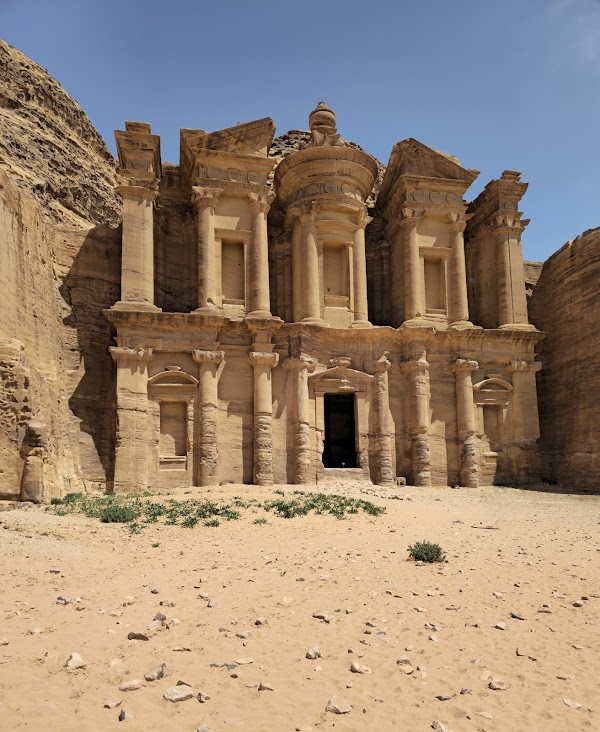
The Monastery is a landmark in Petra, Jordan. Your legs are tired by the time you reach the top. The free Lokali audio guide runs 5 minutes.
✓ Verified August 2026 · how we write these guides
Visitor facts
| Lokali audio guide | 5 min · free |
|---|---|
| Location | Petra, Jordan |
| Coordinates | 30.3213, 35.4379 |
| Languages | 45, in the Lokali app |
The story
Your legs are tired by the time you reach the top. The climb takes around eight hundred steps, cut into the rock long ago. You round a final bend, the path opens, and there it is. A huge carved facade fills the cliff in front of you. After the long climb, the sight feels like a gift earned step by step.
This is the Monastery, known in Arabic as Ad Deir. It is the largest carved monument in all of Petra. The facade rises roughly forty-eight meters tall and stretches almost as wide. Stand near the base and look up. A grown adult barely reaches the bottom of the lowest doorway. The scale is hard to believe until you stand under it.
The name can mislead you. This place was probably not built as a monastery at all. The Nabataean traders who ruled Petra carved it around two thousand years ago, most likely as a temple or a hall for gatherings. The name came much later, from people who found something else carved on the walls inside.
Step into the single great chamber and look closely at the back wall. You can find small crosses cut into the stone. Centuries after the Nabataeans, Christian hermits and monks used this space. They held quiet services in the cool, shadowed room. Those carved crosses gave the monument the name it still carries today.
The design echoes the Treasury, down in the heart of the city. You will see the same broad columns and the same crowning shape with a round urn on top. Yet the Monastery is larger, simpler, and far less crowded. Fewer fine details cover its surface. The effect is heavier and more solid, built for the open mountain air.
Notice the doorway at the center. It stands about eight meters tall on its own. The dark opening leads into one large, plain room carved from the rock. As with most monuments here, the carvers saved their effort for the face of the cliff. The inside was left quiet and bare, a still space behind a grand front.
The walk up here shapes the whole experience. The trail climbs past rock walls, small stalls, and wide views back over the valley. Local Bedouin families run simple stops along the way, selling tea and small goods. Take the climb slowly. The steps are uneven, and the desert sun grows strong as the morning goes on.
The color of the stone rewards a patient eye. The sandstone here runs through shades of gold, pink, and pale brown. Wind and rain have softened the carved edges over the centuries. Run your gaze along the columns and watch how the light catches each ridge. In the late day, the whole facade seems to warm from within.
Across from the Monastery sits a simple rest stop with cushions and shade. From there you can sit and take in the full width of the carving. This is the place to let the scale settle in your mind. Order a tea. Let your heartbeat slow after the climb. There is no need to rush back down.
Walk a short way past the monument to the marked viewpoints. Signs point toward spots labeled as the end of the world, or the best view. From these high ledges the desert spreads out in every direction. Folds of bare mountain run toward the horizon. Up here the air feels thin, clean, and very quiet.
Think about the labor this place required. There were no machines, only hand tools, ropes, and skilled workers on the cliff face. They worked from the top down, shaping the rock as they went. The finished surface had to be smooth and true, with no way to fix a wrong cut once the stone was gone. Every line you see was planned and cut by people standing where you now stand, far above the city floor.
Few travelers climb all the way up, so the crowds thin as you rise. That quiet is part of the reward. Where the Treasury draws a steady throng, the Monastery often gives you room to breathe. Stand alone before it for a moment, and the size of the carving feels almost personal, made just for you.
Before you begin the long walk down, turn back once more. Fix the shape of the facade in your memory, framed against the wide sky. The climb will fade from your legs by tomorrow. This view will stay with you far longer. Then take the steps slowly, and let the mountain return you to the valley below.
Key facts
What to look for
Practical tips
Common questions
How long is the audio guide for The Monastery?
The free Lokali audio guide for The Monastery runs about 5 minutes. Allow extra time beyond that to look around at your own pace.
Is there a free audio guide to The Monastery?
Yes — the Lokali app narrates The Monastery free of charge in 50+ languages. It covers the history, what to look for on site and practical tips, and it works offline once downloaded.
Where is The Monastery?
The Monastery is in Petra, Jordan, at 30.3213, 35.4379. Tap the map link on this page for directions from where you are.
What should you know before visiting The Monastery?
Start the climb early before the midday heat builds.
What is The Monastery known for?
The largest carved monument in all of Petra.
On the map
Opens directions to The Monastery from your location.
Hear The Monastery in your language
The full story, narrated, in 50+ languages. Download it before you go and it plays offline, at your own pace, with no ticket and no tour group.