Photo: Giorgiomugnaini · Public domain · Wikimedia Commons
Populonia is a frazione of Italy. Populonia was an Etruscan city built directly on the coast. The free Lokali audio guide runs 7 minutes.
✓ Published October 2026 · how we write these guides
Visitor facts
| Lokali audio guide | 7 min · free |
|---|---|
| Type | Archaeological Site |
| Location | Piombino, Italy |
| Coordinates | 42.9894, 10.4914 |
| Languages | 50+, in the Lokali app |
The story
Listen to the sea first. Below the hill, small waves break on a curved bay, and the sound reaches you through the umbrella pines. The sand down there is not the pale gold you might expect on a Tuscan beach. In places it is dark, almost grey, and it sparkles faintly in the sun. That colour holds the whole story of this place. For centuries, people here melted rock into metal, and the waste of their furnaces ended up on the shore.
You are standing at Populonia, on the headland north of Piombino. It looks out over the Gulf of Baratti, with the island of Elba sitting low on the horizon to the southwest. In ancient times this was an Etruscan city. The Etruscans were the people who ruled much of central Italy before Rome rose to power. Most of their great cities sat inland on hilltops. This one was different. It stood directly on the coast, facing the open sea.
That choice made sense. Across the water, Elba held rich deposits of iron ore. The Greeks called the island Aethalia, a name linked to soot and smoke. Ancient writers described ore being carried from the island to the mainland, where it was smelted. Populonia became one of the great industrial centres of the ancient Mediterranean. Imagine furnaces burning along this bay, and smoke drifting over the pines. It was a working town, not a quiet retreat.
The city had two parts, and you can still feel that division today. Up on the hill was the acropolis, the high city, with temples and public buildings. Down by the bay was the industrial quarter, close to the harbour and the landing beaches. The cemeteries lay around the bay as well. So the living, the dead, and the furnaces all shared the same stretch of shore. That mix is unusual, and it shaped what archaeologists would find much later.
Here is the first surprise. Over the centuries, the iron slag piled up so thickly that it buried many of the old tombs. Whole burial mounds disappeared beneath heaps of furnace waste. Then, in the twentieth century, people realised the ancient slag still held useful iron. They began to dig it up and process it again. As the machines removed the slag, the tombs came back into the light. Industry hid this cemetery, and industry uncovered it again.
Walk down toward the necropolis of San Cerbone, near the bay. A necropolis is a city of the dead, a large ancient cemetery. Here you will see round tumulus tombs. Each one is a stone drum topped by a mound of earth, with grass growing over it. A low passage leads into a burial chamber inside. These mounds were family tombs for wealthy households. Notice how solid the stonework is, block fitted against block, with no mortar between them.
The largest of these mounds is often called the Tomb of the Chariots. It takes its name from the remains of wheeled vehicles found inside. Chariots in a grave signalled status. They told the community that this family had power and wealth. Stand back from the tomb and look at its full circle. Then picture the funeral procession that once came to it. Families gathered here, left offerings, and sealed the doors behind them.
Now climb toward the necropolis known as Le Grotte, which means the caves. The mood changes completely here. Instead of round mounds, you find chambers cut straight into the soft local sandstone. This area was also an ancient quarry, so the rock walls carry the marks of stone cutting. Tombs open like dark doorways into the cliff. The path runs through woods of holm oak, and in summer the cicadas are loud. It feels more private and more enclosed than the open bay.
Up on the acropolis, excavations have uncovered parts of the Roman phase of the city. Rome eventually absorbed Populonia, as it absorbed every Etruscan city. You can trace foundations of temples, terraces, and paved streets on the summit. From here the view opens wide. You see the bay below, the green coastline, and Elba out to sea. On a clear day the outline of the island looks close enough to reach by rowing boat.
The second surprise is about decline. Ancient sources suggest that by the time of the Greek geographer Strabo, around the turn of the first millennium, the city was largely deserted. Strabo described only a few temples and houses left on the hill, while the iron work continued by the harbour. A once powerful city had shrunk to a small settlement. Long after, in the Middle Ages, a fortified village grew on the height, and that village is still here.
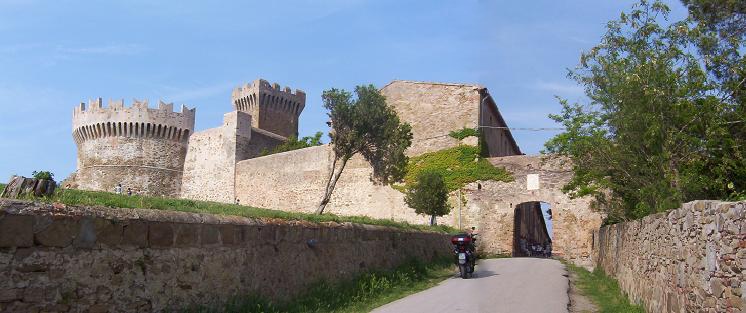
The medieval village of Populonia sits inside stone walls, with a small fortress tower at its edge. Its lanes are narrow and short. You can walk the whole village in a few minutes. Look at the stone of the walls, grey and weathered by sea wind. From the tower the view runs along the coast in both directions. Small shops and cafés line the main lane. In the evening, the village becomes quiet very quickly.
If you want to see what came out of the ground here, the archaeological museum in Piombino holds many of the finds. Among them is a large silver vessel known as the Amphora of Baratti. An amphora is a tall jar with two handles. This one is decorated with many small figures from ancient religion and myth. Seeing the objects in the museum, and then the empty tombs here, helps the two halves of the story fit together.
Before you leave, walk down to the edge of the bay once more. Pick up a handful of that dark sand and look at it closely. Some of those grains may be fragments of ancient slag, worn smooth by the waves. Behind you are the tombs, the quarry, and the hill. In front of you is the sea that carried the ore. Listen again to the small waves... they have been arriving on this shore for all of it.
Key facts
What to look for
Practical tips
Common questions
Is there a free audio guide to Populonia?
Yes — the Lokali app narrates Populonia free of charge in 50+ languages. The guide runs about 7 minutes, covers the history, what to look for on site and practical tips, and works offline once downloaded.
Where is Populonia?
Populonia is near Piombino, Italy, at 42.9894, 10.4914. Tap the map link on this page for directions from where you are.
What is Populonia known for?
Populonia was an Etruscan city built directly on the coast. Iron ore from Elba was smelted here in ancient times.
What should you look for at Populonia?
Dark, glittering slag grains mixed into Baratti beach sand. Mortarless stone blocks forming the round tumulus walls. Low entrance passages leading into the burial chambers.
What should you know before visiting Populonia?
Wear sturdy shoes for the uneven paths at Le Grotte. Bring water and a hat for the exposed summer trails.
When is the best time to visit Populonia?
Bring water and a hat for the exposed summer trails.
On the map
Opens directions to Populonia from your location.
Hear Populonia in your language
The full story, narrated, in 50+ languages. Download it before you go and it plays offline, at your own pace, with no ticket and no tour group.