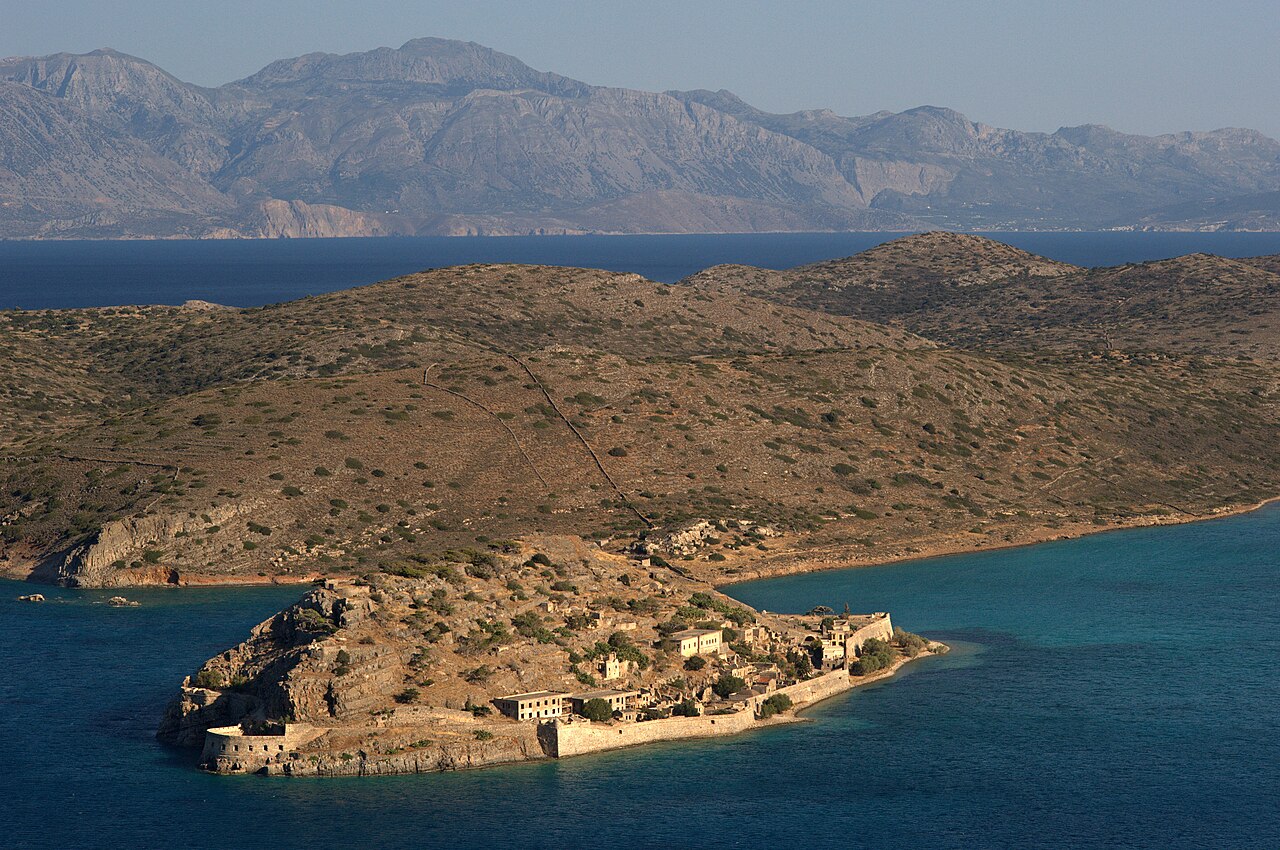
Spinalonga is an island in Plaka, Greece. Venetians fortified the island in the early fifteen hundreds. Greece's leper colony operated from 1903 to 1957. Most visitors spend 2-3 hours here. The free Lokali audio guide runs 4 minutes.
✓ Verified October 2026 · how we write these guides
Visitor facts
| Time needed | 2-3 hours |
|---|---|
| Lokali audio guide | 4 min · free |
| Type | Island |
| Best for | History |
| Location | Plaka, Greece |
| Coordinates | 35.2975, 25.7381 |
| Languages | 45, in the Lokali app |
The story
The boat cuts its engine and drifts toward the low stone quay. Above you, a fortress wall rises straight from the sea — ochre stone weathered to the colour of old parchment, salt-crusted where the waves reach. The air smells of brine and wild thyme.
This is Spinalonga, a fortified island barely four hundred metres long, floating in the mouth of the Gulf of Elounda. The Venetians carved it from the Cretan headland in the early fifteen hundreds, blasting a channel to turn a peninsula into a defensible outpost. For more than a century, their garrison held this rock even after the rest of Crete fell to the Ottomans.
Walk through the arched gate — the Dante Gate, locals call it — and the narrow lane ahead is lined with roofless stone houses. Their doorways gape open to the sky. These are not Venetian barracks. They were built in the early twentieth century, when Greece turned Spinalonga into a leper colony. From 1903 to 1957, people diagnosed with Hansen's disease were exiled here, forbidden to leave.
At its peak, nearly four hundred people lived on this small island. They built a school, a church, a cinema, a market street. They married, raised children, celebrated name days. The Greek state supplied rations and a doctor, but the residents governed themselves. It was exile, but it was also a kind of fierce self-sufficiency — a community that refused to be merely a quarantine.
Climb the stepped lane toward the centre and you pass the remains of the hospital, the disinfection building, the communal ovens. The roofs are gone, but the walls still stand. Wildflowers grow through the floors. In the upper quarter, near the Venetian keep, a small white chapel survives intact — Agios Panteleimon, where the island's last priest held services until the colony closed.
Spinalonga was the last active leper colony in Europe. When antibiotics finally made Hansen's disease curable, the Greek government shuttered the settlement in 1957. The last residents left by boat, carrying what they could. The island stood empty for decades, visited only by fishermen and the occasional curious traveller.
Today, it is one of Crete's most visited sites, reached by small ferries from Plaka and Elounda. Restoration work has stabilised the main street and several key buildings, but much of the island remains as it was left — walls open to the weather, doorways framing views of the sea. Walking these lanes, you move between two histories: the Venetian fortress built to control a coastline, and the twentieth-century village built by people the world tried to forget.
Stand at the northern tip, where the Venetian bastion juts into the strait. Across the water, barely two hundred metres away, the mainland rises green and close. From here, the exiles could see Plaka, could watch fishing boats and ferries, could hear church bells on Sunday mornings. The proximity made the separation sharper.
The island is small enough to walk end to end in twenty minutes, but most visitors spend an hour or more. There are no cafés, no shade structures, no facilities beyond a small ticket kiosk at the landing. Bring water, wear a hat, and give yourself time to sit quietly in one of the roofless courtyards. The stone holds the heat long after the sun drops behind the hills.
As you walk back toward the quay, notice the carved lintels above certain doorways — initials, dates, small attempts at decoration. These were homes, not cells. People planted gardens in tin cans, painted shutters, hung laundry between the walls. The island remembers both the cruelty of exile and the stubborn dignity of those who lived here.
Key facts
What to look for
Practical tips
Common questions
How long do you need at Spinalonga?
Plan 2-3 hours. That is the time most visitors spend at Spinalonga. The free Lokali audio guide runs 4 minutes and is made to listen to while you walk.
Is there a free audio guide to Spinalonga?
Yes — the Lokali app narrates Spinalonga free of charge in 50+ languages. No ticket, tour group or subscription, and it works offline once downloaded.
Where is Spinalonga?
Spinalonga is in Plaka, Greece, at 35.2975, 25.7381. Tap the map link on this page for directions.
What should you know before visiting Spinalonga?
Bring water and sun protection, no facilities on the island
What is Spinalonga known for?
Venetians fortified the island in the early fifteen hundreds
What is the best time to visit Spinalonga?
Visit early morning or late afternoon to avoid midday heat
On the map
Opens directions to Spinalonga from your location.
Hear Spinalonga in your language
The full story, narrated, in 50+ languages. Download it before you go and it plays offline, at your own pace, with no ticket and no tour group.