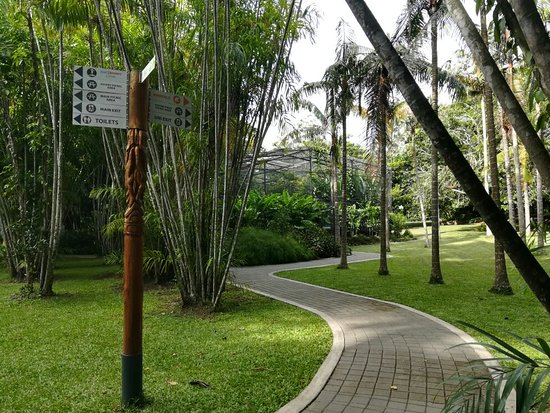
Port Moresby Nature Park
9.4150° S · 147.2367° E · Park
Port Moresby Nature Park is an urban sanctuary showcasing PNG's biodiversity through native birds, reptiles, and plants in naturalistic enclosures. It is in Port Moresby, PG. Most visitors spend 1.5–2 hours here. The free Lokali audio guide runs 5 minutes.
✓ Verified August 2026 · how we write these guides
Visitor facts
| Time needed | 1.5–2 hours |
|---|---|
| Lokali audio guide | 5 min · free |
| Type | Park |
| Best for | Family |
| Location | Port Moresby, PG |
| Coordinates | -9.4150, 147.2367 |
| Languages | 45, in the Lokali app |
The story
You hear the birds before you see them. Calls rise from the trees on every side, layered one over another. The air is warm and heavy, and it smells of damp leaves and turned earth. Light falls in shifting patches through the high canopy above. You have stepped off a city street and into a pocket of living forest. This is Port Moresby Nature Park.
The park covers about thirty acres of green ground. It sits within the grounds of the University of Papua New Guinea, in the Waigani area of the city. The drive from the city centre takes around fifteen minutes. Inside the gates, paved paths and timber boardwalks wind beneath tall trees. The noise of traffic fades quickly behind you, and a softer set of sounds takes its place.
This green space has a long story behind it. It began in 1975 as the National Botanical Gardens, a place for growing and studying plants. For years it grew and slowly changed. In 2012 it was reshaped and reopened under a new name, Port Moresby Nature Park. The new name reflects a wider goal. The park now works to protect both the plants and the animals of the country.
The park holds the only patch of rainforest left standing inside the city. Native trees and plants were gathered here from across the many provinces of Papua New Guinea. As you walk the paths, you pass species that grow naturally hundreds of kilometers away. In this way the park is a small living map of the nation's forests, gathered and kept alive in one protected place.
More than five hundred and fifty native animals live within the park. Many of them were rescued, or were born here in the care of the keepers. The staff feed them, study them, and watch over their health each day. A central part of the park's work is conservation, the slow and patient effort to protect species that face growing pressure out in the wild.
Among the animals are the celebrated birds of paradise. These birds are known for their bright feathers and their strange, beautiful courtship displays. The park keeps one of the largest living collections of them found anywhere. Watch quietly at the right moment and you may see a male shake out his plumes and dance. The colours and the movement are hard to forget once you have seen them.
You will also find tree kangaroos along the way. These are shy animals that climb and rest high in the branches. Unlike the kangaroos that bound across open plains, they have adapted to a life among the trees. Their thick fur and long, heavy tails suit the forest canopy. They move with slow and careful balance from one limb to the next, often pausing to watch you back.
Look for the cassowary as well. This is a tall, heavy bird that cannot fly. It has a brightly coloured neck and a tall, bony crest, called a casque, on top of its head. In the wild it walks the forest floor and helps to spread the seeds of many plants. Keep a respectful distance, as the signs and keepers advise. The cassowary is powerful, and it is best watched calmly from the path.
The park is also a garden of plants. It holds many kinds of orchids, both native species and garden hybrids. Their flowers appear in soft creams and in vivid reds and purples. Other tropical plants, ferns, and palms line the shaded walkways. The mix of constant bird call, deep green shade, and sudden bloom gives the whole place a gentle and very much living feel.
Each year the park draws a large number of visitors through its gates. The yearly count runs somewhere between one hundred and thirty-five thousand and one hundred and fifty thousand people. Families come together on weekends to walk and rest. School groups come to learn about the wildlife. For many children in the city, this quiet park is where they first meet the animals of their own homeland.
Take your time as you walk the loop. Boardwalks lead you through shaded enclosures, past ponds, and across open lawns. There are quiet benches set in the shade, where you can sit and simply listen. Clear signs along the way explain the animals and plants you are seeing. Move slowly, and the park rewards you with small moments, a sudden call, a flash of a wing, a face among the leaves.
Before you reach the gate again, pause under the trees one more time. Listen to the layered sound of the forest closing in around you. In the middle of a growing city, this small and carefully kept place holds onto something old and wild. Carry a little of its calm with you as you step back out into the noise of the day.
Key facts
What to look for
Practical tips
Common questions
How long do you need at Port Moresby Nature Park?
Plan 1.5–2 hours. That is the time most visitors spend at Port Moresby Nature Park. The free Lokali audio guide adds about 5 minutes of narration you can listen to as you walk, so it fits inside your visit rather than adding to it.
Is there a free audio guide to Port Moresby Nature Park?
Yes — the Lokali app narrates Port Moresby Nature Park free of charge in 50+ languages. It covers the history, what to look for on site and practical tips, and it works offline once downloaded.
Where is Port Moresby Nature Park?
Port Moresby Nature Park is in Port Moresby, PG, at -9.4150, 147.2367. Tap the map link on this page for directions from where you are.
What should you know before visiting Port Moresby Nature Park?
Drive about fifteen minutes from the city centre.
What is Port Moresby Nature Park known for?
Opened as the National Botanical Gardens in 1975.
What is the best time to visit Port Moresby Nature Park?
The bird aviary is particularly rewarding in late afternoon when feeding occurs.
On the map
Opens directions to Port Moresby Nature Park from your location.
More to see in Port Moresby

Hear Port Moresby Nature Park in your language
The full story, narrated, in 50+ languages. Download it before you go and it plays offline, at your own pace, with no ticket and no tour group.