
Portchester Castle
50.8375° N · 1.1150° W · Archaeological Site
Photo: Matthew Folley from UK · CC BY 2.0 · Wikimedia Commons
Portchester Castle is a medieval castle in Portchester, Hampshire, England, UK. Roman fort walls built in the late third century. The free Lokali audio guide runs 7 minutes.
✓ Published October 2026 · how we write these guides
Visitor facts
| Lokali audio guide | 7 min · free |
|---|---|
| Type | Archaeological Site |
| Location | Portsmouth, United Kingdom |
| Coordinates | 50.8375, -1.1150 |
| Official website | english-heritage.org.uk |
| Languages | 50+, in the Lokali app |
The story
Listen first. Gulls call over the water, halyards tap against masts, and the tide moves softly against the shingle below the walls. Under your feet the grass is level and wide, and around you rises a long grey wall of flint, set in neat bands of pale stone. This is Portchester Castle, at the quiet northern end of Portsmouth Harbour. It is a strange and lovely place. A Roman fort, a medieval castle, a church and a prison stand inside one enclosure.
Start with that wall, because it is the oldest thing you can see. The Romans built it in the late third century, almost 1,700 years ago. Britain's coast was being raided by sea, and Rome built a chain of strong forts along the south and east shores. Later writers called this defence the Saxon Shore. Portchester was one of those forts. Here is the first surprise. Its walls are often described as the most complete Roman fort walls in northern Europe.
Look closely at the face of the wall. You will see flint, a hard dark stone from the local chalk, packed in mortar. Flat courses of tile and stone run across it at regular heights. Roman builders used these courses to keep the wall level as it rose. Along the circuit, round towers called bastions push out from the line. The Romans built around twenty of them. Most still stand, and they allowed defenders to shoot along the face of the wall at any attacker.
The shape of the fort is simple. It is almost a perfect square, with gates on opposite sides. The harbour once came right up to one side, so ships could reach the fort directly. That position was the whole point. From here, a garrison could watch the harbour mouth and the creeks around it. Stand by the water gate for a moment and look south. You can picture Roman ships at anchor in these grey-green shallows.
When Roman rule in Britain ended in the early fifth century, the fort did not stand empty for long. Archaeologists have found traces of Saxon life inside the walls — timber buildings, wells and everyday rubbish. People lived here because the walls still gave them safety. Over the centuries, the old Roman square became a place of shelter for farmers, and later for local lords. A strong wall kept its value long after the empire that built it had gone.
Now turn towards the tall square tower in the corner. This is the keep, built by the Normans in the twelfth century. They did something clever. Instead of building a new castle from nothing, they used one corner of the Roman fort. They added an inner wall and a ditch to make a smaller, stronger enclosure, called the inner bailey. The keep was later raised higher, and today it stands well above the old Roman wall.
Across the grass, in the opposite corner, stands a quiet stone church. This is the second surprise. In the 1130s, King Henry the First founded a priory here for Augustinian canons, a community of priests who lived under a shared rule. The canons did not stay long. They soon moved a few miles inland to Southwick. But their church stayed behind. Saint Mary's is still a working parish church, and services are still held inside a Roman fort.
Look at the west front of the church. The doorway has round arches and carved bands of decoration. This style is called Romanesque, a style of building with round arches and thick walls that was common across Europe in the eleventh and twelfth centuries. Inside, the plain walls and simple light give the church a calm feeling. It is a good place to sit for a few minutes, away from the wind off the harbour.
Back in the inner bailey, look at the ruined buildings against the walls. In the late fourteenth century, King Richard the Second turned part of the castle into a royal residence. He built a hall, kitchens and private rooms here. Today you can still see tall window openings and fireplaces high in the walls. The floors are gone, so the fireplaces seem to hang in the air. Try to imagine painted walls, warm fires and servants hurrying with dishes from the kitchen.
In 1415, the harbour filled with ships. King Henry the Fifth gathered his army in this area before he sailed to France. That campaign later led to the Battle of Agincourt, one of the best-known English victories of the Middle Ages. Before he sailed, a plot to kill the king was discovered, and the plotters were tried and executed. Portchester's place on the harbour made it part of that story, as an assembly point for men and ships.
The next chapter is less glorious. During the wars with France in the late eighteenth and early nineteenth centuries, the castle became a prison. Thousands of prisoners of war were held here at times, many of them French sailors and soldiers. They lived crowded inside the keep and in wooden huts in the enclosure. Some prisoners made small objects to sell, and some cut their names into the stone. Look for this graffiti inside the keep. It is a personal record of men far from home.
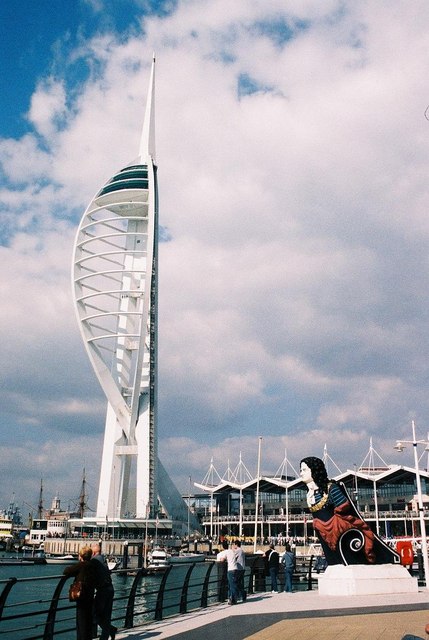
If you can, climb the stairs to the top of the keep. The steps are steep and narrow, so take your time. From the roof, the whole fort lies below you like a plan on a page. You can see the square of the Roman wall, the inner bailey and the church. Beyond, the harbour opens out towards Portsmouth. On a clear day you can pick out the white sail-like shape of the Spinnaker Tower on the far shore.
Before you leave, walk along the outside of the walls, by the shore path. Here the flint looks darker, cut by weather and salt. The tide may be in, with the water close and bright. Or it may be out, with mudflats shining and wading birds picking along the edge. Either way, the wall runs beside you just as it did for Roman sentries. Touch the cold flint as you pass. Hands have rested on these stones for almost two thousand years.
Key facts
What to look for
Practical tips
Common questions
Is there a free audio guide to Portchester Castle?
Yes — the Lokali app narrates Portchester Castle free of charge in 50+ languages. The guide runs about 7 minutes, covers the history, what to look for on site and practical tips, and works offline once downloaded.
Where is Portchester Castle?
Portchester Castle is near Portsmouth, United Kingdom, at 50.8375, -1.1150. Tap the map link on this page for directions from where you are.
What is Portchester Castle known for?
Roman fort walls built in the late third century. Part of Rome's coastal defences called the Saxon Shore.
What should you look for at Portchester Castle?
Bands of flat stone running through the flint walls. Round Roman bastions projecting from the wall line. Fireplaces hanging high in Richard the Second's ruined walls.
What should you know before visiting Portchester Castle?
Climb the keep for a full view of the fort. Walk the shore path outside the walls at low tide.
On the map
Opens directions to Portchester Castle from your location.
More to see in Portsmouth


Hear Portchester Castle in your language
The full story, narrated, in 50+ languages. Download it before you go and it plays offline, at your own pace, with no ticket and no tour group.