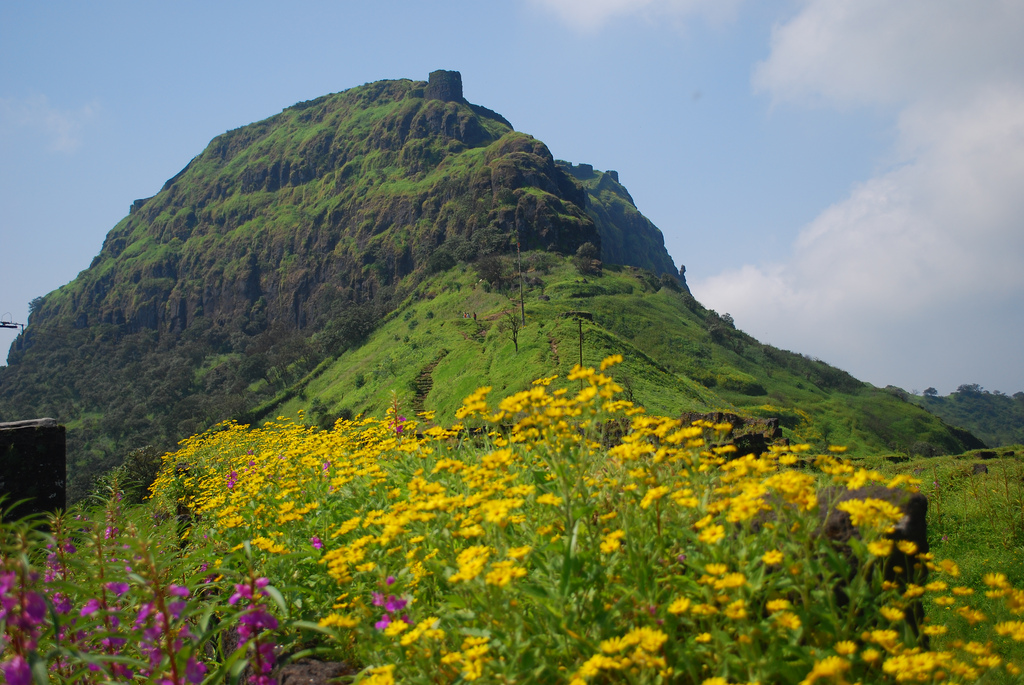
Rajgad Fort
18.2460° N · 73.6822° E · Fortification
Photo: Goldengoof · Public domain · Wikimedia Commons
Rajgad Fort is a hill fort in Pune district, Maharashtra, India. Rajgad was originally known as Murumbdev before Shivaji renamed it. The free Lokali audio guide runs 7 minutes.
✓ Published October 2026 · how we write these guides
Visitor facts
| Lokali audio guide | 7 min · free |
|---|---|
| Type | Fortification |
| Location | Pune district, India |
| Coordinates | 18.2460, 73.6822 |
| Languages | 50+, in the Lokali app |
The story
Listen for a moment. Up here, the wind is the loudest thing you will hear. It moves across the dry grass in long waves and hums against the old stone. Under your feet the path is rough basalt, dark volcanic rock, worn smooth in places by centuries of sandals and bare feet. Around you, the ridges of the Sahyadri mountains fold away into blue haze. You are standing on Rajgad, the King's Fort, and for many years this hilltop was the heart of a new kingdom.
The Sahyadri range is the local name for the Western Ghats, the long chain of mountains that runs down the western edge of India. These hills are made of layered volcanic rock. Over millions of years, rain and wind cut them into flat-topped summits with sheer cliffs on every side. To a builder of forts, that shape was a gift. Nature had already made the walls. People only needed to add gates, ramparts and water tanks.
Before it carried its royal name, this mountain was known as Murumbdev. The name is linked to a local deity of the hill. In the seventeenth century, a young Maratha leader named Shivaji took control of the area and began to build here on a large scale. The Marathas were a warrior people of this region, and Shivaji would become the founder of their kingdom. He renamed the fort Rajgad, which simply means the King's Fort. The name was a statement of ambition.
Here is the first fact many visitors do not expect. Rajgad, not the better-known Raigad, served as Shivaji's capital for the longest stretch of his career. Historians generally count well over two decades here. Only later, around the time of his formal coronation in 1674, did the royal seat move to Raigad. So many of the turning points of his life were planned, celebrated or mourned on the ground you are walking now.
Look at the shape of the fort around you. Rajgad is built on a central peak with three long spurs, or ridges, running out from it. Each spur ends in a terraced plateau called a machi. The three are Padmavati Machi, Suvela Machi and Sanjivani Machi. At the very top sits the citadel, called the Balekilla. Seen from the air, the layout looks a little like a star with uneven arms. Each arm was a separate line of defence.
Padmavati Machi was the busy centre of life. This is where most people lived and worked when the court was here. You can still find a temple to the goddess Padmavati, and a large stone-lined lake that held water through the dry months. Water was everything on a hill fort. A strong wall meant nothing if the defenders could not drink during a long siege. Notice how many tanks and cisterns are cut directly into the rock across the fort.
Also on Padmavati Machi stands a memorial to Saibai, Shivaji's first wife. She died at Rajgad in 1659. It was a hard year. In that same period, Shivaji faced Afzal Khan, a powerful general sent against him by the Bijapur Sultanate, a rival kingdom to the south-east. Their meeting near Pratapgad ended with Afzal Khan's death. Local tradition says the general's head was brought back and buried here at Rajgad. That story is widely told, but treat it as tradition rather than settled record.
Now turn toward Sanjivani Machi. This is perhaps the most impressive piece of military engineering on the fort. Along much of its length, the builders raised two walls instead of one, with a narrow passage running between them. If attackers broke through the outer wall, they found themselves trapped in a corridor under the defenders above. Walk a little way along it and feel how tight the space is. Small bastions push out from the walls like stone shoulders.
Suvela Machi, on the eastern spur, has its own surprise. Near its end, a natural hole passes straight through a rock wall. Locals call it the Nedhe, which means the eye of a needle. Nearby, a large boulder is said to resemble an elephant, and it carries a name to match. Climbers like to crawl through the Nedhe and look out at the valley through the stone frame. It is a small, playful moment on a very serious fortress.
Here is the second fact that surprises many people. Shivaji's son Rajaram was born here at Rajgad, in 1670. Rajaram would later lead the Maratha state through one of its darkest periods, when the Mughal Empire, the great power ruling much of northern India, pushed hard into this region. And earlier, in 1666, after his famous escape from house arrest in Agra, Shivaji made his way back to these hills. Rajgad was home ground, the place he returned to.
The gates of Rajgad tell you how people arrived. The Pali Darwaja and the Gunjavane Darwaja are named after villages at the foot of the mountain. Darwaja simply means gate. There is also a Chor Darwaja, or thief's gate, a small hidden exit for messengers and quiet escapes. Notice how many gates turn sharply after you enter. An enemy could not charge straight in. They had to slow down and turn, right under the defenders' eyes.
The climb itself is part of the experience. Most visitors walk up from the villages below, and the path is steep, rocky and exposed to the sun. In the monsoon months, the whole mountain turns green. Mist pours over the edges, and small waterfalls run down the cliffs. In the dry season, the grass turns gold and the views stretch much further. On a clear day, you can pick out Torna, another Maratha fort, on a ridge to the west.
Pause at the top of the Balekilla if you can. This was the most protected place on the mountain, reached by a final steep scramble. From here, a ruler could watch every approach and every valley. Today it is quiet. Swifts cut through the air, and the stone is warm under your hand in the afternoon. It is easy to imagine messengers climbing these paths with news that could change the fate of a kingdom.
Before you start down, look once more along the three ridges. See the walls following every curve of the rock, the dark water in the tanks, the paths you climbed. The fort is a ruin now, but its plan is still easy to read. As you walk away, listen again for the wind. It is the same wind the guards heard on these walls, nearly four centuries ago.
Key facts
What to look for
Practical tips
Common questions
Is there a free audio guide to Rajgad Fort?
Yes — the Lokali app narrates Rajgad Fort free of charge in 50+ languages. The guide runs about 7 minutes, covers the history, what to look for on site and practical tips, and works offline once downloaded.
Where is Rajgad Fort?
Rajgad Fort is in Pune district, India, at 18.2460, 73.6822. Tap the map link on this page for directions from where you are.
What is Rajgad Fort known for?
Rajgad was originally known as Murumbdev before Shivaji renamed it. Served as Shivaji's capital for over two decades.
What should you look for at Rajgad Fort?
The double walls running along Sanjivani Machi. The Nedhe, a natural hole through rock on Suvela Machi. The stone-lined lake and Padmavati temple on Padmavati Machi.
What should you know before visiting Rajgad Fort?
Start the climb early to avoid the midday heat. Carry plenty of water; refill points on the trail are limited.
When is the best time to visit Rajgad Fort?
Start the climb early to avoid the midday heat.
On the map
Opens directions to Rajgad Fort from your location.
More to see in Pune district


Hear Rajgad Fort in your language
The full story, narrated, in 50+ languages. Download it before you go and it plays offline, at your own pace, with no ticket and no tour group.