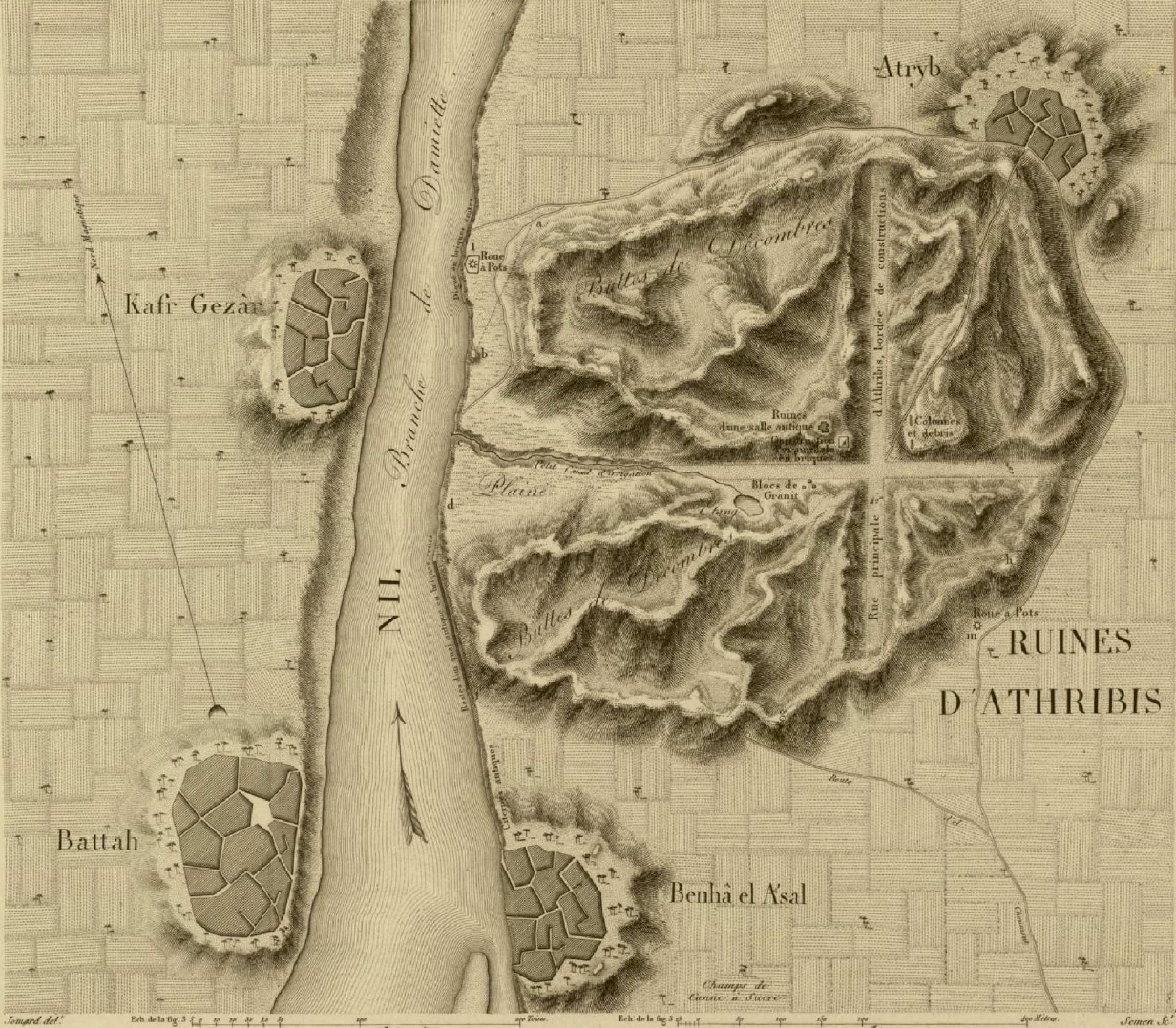
Photo: Wikimedia Commons contributor · Public domain · Wikimedia Commons
Athribis is a city in Lower Egypt. Ancient Egyptian name was Hut-heryib, the mansion in the middle. The free Lokali audio guide runs 6 minutes.
✓ Published October 2026 · how we write these guides
Visitor facts
| Lokali audio guide | 6 min · free |
|---|---|
| Type | Archaeological Site |
| Location | Qalyubia, Egypt |
| Coordinates | 30.4667, 31.1833 |
| Languages | 50+, in the Lokali app |
The story
Listen first. Car horns drift over from the streets of Benha, a donkey cart rattles past, and somewhere a radio plays. Underfoot, the ground is not quite earth. It is a crumbly mix of dust, broken pottery and old mudbrick. Bend down and you will find small sherds of red and grey clay almost everywhere. You are standing on Athribis, one of the old cities of the Nile Delta.
The ancient Egyptians called this place Hut-heryib, which scholars usually translate as something like the mansion in the middle. Greek speakers later shortened that name to Athribis, and the Arabic name of the mound, Tell Atrib, keeps an echo of it. A tell is a hill made by people. Each new generation built on top of the ruins of the one before, so the ground slowly rose over thousands of years.
First, a small surprise that confuses many travellers. There are two places called Athribis in Egypt. The other one lies far to the south, in Upper Egypt, near the modern city of Sohag. This guide is about the Delta city here in Qalyubia, close to the eastern branch of the Nile that flows north toward Damietta. If you read about a large temple with zodiac ceilings, that is probably the southern site, not this one.
In pharaonic times, this city was the capital of one of the provinces of Lower Egypt. The Greeks later called these provinces nomes. Each nome had its own main town, its own temples and its own local gods. The patron god here was Khentykhety, a deity linked with both the crocodile and the falcon. Athribis sat on good farmland and on river routes, so it stayed important through many dynasties.
The city also gave Egypt one of its most respected men. Amenhotep son of Hapu was born here. He served the pharaoh Amenhotep the Third in the fourteenth century before Christ as a scribe, an organiser of great building works and a royal adviser. Later generations remembered him as a sage. Centuries after his death, people prayed to him as a healer, almost as a god. Not many royal officials reached that kind of fame.
Now look around and ask a simple question. Where are the great stone temples? The answer is one of the sad stories of Delta archaeology. Stone is rare here, so later builders often took blocks from old buildings and used them again. Then, in more recent centuries, farmers dug into the mounds for sebakh. Sebakh is the old decayed mudbrick, rich in nitrogen, and they spread it on their fields as fertiliser.
This digging removed huge parts of the ancient city. It also brought objects to light, and many of them went to markets and museums without a clear record of where they came from. So the Athribis you see today is mostly the lower layers, the leftovers, and the parts that houses and roads have not yet covered. The modern town of Benha has grown right up against the ancient site.
And yet the remains that survive have taught archaeologists a great deal. Since the mid-1980s, a Polish and Egyptian team has worked here. They have focused especially on the city of the Ptolemaic and Roman periods. That is the time after Alexander the Great, when Greek-speaking kings, and later Roman emperors, ruled Egypt. In that age, Athribis was a prosperous town of workshops, houses and baths.
The excavators found traces of everyday industry. There were kilns for firing pottery, and workshops that made small figurines in clay and faience. Faience is a glazed material, often blue or green, which Egyptians used for amulets and little statues. Some figurines show gods, some show playful or rude scenes, and some may have served as offerings. These objects bring you close to the ordinary people of the town.
The team also studied a Roman bath complex. Public baths were a key part of town life across the Roman world. People came to wash, to relax in warm rooms and to meet their neighbours. Picture the steam, the wet stone and the noise of voices echoing off the walls. It is not so different from the life you can hear in the streets of Benha today.
Athribis did not end with the pharaohs or the Romans. In the Christian era, the city became the seat of a bishop, and its name appears in church records of the Coptic tradition. Later, under Islamic rule, the regional centre shifted toward Benha, and the old mound slowly became a place at the edge of town. Its long life, from the pharaohs to the Middle Ages, is written in the layers under your feet.
As you walk, keep your eyes low. Look for shallow trenches, lines of mudbrick walls and areas where burnt red brick shows an old kiln or hearth. Notice how the ground rises and falls. Each small slope may be a buried house or a heap of ancient rubbish. Archaeologists value rubbish heaps very much, because broken things tell honest stories about how people lived.
This is not a polished tourist site with signs and paths, so treat it gently. Do not take sherds home, and do not climb on exposed walls. Some areas may be closed or need permission from the antiquities authorities. Bring water and a hat, because there is little shade. The real reward here is quiet attention, not a perfect photograph.
Before you leave, stand still for a moment and look at the edge where the mound meets the modern town. Apartment blocks, minarets and palm trees rise beside ground that people have lived on for thousands of years. The Nile is still close, the fields are still green, and life in this place still goes on, one layer above the last.
Key facts
What to look for
Practical tips
Common questions
Is there a free audio guide to Athribis?
Yes — the Lokali app narrates Athribis free of charge in 50+ languages. The guide runs about 6 minutes, covers the history, what to look for on site and practical tips, and works offline once downloaded.
Where is Athribis?
Athribis is near Qalyubia, Egypt, at 30.4667, 31.1833. Tap the map link on this page for directions from where you are.
What is Athribis known for?
Ancient Egyptian name was Hut-heryib, the mansion in the middle. Capital of a Lower Egyptian province in pharaonic times.
What should you look for at Athribis?
Red and grey pottery sherds scattered across the surface. Low lines of mudbrick walls in excavated trenches. Patches of burnt red brick from old kilns.
What should you know before visiting Athribis?
Check site access with the local antiquities office before visiting. Bring water and a sun hat for the open mound.
When is the best time to visit Athribis?
Visit in the morning before the Delta heat builds.
On the map
Opens directions to Athribis from your location.
More to see near Athribis


Hear Athribis in your language
The full story, narrated, in 50+ languages. Download it before you go and it plays offline, at your own pace, with no ticket and no tour group.