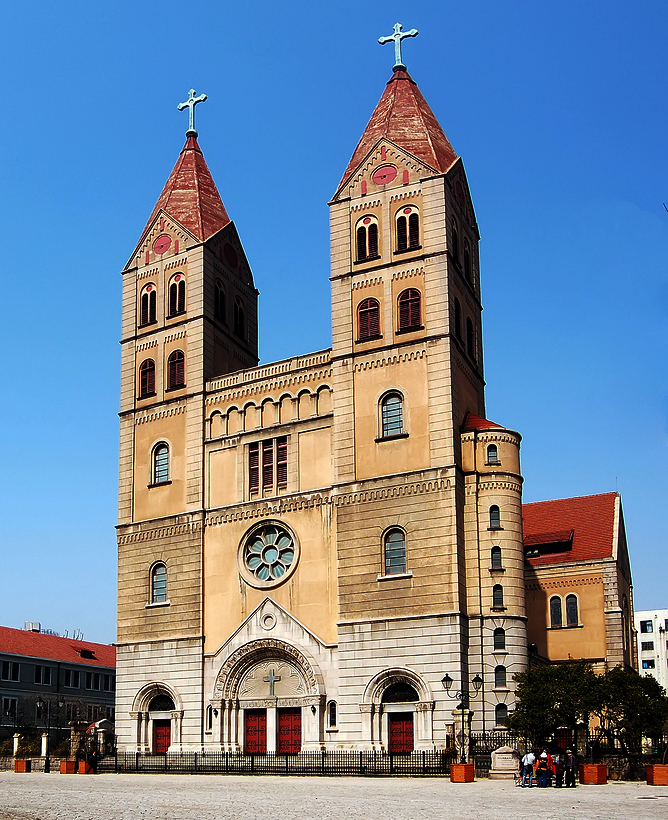
St. Michael's Cathedral, Qingdao
36.0678° N · 120.3154° E · Cathedral
Photo: Noraft · Public domain · Wikimedia Commons
St. Michael's Cathedral, Qingdao is a church building in Qingdao, China. Completed by German Catholic missionaries in the 1930s. The free Lokali audio guide runs 6 minutes.
✓ Published October 2026 · how we write these guides
Visitor facts
| Lokali audio guide | 6 min · free |
|---|---|
| Type | Cathedral |
| Location | Qingdao, China |
| Coordinates | 36.0678, 120.3154 |
| Languages | 50+, in the Lokali app |
The story
Listen first. A camera shutter clicks somewhere on the square. A breeze comes up the slope from the sea and carries a faint smell of salt. Above you, two pale towers rise against the sky. Each tower ends in a sharp spire and a cross. You are standing in front of Saint Michael's Cathedral, in the old heart of Qingdao.
Take a moment to feel the ground. The streets here climb and twist over small hills, and the cathedral sits on raised ground above the lanes around it. That position was a deliberate choice. A church on high ground can be seen from far away. For decades this church was one of the tallest buildings in the old town. Sailors coming into the bay could pick out its spires from the water.
Now look at the facade. The style is mainly Gothic, which means pointed shapes, vertical lines and towers that pull the eye upward. You can also see rounder, heavier Romanesque touches. Romanesque is the older European church style, with thick walls and rounded arches. The mix gives the building a solid, grounded look under its tall spires. The stone base and pale walls look plain in strong sun. In evening light they turn a warm gold.
Here is the first surprise. Many visitors assume this church dates from the German period. Qingdao was a German leased territory from 1898 until the First World War. German missions, villas and red-tiled roofs still shape these streets. But the cathedral came later. Catholic missionaries completed it in the 1930s, two decades after German rule had ended. By then Japan had occupied the city, and then it had returned to Chinese control.
So the building has a strange timing. It looks like a monument to the colonial era, yet it went up in a very different China. The 1930s were years of political turmoil and war. Building a great stone church in that decade took money, labour and patience. The missionaries were German Catholics, and they built in the European tradition they knew. The hands that laid the stone, of course, were mostly local.
Look up at the towers again. Count the windows and openings as they rise, level by level. Each stage is a little narrower than the one below. That stepping effect makes the towers look taller than they really are. It is an old trick of church builders. At the very top, the crosses mark the highest point of the building. They have not always been there.
This is the second surprise, and a sad one. During the Cultural Revolution in the 1960s, the cathedral was badly damaged. Red Guards, the young activists of that movement, attacked religious buildings across China. Here they tore down the crosses and wrecked much of the interior. Religious life inside the church stopped. For years the building stood damaged in the middle of the old town.
Recovery came in the early 1980s, when China began to reopen. The cathedral was repaired, the crosses went back up, and Mass returned. Today it serves as a working Catholic church for the local community. If you visit on a Sunday morning, you may hear hymns sung in Mandarin. Please keep this in mind as you explore. For some people here, this is a tourist sight. For others, it is their parish.
If you go inside, notice the change in the light. The noise of the square fades behind the heavy doors. The air feels cooler. Coloured light falls through the windows and moves across the pews as the sun shifts. Your eyes travel down the long central aisle to the altar. Much of what you see is restoration work, carefully done after the damage of the past.
Step back outside and look at the square itself. You will almost certainly see couples in wedding clothes. Brides in white gowns pose on the steps. Photographers direct them with quick gestures. This cathedral is one of the most popular wedding-photo backdrops in Qingdao. Many of these couples are not Catholic. They come for the European look, the towers and the light. It is a very modern ritual on very old stones.
Turn around and look down the slope. The streets below hold some of Qingdao's oldest buildings. You can see red tile roofs, stone walls and narrow lanes with small cafes. Older residents still live in some of these houses. Washing hangs from windows. Delivery scooters weave between tourists. Walk a few streets toward the water and you will reach the seafront, where the long pier reaches into the bay.
Think about the layers in this one view. There is a German colonial street plan, and a church built after the Germans left. There is damage from the 1960s and repairs from the 1980s. And today there are wedding photographers and souvenir sellers. No single era owns this place. The cathedral carries traces of all of them. That is part of what makes it worth a slow look.
Before you leave, stand still for a moment at the edge of the square. Look at how the twin spires frame the sky between them. Listen to the mix of voices, the camera shutters, the scooters on the slope. Feel the sea breeze on your face again. As you walk down into the old streets, glance back once. The towers will follow you for several blocks, just as they once guided ships into the bay.
Key facts
What to look for
Practical tips
Common questions
Is there a free audio guide to St. Michael's Cathedral, Qingdao?
Yes — the Lokali app narrates St. Michael's Cathedral, Qingdao free of charge in 50+ languages. The guide runs about 6 minutes, covers the history, what to look for on site and practical tips, and works offline once downloaded.
Where is St. Michael's Cathedral, Qingdao?
St. Michael's Cathedral, Qingdao is in Qingdao, China, at 36.0678, 120.3154. Tap the map link on this page for directions from where you are.
What is St. Michael's Cathedral, Qingdao known for?
Completed by German Catholic missionaries in the 1930s. Built after German rule over Qingdao had ended.
What should you look for at St. Michael's Cathedral, Qingdao?
Twin towers narrowing in stages toward the spires. Crosses topping each spire against the sky. Couples posing on the steps in wedding clothes.
What should you know before visiting St. Michael's Cathedral, Qingdao?
Come late afternoon for warm light on the facade. Keep quiet inside during Mass on Sunday mornings.
When is the best time to visit St. Michael's Cathedral, Qingdao?
Come late afternoon for warm light on the facade.
On the map
Opens directions to St. Michael's Cathedral, Qingdao from your location.
More to see near St. Michael's Cathedral, Qingdao

Hear St. Michael's Cathedral, Qingdao in your language
The full story, narrated, in 50+ languages. Download it before you go and it plays offline, at your own pace, with no ticket and no tour group.