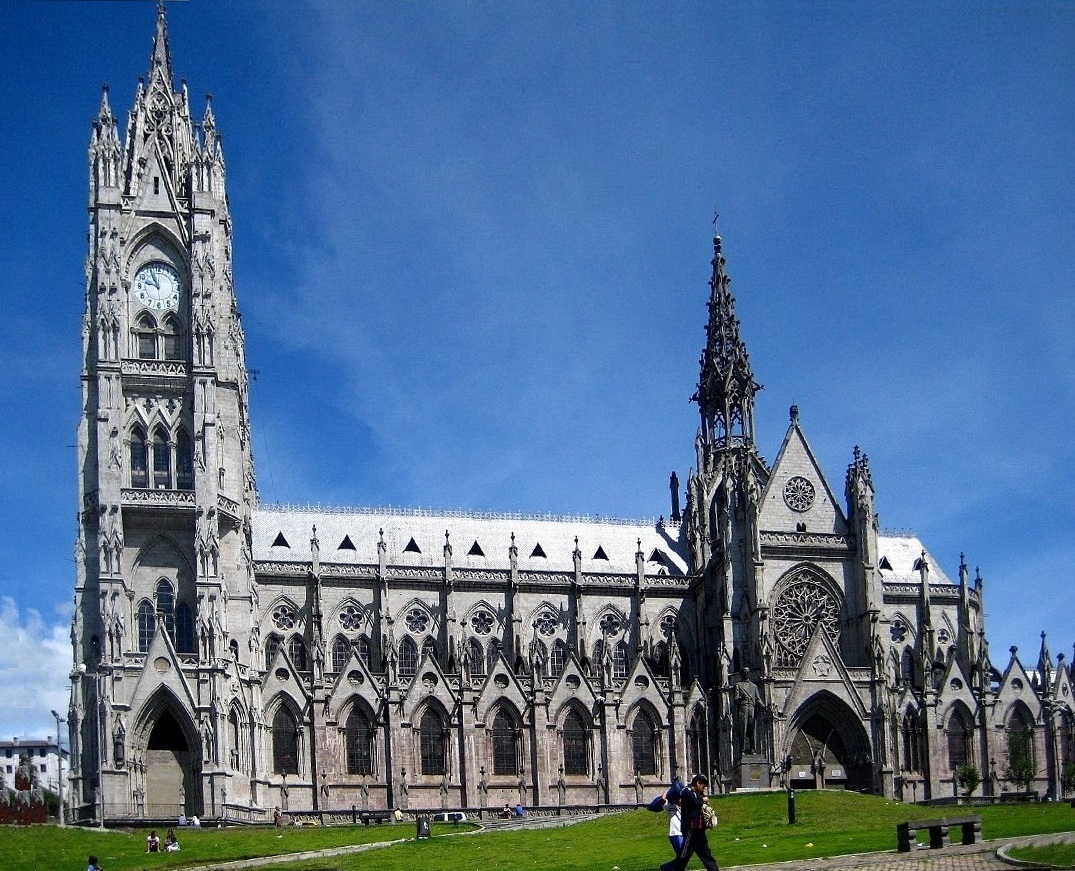
Basílica del Voto Nacional
0.2150° S · 78.5074° W · Church
Photo: Quito magnífico (shifted by Rabanus Flavus) · CC BY-SA 4.0 · Wikimedia Commons
Basílica del Voto Nacional is a church in Quito, Ecuador. Often called the largest neo-Gothic church in the Americas. The free Lokali audio guide runs 6 minutes.
✓ Published October 2026 · how we write these guides
Visitor facts
| Lokali audio guide | 6 min · free |
|---|---|
| Type | Church |
| Location | Quito Metro, Ecuador |
| Coordinates | -0.2150, -78.5074 |
| Official website | arquidiocesisdequito.com.ec |
| Languages | 50+, in the Lokali app |
The story
Tilt your head back. Grey stone rises in pointed arches, then keeps rising, until the towers seem to lean against the clouds that drift down from the mountains. The air up here is thin and cool. Somewhere above you, pigeons shift on narrow ledges. And if you look closely at the edges of the roof, you may notice that the creatures watching you are not quite the ones you expect.
Welcome to the Basílica del Voto Nacional, the Basilica of the National Vow, on the northern edge of Quito's historic centre. Its style is neo-Gothic. That means it was built in the nineteenth and twentieth centuries, but it borrows the language of medieval European cathedrals: pointed arches, flying buttresses, rose windows and tall spires. It is often described as the largest neo-Gothic church in the Americas. Standing beneath it, that claim is easy to believe.
The name holds the first part of the story. In the 1870s, under a deeply Catholic government, Ecuador was formally consecrated to the Sacred Heart of Jesus. The Sacred Heart is a devotion that focuses on Christ's love for humanity, and it was very popular in the Catholic world at that time. A great church would stand as the physical promise of that national dedication. This is the vow in the building's name, and the church is dedicated to the Sacred Heart.
The project moved slowly. Work began in the 1890s, and the design looked to France for inspiration. Visitors and guides often compare it to Notre-Dame in Paris and to the cathedral of Bourges, in central France. For decades the basilica grew stone by stone, through changes of government, shortages of money and long pauses. It was finally inaugurated in 1988, almost a century after construction started. Even then, it was not truly finished.
That unfinished state has created one of Quito's favourite stories. Locals say that the day the basilica is completed, the world will end. It is folklore, of course, told with a smile. But it explains why many people in the city seem quite comfortable with a few undecorated corners and a little scaffolding. Look around the exterior and you can still see surfaces that never received their final details.
Now, back to those creatures on the roof. In medieval Europe, gargoyles were often demons, dragons or grotesque faces. They carried rainwater away from the walls and reminded the faithful of evil outside the church. Here, the builders chose something different. The gargoyles show animals of Ecuador. Look for tortoises, iguanas, armadillos, monkeys and condors, the great vultures of the Andes. Many visitors walk right past them. Once you see them, the whole façade changes character.
This is the first surprise of the place. A building that copies European models still found a way to speak about its own country. The tortoises point to the Galápagos Islands, far out in the Pacific. The condor points to the high Andes around you. The armadillos and monkeys suggest the forests of the east. In a few stone figures, the basilica maps the landscapes of Ecuador onto a French design.
Step inside, and the temperature drops. The nave, the long central space of the church, stretches ahead under ribbed vaults. Light falls through tall stained-glass windows and colours the stone floor in patches of red, blue and gold. Sounds travel far here. A footstep or a cough rises into the vault and returns softly. Take a moment to stand still and let your eyes adjust before you walk forward.
The great rose window above the entrance deserves a long look. A rose window is a large circular window divided into petal-like sections, a classic feature of Gothic churches. Many visitors notice that some windows inside include plants and flowers from Ecuador, continuing the same local theme as the gargoyles outside. Study the glass slowly. The details are easy to miss when the light is strong and the space is crowded.
Here is the second surprise. Unlike many great churches, this one lets you climb high into its structure. With a separate ticket, visitors can go up through the towers. The route includes narrow stairs, steep metal ladders and, for the brave, a walkway that crosses above the roof of the nave. It is not for everyone. If you dislike heights, the lower viewpoints are still rewarding. Take your time, because the altitude in Quito makes every step feel heavier.
From the top, the city opens around you. Red-tiled roofs and church domes fill the old town below. To the south, on the hill called El Panecillo, you can usually see the large statue of the winged Virgin watching over the city. Beyond the streets, green mountain slopes rise on every side, and on clear days volcanic peaks may appear in the distance. Clouds move fast here, so the view can change within minutes.
Back at street level, notice how the basilica sits in its neighbourhood. Ordinary life continues around it. Buses pass, students hurry along the slopes, and small shops sell snacks and drinks. The streets climb and dip steeply, a reminder that Quito is built across the folds of a valley high in the Andes. The basilica does not stand apart from the city. It rises straight out of everyday Quito.
Before you leave, turn around one more time. Look up at the towers, the grey stone and the animals watching from the edges of the roof. A vow from the nineteenth century still stands here, unfinished, and still open to visitors who climb its stairs. As you walk downhill toward the old town, listen to the traffic and the voices around you... and glance back once more at the tortoises and condors.
Key facts
What to look for
Practical tips
Common questions
Is there a free audio guide to Basílica del Voto Nacional?
Yes — the Lokali app narrates Basílica del Voto Nacional free of charge in 50+ languages. The guide runs about 6 minutes, covers the history, what to look for on site and practical tips, and works offline once downloaded.
Where is Basílica del Voto Nacional?
Basílica del Voto Nacional is near Quito Metro, Ecuador, at -0.2150, -78.5074. Tap the map link on this page for directions from where you are.
What is Basílica del Voto Nacional known for?
Often called the largest neo-Gothic church in the Americas. Construction began in the 1890s and continued for decades.
What should you look for at Basílica del Voto Nacional?
Gargoyles shaped like Galápagos tortoises and iguanas. Andean condors carved along the upper edges. The large rose window above the main entrance.
What should you know before visiting Basílica del Voto Nacional?
Buy the separate tower ticket if you want to climb. Wear closed shoes with good grip for steep ladders.
When is the best time to visit Basílica del Voto Nacional?
Come on a clear morning for wider mountain views.
On the map
Opens directions to Basílica del Voto Nacional from your location.
More to see near Basílica del Voto Nacional

Hear Basílica del Voto Nacional in your language
The full story, narrated, in 50+ languages. Download it before you go and it plays offline, at your own pace, with no ticket and no tour group.