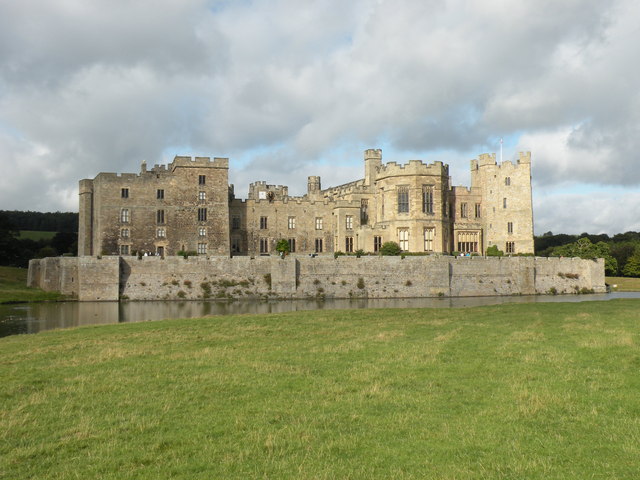
Photo: malcolm tebbit · CC BY-SA 2.0 · Wikimedia Commons
Raby Castle is a medieval castle in England. Most of the castle dates from the fourteenth century. The free Lokali audio guide runs 7 minutes.
✓ Published October 2026 · how we write these guides
Visitor facts
| Lokali audio guide | 7 min · free |
|---|---|
| Type | Museum |
| Location | Raby with Keverstone, United Kingdom |
| Coordinates | 54.5909, -1.8017 |
| Official website | rabycastle.com |
| Languages | 50+, in the Lokali app |
The story
Listen first. Out across the parkland, the grass is moving, and somewhere a deer is calling. The ground under your feet is soft and green. Ahead, grey stone rises in a cluster of towers above the water of a moat. It looks less like one building and more like a small walled town. That is the right first impression, and we will see why as we walk.
You are standing in County Durham, in the north-east of England, close to the village of Staindrop. This is Raby Castle. For centuries it was the seat of some of the most powerful families in the north. Today it is still a family home, as well as a place that visitors can explore. That double life matters. Raby is not a ruin, and it is not a museum frozen at one moment. People have lived here, changed it, and argued over it for more than six hundred years.
The castle we see today belongs mostly to the fourteenth century. It was built by the Nevills, a northern family whose name you will hear again and again in English history. Their wealth came from land, and their power came from the border. This part of England sat between the English crown and Scotland. A lord who held the north kept the frontier, so a castle like this was a statement of military strength as much as a home.
Look at the shape of the walls as you approach. There is no single great keep in the middle. Instead, there are several towers, each with its own character, linked together around courtyards. Some carry the names of people connected to the castle. One is called Clifford's Tower. Another is called Bulmer's Tower. Legend has it that Bulmer's Tower stands on much older foundations, linked to a figure from before the Norman Conquest. Treat that as a local tale rather than settled history.
There is an even older story. Locals say this land was once linked to Cnut, the Danish king who ruled England in the eleventh century. According to the tale, he held the estate here, near Staindrop. Historians treat the details with caution. Still, the idea shows how people have long felt about this place. It seemed old even to those who built the present castle.
Now for a story that surprises many visitors. In the late fourteenth century, a daughter was born into the Nevill family. Her name was Cecily. She later married Richard, Duke of York. Two of her sons became kings of England, Edward the Fourth and Richard the Third. She was known by a lovely nickname, the Rose of Raby. So the line of English kings in the Wars of the Roses — the long fight between two rival royal houses — runs straight through this quiet Durham park.
The Nevills did not keep Raby forever. In 1569, northern lords rose against Queen Elizabeth the First. They wanted to restore the old Catholic faith, and they hoped to free Mary, Queen of Scots. This revolt is known as the Rising of the North. Raby was at the centre of the planning. Tradition says that hundreds of knights gathered in the great hall here to plot. The rising failed. The Nevill earl fled abroad, and the family lost the castle to the crown.
That great hall is called the Barons' Hall. If you go inside, try to imagine it full of armed men, talking in low voices about rebellion. The number of knights who met here is often told in round, dramatic figures. That count belongs to tradition. What is certain is the scale of the room itself. It was built to hold a lord's whole household, his followers and his guests. It is a room designed to impress.
In the early seventeenth century, the castle was bought by Sir Henry Vane, a senior official at the court of King Charles the First. His family has held Raby ever since. Their story has its own drama. His son, also called Henry Vane, took Parliament's side in the English Civil War. After the monarchy returned, he was executed in 1662. Later generations of the family rose again, becoming Dukes of Cleveland and, after them, Lords Barnard.
Each generation left its mark. Inside, rooms were reshaped in the eighteenth and nineteenth centuries to suit new ideas of comfort and style. You can see the contrast clearly. Thick medieval walls hold rooms with fine plasterwork, rich colours and large paintings. One room, the Octagon Drawing Room, shows how far taste had travelled from the age of armour. Look for the moments where old stone meets newer decoration. Those joins show the life of the house.
Do not miss the kitchen, if it is open on your visit. It is one of the oldest parts of the castle. For centuries, this room fed a huge household, and the work here never really stopped. Stand still and look up at the height of the room. Kitchens were built tall for a practical reason. Heat and smoke from the open fires needed somewhere to go. It is a simple detail, but it brings the daily life of the castle very close.
Now turn back to the park. Herds of deer still graze across this land, both red deer and fallow deer. The red deer are larger, with deep reddish coats. The fallow deer are smaller, often spotted, with broad, flat antlers on the males. In autumn, the stags roar during the rut, the mating season. Keep a respectful distance at all times. Beyond the park lies a walled garden, sheltered from the northern wind, with its own quieter mood.
Before you leave, look once more at the towers above the moat. The light changes the stone quickly here. On a bright day it looks pale and almost soft. Under cloud it turns dark and severe. Rebels, kings' mothers, courtiers and generations of one family all lived with this same view. Now it is yours for a moment. As you walk away, listen again for the deer and the wind across the grass.
Key facts
What to look for
Practical tips
Common questions
Is there a free audio guide to Raby Castle?
Yes — the Lokali app narrates Raby Castle free of charge in 50+ languages. The guide runs about 7 minutes, covers the history, what to look for on site and practical tips, and works offline once downloaded.
Where is Raby Castle?
Raby Castle is near Raby with Keverstone, United Kingdom, at 54.5909, -1.8017. Tap the map link on this page for directions from where you are.
What is Raby Castle known for?
Most of the castle dates from the fourteenth century. Built by the Nevills, a powerful northern family.
What should you look for at Raby Castle?
Clusters of separate towers instead of one central keep. Bulmer's Tower and its distinct shape among the others. The tall roof of the medieval kitchen.
What should you know before visiting Raby Castle?
Walk the outside of the moat before going indoors. Bring binoculars to watch the deer from a distance.
When is the best time to visit Raby Castle?
Visit in autumn to hear red deer stags roar.
On the map
Opens directions to Raby Castle from your location.
More to see near Raby Castle


Hear Raby Castle in your language
The full story, narrated, in 50+ languages. Download it before you go and it plays offline, at your own pace, with no ticket and no tour group.