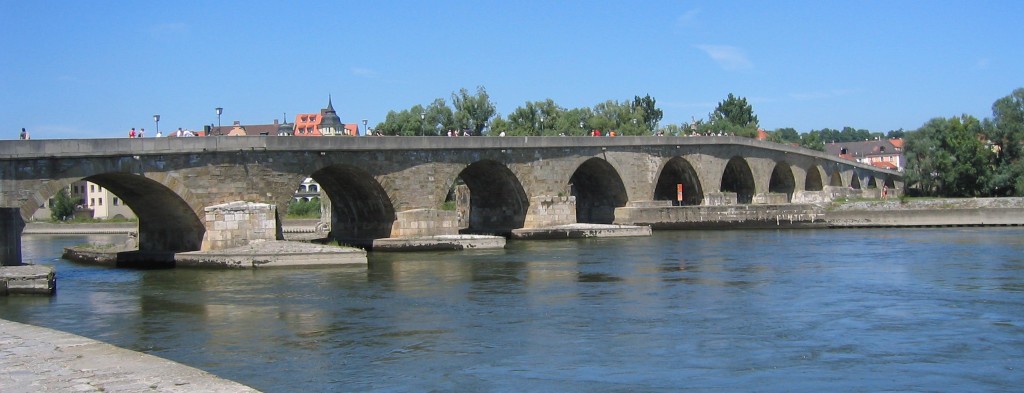
Photo: Hytrion at German Wikipedia · CC BY-SA 3.0 · Wikimedia Commons
Stone Bridge is a 12th-century bridge across the Danube in Regensburg, Germany. Built in the twelfth century, around the 1130s and 1140s. The free Lokali audio guide runs 6 minutes.
✓ Published October 2026 · how we write these guides
Visitor facts
| Lokali audio guide | 6 min · free |
|---|---|
| Type | Bridge |
| Location | Regensburg, Germany |
| Coordinates | 49.0218, 12.0973 |
| Languages | 50+, in the Lokali app |
The story
Listen first. Beneath your feet, the Danube pushes hard against the stone. It rushes around the thick piers of the bridge with a steady, rough sound, more like a mountain stream than a slow river. Look down over the low parapet and you will see the water fold and swirl. This bridge was built to stand in that current, and it has stood there for close to nine hundred years.
This is the Stone Bridge of Regensburg. Locals call it the Steinerne Brücke. It was built in the twelfth century, and the work is generally dated to roughly the 1130s and 1140s. At that time, a bridge made entirely of stone across a river this wide was rare in Central Europe. Most crossings were wooden, and floods or ice often carried them away. This one did not go away.
Take a moment to count the arches. The bridge was built with sixteen of them. Some sit low and close to the water, and the span runs for roughly three hundred metres from the old town to the far bank. Look closely and you will notice that the arches are not all the same width. The medieval builders worked with the riverbed as they found it. The result is a slightly uneven rhythm, and that unevenness is part of its character.
Now look at the base of each pier. Each one sits on a broad, pointed platform of stone that splits the current. These protective islands kept the foundations safe. They also narrowed the river so much that the water speeds up between them. For centuries, boatmen feared this stretch of the Danube. Passing under the bridge took skill, nerve, and sometimes extra help from people on the shore.
Why build such a structure here? In the twelfth century, Regensburg was one of the most important cities in the German lands. It sat on trade routes that linked Western Europe with the East. Merchants moved salt, cloth, wine, and luxury goods through this city. A permanent crossing made Regensburg richer and more powerful. For a long time, it was the only fixed crossing of the Danube for a great distance in either direction.
The bridge also carried soldiers and pilgrims. Crusading armies gathered in Regensburg in the twelfth century, and the city served as a starting point for the journey east. Historians associate the bridge with the departure of crusaders on these routes. So the stones under your feet may have carried knights and their horses on their way toward Constantinople and the Holy Land.
Now, a story that every child in Regensburg knows. Legend has it that the master builder of the bridge made a bet with the master builder of the cathedral. Each claimed he would finish first. The bridge builder fell behind, so the tale says he made a pact with the devil. In return for help, the devil would receive the first three souls to cross the finished bridge.
According to the legend, the builder was clever. When the bridge was complete, he did not send three people across. He sent a rooster, a hen, and a dog. The devil was furious. Locals say he tried to destroy the bridge in his anger, and that this explains the slight hump in its line. It is a tale, not history, but it is told with great affection here.
As you walk, look for a small stone figure on the bridge. People call him the Bruckmandl, which means the little bridge man. He sits high on a pillar, shading his eyes and looking toward the cathedral. Many locals link him to the old rivalry between the two builders. The figure you see today is a later copy, and earlier versions have been replaced over the centuries.
At the old town end, a tall tower guards the entrance. This is the bridge tower, once part of the city defences. Its gateway controlled who came in and who paid to cross. Beside it stands the long Salzstadel, a large salt warehouse with a steep roof. Salt was one of the most valuable goods in medieval trade. This building shows how close the bridge was to the wealth of the city.
Here is something many visitors miss. Just below the bridge, near the riverbank, there is a small sausage kitchen with smoke rising from its chimney. It is known as the Historic Sausage Kitchen. It claims a very long history at this spot, serving workers who built and maintained the bridge and the quay. You may smell grilled sausages and sweet mustard before you see the low building.
For most of its life, the bridge carried every kind of traffic. Carts, then cars, then buses all crossed here. In the early twenty-first century, the city closed it to motor traffic to protect the old stone. A long restoration followed, and damaged blocks were carefully repaired or replaced. Today it is a place for people on foot and on bicycles. It feels calmer than it has for a very long time.
The bridge is also part of a larger story. In 2006, the old town of Regensburg and the district of Stadtamhof across the river became a UNESCO World Heritage Site. The bridge links these two parts together. Stand near the middle and turn slowly. Behind you, you will see the twin spires of the cathedral rising above red roofs. In front, the smaller, quieter streets of Stadtamhof.
Before you move on, stay still for one more minute. Rest your hand on the parapet and feel how rough and cool the stone is. Listen again to the water working against the piers, the same sound people heard here in the twelfth century. When you walk away, look back once. Notice how low and steady the bridge sits on the river, as if it has always been part of it.
Key facts
What to look for
Practical tips
Common questions
Is there a free audio guide to Stone Bridge?
Yes — the Lokali app narrates Stone Bridge free of charge in 50+ languages. The guide runs about 6 minutes, covers the history, what to look for on site and practical tips, and works offline once downloaded.
Where is Stone Bridge?
Stone Bridge is in Regensburg, Germany, at 49.0218, 12.0973. Tap the map link on this page for directions from where you are.
What is Stone Bridge known for?
Built in the twelfth century, around the 1130s and 1140s. Originally designed with sixteen stone arches across the Danube.
What should you look for at Stone Bridge?
The Bruckmandl figure shading his eyes toward the cathedral. Pointed stone platforms protecting the base of each pier. Fast swirling water rushing between the narrow arches.
What should you know before visiting Stone Bridge?
Walk the full length to reach the quieter Stadtamhof district. Stand mid-bridge for the clearest view of the cathedral spires.
When is the best time to visit Stone Bridge?
Visit early morning for fewer people on the walkway.
On the map
Opens directions to Stone Bridge from your location.
More to see in Regensburg


Hear Stone Bridge in your language
The full story, narrated, in 50+ languages. Download it before you go and it plays offline, at your own pace, with no ticket and no tour group.