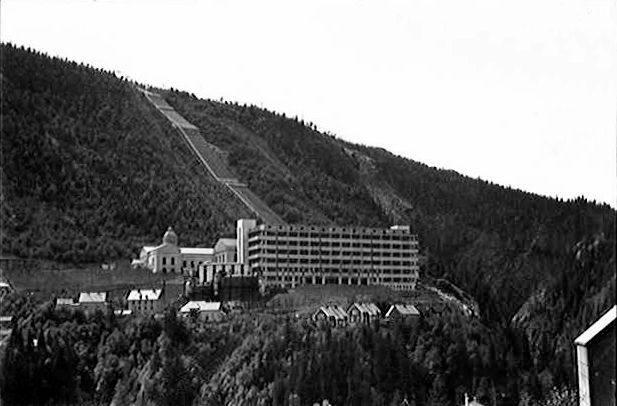
Photo: Anders Beer Wilse · Public domain · Wikimedia Commons
Vemork is a hydroelectric power station and museum in Tinn, Norway. Vemork power station opened in 1911 for Norsk Hydro. The free Lokali audio guide runs 7 minutes.
✓ Published October 2026 · how we write these guides
Visitor facts
| Lokali audio guide | 7 min · free |
|---|---|
| Type | Monument |
| Location | Rjukan, Norway |
| Coordinates | 59.8717, 8.4944 |
| Official website | nia.no |
| Languages | 50+, in the Lokali app |
The story
Listen first. Below you, deep in the gorge, water is moving. You can hear it before you see it, a steady roar rising off the rock. The air here is cool, even in summer, and it smells of wet stone and pine. On the far side of the chasm stands a long building of grey stone, with tall arched windows and a roofline that looks almost like a castle. This is Vemork. A power station built to make electricity, and later the target of one of the most famous acts of sabotage in the Second World War.
Before the war, before the spies and the skiers, there was water. The river Måna drops steeply through this valley on its way from Lake Møs toward Lake Tinn. For centuries it fell over a great waterfall called Rjukanfossen, the smoking waterfall, named for the spray that hung above it like smoke. In the early twentieth century, engineers saw that falling water as a source of enormous power. They decided to capture it.
The men behind the idea were the industrialist Sam Eyde and the physicist Kristian Birkeland. Together they founded the company Norsk Hydro in 1905. Birkeland had developed a way to use a powerful electric arc to pull nitrogen from the air. That nitrogen could then become artificial fertiliser, and the world needed fertiliser to grow more food. The process used huge amounts of electricity. So the company needed a power station on a scale few people had ever attempted.
Vemork opened in 1911. At the time, it was described as the largest hydroelectric power station in the world. Look up the hillside behind it and you will see the heavy pipes, called penstocks, running down the slope. They carried water from high above and dropped it onto the turbines inside. The town of Rjukan, further down the valley, grew almost overnight to house the workers. Houses, schools, and shops appeared in a place that had been farmland and forest.
Now, a small surprise. In the 1930s, a separate plant beside the power station began producing something unusual — heavy water. This is water in which ordinary hydrogen is replaced by a heavier form called deuterium. It looks and tastes like normal water. But scientists had discovered that heavy water could help control a nuclear chain reaction. Vemork was one of very few places on Earth that could make it in useful quantities, because it had so much cheap electricity.
In 1940, Germany invaded Norway, and Vemork came under German control. The Allies feared that Nazi scientists might use the heavy water in research toward an atomic weapon. From London, British planners and the Norwegian government in exile began to think about how to stop production. It would not be easy. The plant sat on a ledge above a deep gorge, reached by a single suspension bridge, and it was guarded.
The first attempt ended in tragedy. In late 1942, a small advance team of Norwegian commandos was parachuted onto the high, frozen plateau above the valley. They waited there, in brutal cold, for British soldiers to arrive by glider. That mission was called Operation Freshman. The gliders crashed in bad weather. Several men died in the crashes, and the German forces executed the survivors who were captured. The Norwegians on the plateau survived the winter by hunting and eating what they could find.
Then came a second plan, called Operation Gunnerside. In February 1943, more Norwegian commandos joined the team already waiting in the mountains. Their leader was a young man named Joachim Rønneberg. On a winter night, they skied toward Vemork. Instead of crossing the guarded bridge, they made a choice that still amazes people. They climbed down into the gorge below you, crossed the frozen river, and climbed up the steep rock on the other side.
From there, they followed a railway line toward the plant and slipped inside. They placed explosive charges on the equipment used to make heavy water. The charges went off, and the saboteurs escaped into the snow. Not a single shot was fired, and no one was killed during the raid. Many of the men then skied hundreds of kilometres across the mountains, some all the way to Sweden. The German search afterward was large, but it did not catch them.
The story did not end that night. Production was repaired, and later in 1943 American bombers attacked the area. Then, in early 1944, the Germans tried to ship the remaining heavy water to Germany. Norwegian resistance fighters sank the ferry carrying it on Lake Tinn. That act also took the lives of Norwegian civilians on board. It is a hard part of the history, and locals still remember it with sadness rather than celebration.
After the war, the story became famous around the world. It inspired books, a Hollywood film in the 1960s called The Heroes of Telemark, and later a Norwegian television series. The heavy water building itself no longer stands. It was demolished in the 1970s. But the old power station survived, and today it houses the Norwegian Industrial Workers Museum. Inside, you can see the machine hall and learn about both the sabotage and the everyday lives of the people who worked here.
It is worth remembering that Vemork is about more than one dramatic night. In 2015, the industrial landscape of Rjukan and nearby Notodden was added to the UNESCO World Heritage list. It was recognised for showing how hydroelectric power helped build a new industrial society. The railway, the ferries, the workers' housing, and this power station all form one connected story. It is a story of electricity, fertiliser, and ordinary families who moved into a narrow mountain valley.
Before you go, take one more look at the gorge. Picture it in winter, black water under ice, snow on every ledge, and a handful of men climbing in the dark. Then look back at the stone building, its windows catching the light. As you walk away, listen again to the water below. It is the same river that once turned the turbines here. It is still running, as it was long before anyone came to this valley.
Key facts
What to look for
Practical tips
Common questions
Is there a free audio guide to Vemork?
Yes — the Lokali app narrates Vemork free of charge in 50+ languages. The guide runs about 7 minutes, covers the history, what to look for on site and practical tips, and works offline once downloaded.
Where is Vemork?
Vemork is near Rjukan, Norway, at 59.8717, 8.4944. Tap the map link on this page for directions from where you are.
What is Vemork known for?
Vemork power station opened in 1911 for Norsk Hydro. Once described as the world's largest hydroelectric power station.
What should you look for at Vemork?
Heavy penstock pipes running down the hillside behind the station. Tall arched windows along the grey stone facade. The deep gorge the saboteurs climbed down and up.
What should you know before visiting Vemork?
Wear sturdy shoes for the walk and slopes around the site. Bring a warm layer, the gorge air stays cool.
On the map
Opens directions to Vemork from your location.
Hear Vemork in your language
The full story, narrated, in 50+ languages. Download it before you go and it plays offline, at your own pace, with no ticket and no tour group.