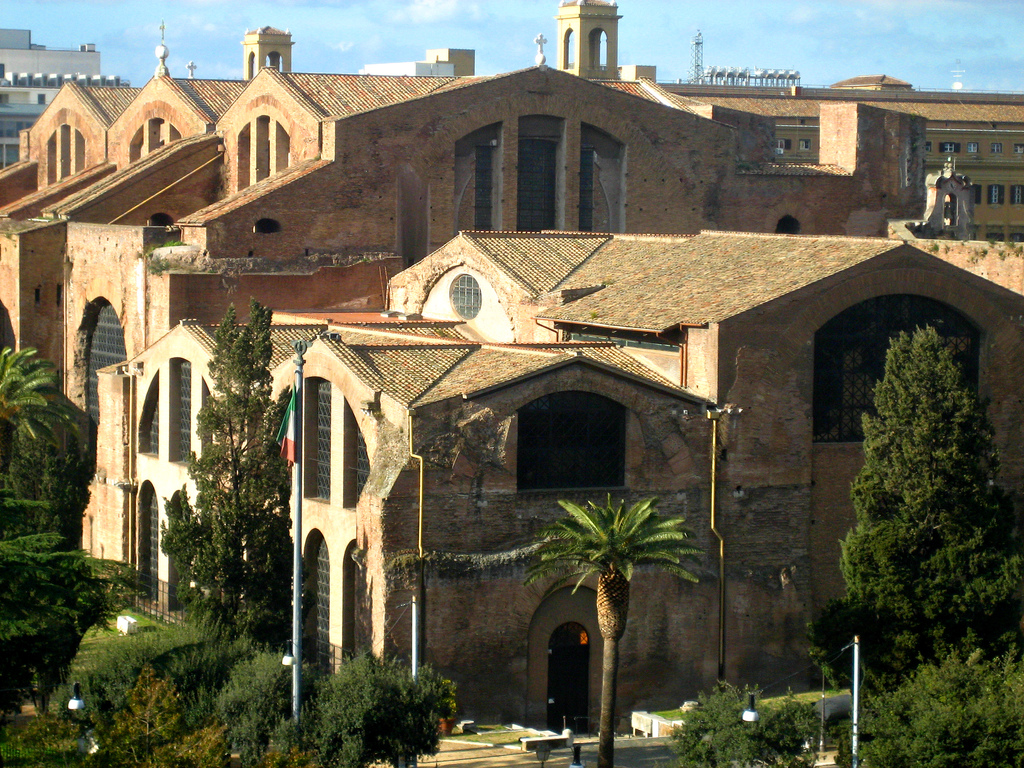
Baths of Diocletian
41.9028° N · 12.4983° E · Archaeological Site
Photo: Wikimedia Commons contributor · CC BY 2.0 · Wikimedia Commons
Baths of Diocletian is an ancient Roman bath, a landmark of Rome, Italy. Built in the late 290s, dedicated around 305 or 306. The free Lokali audio guide runs 7 minutes.
✓ Published October 2026 · how we write these guides
Visitor facts
| Lokali audio guide | 7 min · free |
|---|---|
| Type | Archaeological Site |
| Location | Rome, Italy |
| Coordinates | 41.9028, 12.4983 |
| Languages | 50+, in the Lokali app |
The story
Stand still for a moment and listen. Buses rumble around the square, and water splashes in a fountain nearby. Look up at the walls in front of you. They are rough, pitted brick, the colour of dry clay, with gaps where marble once hung. Seventeen centuries ago, this brick sat behind polished stone, and the air inside smelled of steam, oil and wet skin. You are standing at the edge of the largest bathing complex ancient Rome ever built.
The Baths of Diocletian rose at the very end of the third century and the start of the fourth. Building began in the late 290s, during the reign of the emperor Diocletian. His co-emperor Maximian oversaw much of the work, and the complex was dedicated around 305 or 306. By then, Diocletian had done something almost no Roman emperor did. He had stepped down from power voluntarily, and he retired to his palace on the Adriatic coast. He may never have bathed here at all.
The scale is hard to picture from street level. The complex covered roughly thirteen hectares, an area larger than many modern city blocks combined. Ancient sources and modern estimates suggest it could hold around three thousand bathers at once. There were hot rooms, warm rooms and a vast cold pool. There were gardens, libraries, lecture halls and exercise yards. For ordinary Romans, this was not a luxury spa. It was a daily public space, open to almost everyone, where people washed, talked, did business and passed the afternoon.
A bath of this size needed an enormous supply of water. Most historians link it to the Aqua Marcia, one of the oldest aqueducts serving the city. Water arrived from the hills, collected in large cisterns, and then moved through the building. Below the floors, furnaces heated air that flowed through hollow spaces under the pavement and inside the walls. Slaves fed those fires constantly. The heat in the hottest rooms was strong enough that bathers wore wooden sandals to protect their feet.
Here is the first surprise. Look at the square around you, Piazza della Repubblica. Notice how the buildings curve in a perfect half circle, with long arcades at street level. That curve is not a modern design choice. It follows the line of the great exedra of the baths — a semicircular wall that once closed one side of the complex. Romans still often call this square Piazza Esedra. The ancient building still shapes how traffic moves here today.
And here is a second one. The main railway station of Rome, just a short walk east, is called Termini. Many people assume the name means 'the end of the line'. The more common explanation is different. It comes from 'thermae', the Latin word for public baths, because the station stands near these ruins. Every traveller who arrives in Rome by train passes, in name at least, through Diocletian's baths.
After the empire fell, the baths slowly died. In the sixth century, invaders cut the aqueducts that supplied Rome, and the water stopped. Without water, the furnaces had no purpose. Over the following centuries, people stripped the marble, carried away the columns and burned decorative stone to make lime. The great vaults survived mainly because they were too big and too solid to pull down easily. Gardens, vineyards and small dwellings filled the spaces between the walls.
The next chapter begins with a vision. According to a popular story, a Sicilian priest dreamed of angels rising from these ruins. He spent years urging the Church to build a sanctuary here. Tradition also says that Christians forced into labour helped to construct the baths, and that this place should honour them. That part is legend rather than documented history. But it gave the later church its name: Santa Maria degli Angeli e dei Martiri, Saint Mary of the Angels and the Martyrs.
In the 1560s, Pope Pius the Fourth gave the commission to Michelangelo, then in the last years of his long life. His solution was remarkably restrained. He did not tear the ancient building down. Instead, he used the great central hall of the baths as the body of the church, keeping its soaring cross vaults. Walk through the plain entrance and the space opens up suddenly above you. In the eighteenth century, the architect Luigi Vanvitelli reworked the interior and added much of the decoration you see now.
Inside, look for the huge granite columns. Some of them are original to the baths, still standing where Roman builders placed them. Then look down at the floor. A long bronze line runs diagonally across the marble. This is a meridian line, installed in 1702 by the astronomer Francesco Bianchini. At solar noon, a beam of sunlight falls through a small hole in the wall and lands on the line. For many years, this light helped to set the clocks of Rome.
Next to the church, another part of the complex became a Carthusian monastery — a community of monks who lived in silence. Its large cloister, with long arcades around a garden, is traditionally linked to Michelangelo's design, although historians debate how much is really his. Today these spaces belong to the National Roman Museum. Inside, you can walk among ancient inscriptions carved in stone, grave markers and public notices, with the quiet garden at the centre.
Not every surviving piece sits inside the church or the museum. A domed octagonal hall from the baths survives nearby and has been used for exhibitions. Elsewhere in the surrounding streets, fragments of the ancient walls appear in unexpected places — in a building facade, along a side street, behind a modern fence. As you walk, look for stretches of the same reddish brick. Once you notice them, you begin to see the outline of a building far larger than any single ruin.
Take one more look at the brick facade of the church before you leave. It is not a facade in the usual sense. It is the bare inside of an ancient wall, left open where a Roman room once stood. Behind you, the fountain keeps running, and the cars keep circling the old curve of the exedra. The baths lost their water fifteen centuries ago — but the city still flows around their shape, every single day.
Key facts
What to look for
Practical tips
Common questions
Is there a free audio guide to Baths of Diocletian?
Yes — the Lokali app narrates Baths of Diocletian free of charge in 50+ languages. The guide runs about 7 minutes, covers the history, what to look for on site and practical tips, and works offline once downloaded.
Where is Baths of Diocletian?
Baths of Diocletian is in Rome, Italy, at 41.9028, 12.4983. Tap the map link on this page for directions from where you are.
What is Baths of Diocletian known for?
Built in the late 290s, dedicated around 305 or 306. Largest public baths ever built in ancient Rome.
What should you look for at Baths of Diocletian?
Rough ancient brick wall forming the church facade. Bronze meridian line running diagonally across the floor. Original Roman granite columns inside the basilica.
What should you know before visiting Baths of Diocletian?
Visit the church first, then the museum and cloister. Arrive near solar noon to watch the meridian line.
On the map
Opens directions to Baths of Diocletian from your location.
More to see in Rome


Hear Baths of Diocletian in your language
The full story, narrated, in 50+ languages. Download it before you go and it plays offline, at your own pace, with no ticket and no tour group.