Photo: Mark Miller (talk) · Public domain · Wikimedia Commons
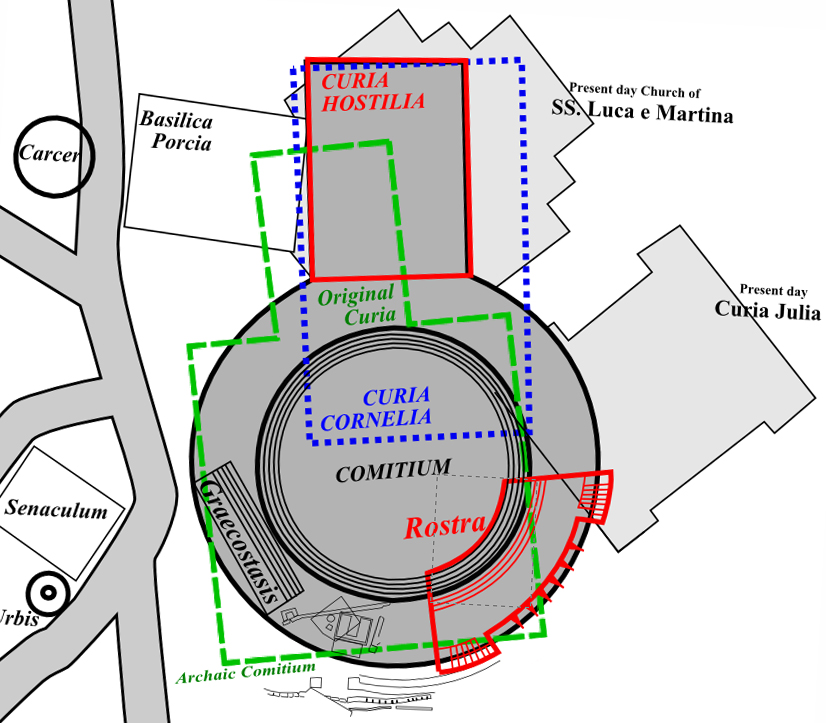
Comitium is an original open-air public meeting space of Ancient Rome. The Comitium was the Roman Republic's main open-air assembly space. The free Lokali audio guide runs 7 minutes.
✓ Published October 2026 · how we write these guides
Visitor facts
| Lokali audio guide | 7 min · free |
|---|---|
| Type | Archaeological Site |
| Location | Rome, Italy |
| Coordinates | 41.8928, 12.4850 |
| Languages | 50+, in the Lokali app |
The story
Stand still for a moment and look down. Beneath your feet, the ground of the Roman Forum is a patchwork of worn grey paving, scattered brick, and grass growing between old stones. Somewhere close by, a gull calls from the top of a column. The air smells of dust and warm travertine. This open, uneven patch in the northwest corner of the Forum does not look like much at first. But for centuries, this was where the Roman people came to argue, to vote, and to listen.
This is the Comitium. The name comes from a Latin phrase meaning, roughly, the place where people come together. Long before Rome had an emperor, before it ruled the Mediterranean, this was its political heart. Citizens gathered here in organised assemblies. Magistrates spoke to them. Laws were announced. If the Forum was the city's living room, the Comitium was the room where the family made its decisions — loudly, and in public.
What survives today is fragmentary. You will not find a grand amphitheatre or a clear outline. The Comitium was rebuilt and reshaped many times over the centuries. Archaeologists still debate its exact form in different periods. Some evidence suggests a stepped space where people could stand and face the speakers. Other phases look quite different. So as you stand here, it helps to imagine layers, one city stacked on top of another, rather than a single moment frozen in stone.
The building that anchors this corner is the tall brick structure with the plain, flat facade. That is the Curia, the meeting house of the Roman Senate. Tradition says an early senate house here was founded by Tullus Hostilius, one of Rome's legendary kings — but that story belongs to legend more than documented history. The building you see now is a later reconstruction. It dates to the reign of the emperor Diocletian, after a fire in the late third century.
Here is the first surprise. The Curia survived when so much around it fell, and it survived because it became a church. In the seventh century, the building was converted into the Church of Sant'Adriano. Its walls stayed in use, and so they stayed standing. In the 1930s, restorers stripped away the church additions and returned the building to something close to its ancient shape. That is why its brickwork looks so complete compared with the ruins nearby.
Now look at the great bronze doors of the Curia. They look ancient, and they look right. But they are copies. The original Roman doors were moved in the seventeenth century to the Basilica of Saint John Lateran, across the city, where they still hang today. The architect Borromini adapted them for their new home. So the doors in front of you are a faithful stand-in. The real ones have spent more than three hundred years guarding a church.
Between the Curia and the speakers' area, the senators and the people stood close together. This closeness mattered. The Senate met inside, behind walls. The assemblies met outside, under the open sky. Politics in the Republic moved back and forth across this small space. A senator could step out of the Curia and, within a few paces, be standing before a crowd. Decisions made in private quickly became arguments in public.
The speakers addressed that crowd from a raised platform called the Rostra. The name has a striking origin. In 338 BCE, Rome defeated the coastal town of Antium in a naval battle. The Romans took the bronze rams from the prows of the enemy ships and fixed them to the speakers' platform as trophies. In Latin, those rams were called rostra. Even today, in many languages, a rostrum means a place to speak from.
The Rostra did not stay in one place. Julius Caesar reorganised this whole corner of the Forum in the last years of the Republic. He moved the speakers' platform and began a new senate house, which Augustus completed after Caesar's death. Many historians see these changes as symbolic. The old open space of popular assembly shrank, while the power of one man grew. The ground itself shifted to fit a new kind of Rome.
Now look for a small fenced area near the Arch of Septimius Severus, the large triumphal arch close by. Inside, you may see a patch of dark stone paving. This is the Lapis Niger, which simply means the black stone. Romans themselves treated this spot as sacred and mysterious. Ancient writers linked it to an ill-omened place, and some said it marked the tomb of Romulus, the city's founder. That is legend, not proven fact — but it shows how old this spot already felt to the Romans.
Here is the second surprise. In 1899, the archaeologist Giacomo Boni excavated beneath the black stone. He found an archaic shrine and a stone pillar carved with an inscription. It is among the oldest known Latin texts, usually dated to around the sixth century BCE. The lines run back and forth, changing direction like a farmer ploughing a field. The text is damaged and hard to read. But scholars generally agree that one word refers to a king.
Think about what that means. When you stand here, you are near a place where Romans were writing laws or sacred rules while kings still ruled the city. Centuries later, Cicero and Caesar walked over this same ground. Later still, emperors held processions past it. Pilgrims came to pray in Sant'Adriano. Today, visitors with phones and water bottles drift through. The Comitium has never been empty for long. Only the reasons for coming here have changed.
Before you move on, take one more look around. Notice the brick of the Curia warming in the light, the dark patch of the black stone, the broken columns and paving stones spread toward the rest of the Forum. Listen to the voices of other visitors — dozens of languages, all mixing together. In a quiet way, that is fitting. This was always a place of many voices. As you walk away, you are crossing ground where Rome first learned to argue with itself.
Key facts
What to look for
Practical tips
Common questions
Is there a free audio guide to Comitium?
Yes — the Lokali app narrates Comitium free of charge in 50+ languages. The guide runs about 7 minutes, covers the history, what to look for on site and practical tips, and works offline once downloaded.
Where is Comitium?
Comitium is in Rome, Italy, at 41.8928, 12.4850. Tap the map link on this page for directions from where you are.
What is Comitium known for?
The Comitium was the Roman Republic's main open-air assembly space. The Rostra took its name from captured warship rams.
What should you look for at Comitium?
The Curia's plain brick facade and tall flat front. Bronze Curia doors, replicas of the originals. Dark paving of the Lapis Niger behind its fence.
What should you know before visiting Comitium?
Visit as part of the Roman Forum archaeological area. Look inside the Curia when its doors are open.
On the map
Opens directions to Comitium from your location.
More to see in Rome


Hear Comitium in your language
The full story, narrated, in 50+ languages. Download it before you go and it plays offline, at your own pace, with no ticket and no tour group.