Villa of Livia
42.0021° N · 12.4936° E · Archaeological Site
Photo: Unknown authorUnknown author · Public domain · Wikimedia Commons
Villa of Livia is a building in Prima Porta, Italy. It is in Rome, Italy. Villa belonged to Livia, wife of Emperor Augustus. The free Lokali audio guide runs 6 minutes.
✓ Published October 2026 · how we write these guides
Visitor facts
| Lokali audio guide | 6 min · free |
|---|---|
| Type | Archaeological Site |
| Location | Rome, Italy |
| Coordinates | 42.0021, 12.4936 |
| Languages | 50+, in the Lokali app |
The story
Listen first. Out here on the northern edge of Rome, the noise of the city thins out. You hear wind in dry grass, a few birds, and the distant hum of traffic on the old road below. Underfoot, the ground is uneven, with soft earth, broken brick, and the low stubs of ancient walls. This hilltop looks quiet today. Two thousand years ago it belonged to one of the most powerful women in the Roman world.
This is the Villa of Livia, at a place now called Prima Porta. Livia Drusilla was the wife of Augustus, the first Roman emperor. She was his partner for more than fifty years, and she was the mother of Tiberius, who ruled after him. Rome is full of the public buildings of that family. This site gives you something rarer: a country house, a private place where the imperial family came to rest.
The Romans had a charming name for this estate. They called it Ad Gallinas Albas, which means "at the white hens." The name comes from a story that ancient writers liked to tell. According to the tale, an eagle flew over Livia, soon after her marriage, and dropped a white hen into her lap. In its beak, the hen held a small branch of laurel.
The story continues, and it gets stranger. Livia was told to keep the hen and plant the laurel. The hen raised many chicks, and the laurel grew into a whole grove. Later emperors are said to have cut sprigs from this grove for their victory wreaths. Then, the legend says, the grove withered and the hens died out just before the death of Nero, the last emperor of the family. True or not, it shows how Romans linked this hill to the fate of the dynasty.
Now look at the setting. The villa sits on a ridge above the Via Flaminia, one of the great roads that ran north out of ancient Rome. Below, the Tiber valley opens out. On a clear day you can understand why a wealthy Roman family chose this spot. There is height, there is a breeze in summer, and there is a long view down towards the city, close enough to reach, far enough to escape.
What you see around you is mostly foundations. The walls stand low, often only knee or waist height. You can trace rooms, corridors, and the edges of courtyards. Look closely at the building methods. The Romans often faced their concrete walls with small, regular stones or bricks. In many places you can still see neat patterns in the facing, laid by hand by builders who never imagined anyone would study their work.
Here is the first surprise. One of the most famous statues of ancient Rome was found on this site. In 1863, excavators uncovered a marble statue of Augustus, standing with one arm raised, as if speaking to his troops. His breastplate is covered in carved scenes. Today it is called the Augustus of Prima Porta, after this very place. You will not see it here. It now stands in the Vatican Museums, but it was buried on this hill for centuries.
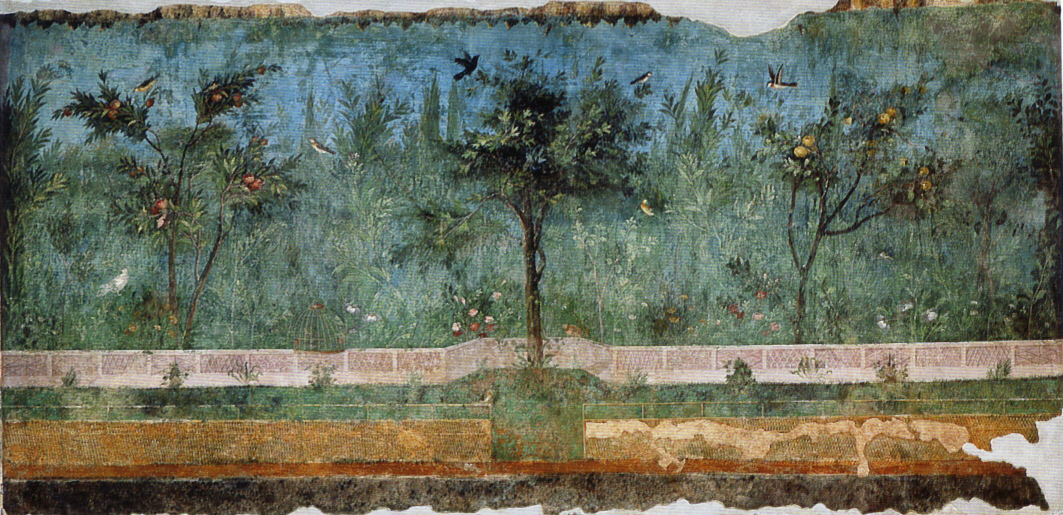
The second surprise was found under the ground. Archaeologists discovered a room that was partly sunk below the level of the house. Its walls were covered with a painted garden. It was not a garden with people or gods, just plants and birds. The painting runs all the way around the room, so a guest inside would feel surrounded by greenery. Many scholars believe the room was built below ground to stay cool in the heat of summer.
The details of that painting are remarkable. There are fruit trees heavy with pomegranates and quinces. There are pines, palms, and flowering shrubs. Small birds perch on branches or fly across a soft blue sky. In the foreground runs a low fence, like the edge of a real garden. The artists painted plants that bloom in different seasons all together, so the garden is always in fruit and always in flower.
In the twentieth century, the frescoes were in danger from damp, so they were carefully detached from the walls. The painted garden now lives in Rome, in the Palazzo Massimo, part of the National Roman Museum. There, the room has been rebuilt so you can stand inside it, much as Livia's guests once did. If you have time on this trip, visiting both places makes the story complete: the empty site here, and the colour there.
It is worth thinking about what this house meant. Augustus liked to present himself and his family as modest, close to old Roman values. A country villa with hens, laurel, and a painted orchard fits that image well. Yet this was also a family that controlled an empire. The quiet garden and the marble statue in armour come from the same hill. Together, they show two sides of the same power.
This landscape kept its importance long after Livia. The area along the Via Flaminia, just north of here, saw armies pass and battles fought in later centuries. Excavation on the villa itself has continued over the years, and archaeologists still study how its rooms, terraces, and gardens fitted together. Parts of the site may be covered or fenced as work goes on. What you see today is a site still being understood, not a finished story.
Before you leave, take a moment where the view is widest. Look down towards the road and the river, and then back at the low walls beside you. Imagine those walls rising, painted inside, with a cool garden room below your feet. Listen again for the birds. They are not painted ones, but they are still here. As you walk back down the hill, you carry the hens, the laurel, and Livia's garden with you.
Key facts
What to look for
Practical tips
Common questions
Is there a free audio guide to Villa of Livia?
Yes — the Lokali app narrates Villa of Livia free of charge in 50+ languages. The guide runs about 6 minutes, covers the history, what to look for on site and practical tips, and works offline once downloaded.
Where is Villa of Livia?
Villa of Livia is in Rome, Italy, at 42.0021, 12.4936. Tap the map link on this page for directions from where you are.
What is Villa of Livia known for?
Villa belonged to Livia, wife of Emperor Augustus. Ancient name Ad Gallinas Albas means at the white hens.
What should you look for at Villa of Livia?
Low wall stubs that trace the outline of rooms. Small regular stones or bricks facing the concrete walls. The sunken area where the painted garden room once stood.
What should you know before visiting Villa of Livia?
Check access in advance, as opening days here are limited. Wear sturdy shoes for uneven ground and loose earth.
When is the best time to visit Villa of Livia?
Check access in advance, as opening days here are limited.
On the map
Opens directions to Villa of Livia from your location.
More to see in Rome


Hear Villa of Livia in your language
The full story, narrated, in 50+ languages. Download it before you go and it plays offline, at your own pace, with no ticket and no tour group.