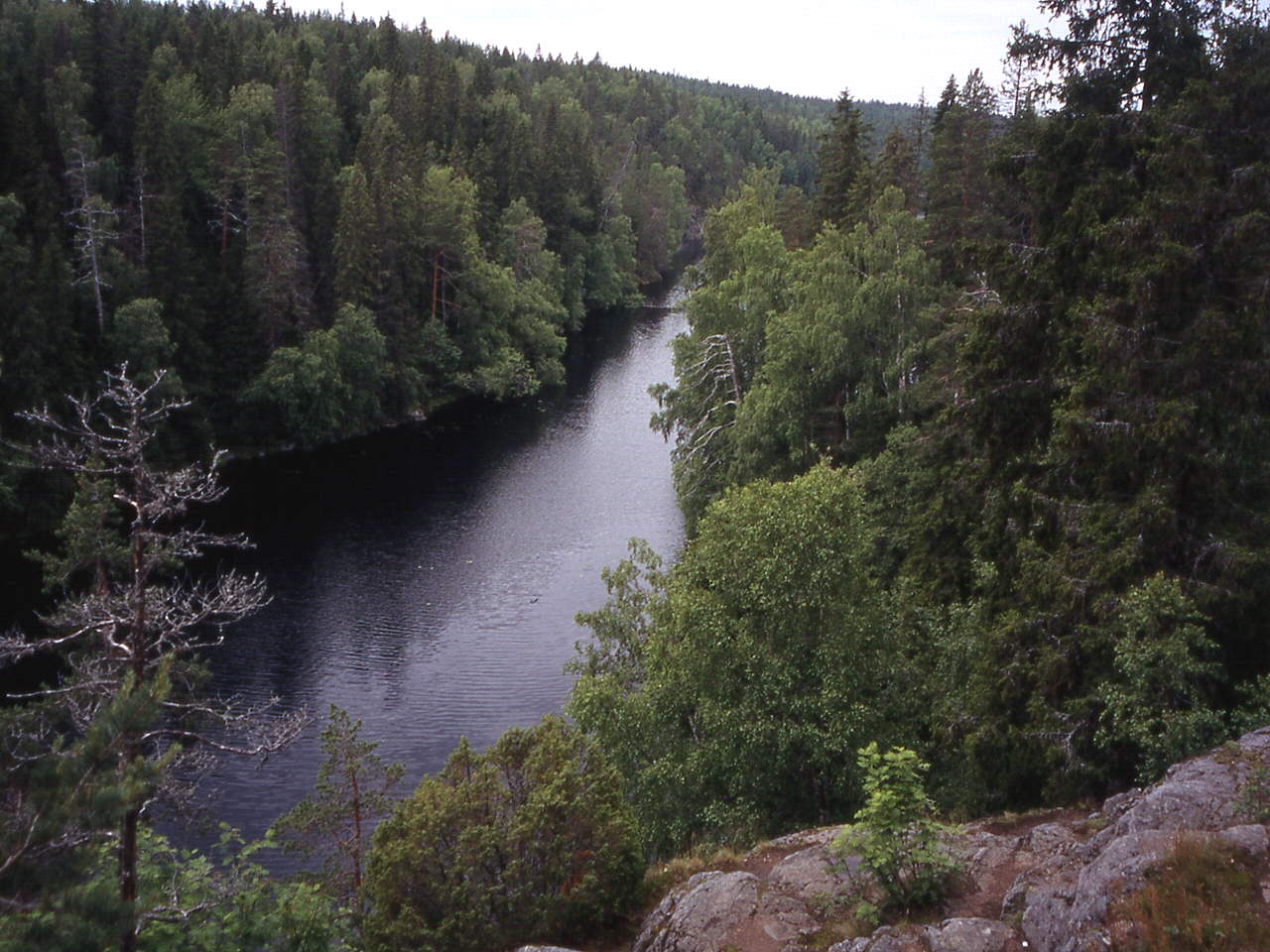
Helvetinjärvi National Park
62.0333° N · 23.8500° E · National Park
Photo: The original uploader was Steffen M. at German Wikipedia. · CC BY-SA 3.0 · Wikimedia Commons
Helvetinjärvi National Park is a national park in Ruovesi, Finland. Helvetinjärvi translates literally from Finnish as Hell's Lake. The free Lokali audio guide runs 7 minutes.
✓ Published October 2026 · how we write these guides
Visitor facts
| Lokali audio guide | 7 min · free |
|---|---|
| Type | National Park |
| Location | Ruovesi, Finland |
| Coordinates | 62.0333, 23.8500 |
| Official website | luontoon.fi |
| Languages | 50+, in the Lokali app |
The story
Listen first. Under your boots there is a soft layer of pine needles and moss. Under that, close to the surface, is hard grey rock. The air smells of resin and damp lichen. Somewhere ahead, water lies still in a long, dark lake. You are standing in Helvetinjärvi National Park, in the forested heart of Finland, a short drive from the small lakeside municipality of Ruovesi.
Let us start with the name, because it tends to stop people. Helvetinjärvi means, quite literally, Hell's Lake. It sounds dramatic for such a quiet place. Locals say the name came from how harsh this terrain felt to the people who once had to cross it. Steep cliffs, narrow rock passages and deep forest made travel slow and difficult. To a farmer leading a horse through here, this was not scenery... it was hard work.
The park was established in 1982. It covers roughly fifty square kilometres of forest, lakes and rocky ground in the region of Pirkanmaa, in western Finland. That is small compared with the large wilderness parks of Lapland. But size is not the point here. The value of this place is in its shape — the way the land rises and splits and falls away into water.
To understand that shape, imagine the bedrock under Finland as very old and very hard. Over an immense span of time, the crust cracked along lines of weakness. Later, during the Ice Age, thick sheets of ice moved across the land and scraped those cracks deeper. When the ice melted, water filled the long, narrow hollows. The result is what you see around you: slim lakes lying in rock valleys, with steep walls on either side.
The most famous of these breaks in the rock is Helvetinkolu, which translates as Hell's Gorge, or Hell's Cleft. It is a narrow fissure in the cliff, deep and shadowed, with a passage that takes you down toward the lake below. Many visitors come to the park only to see this one spot. And when you reach it, you will understand why. The rock walls close in, the light drops, and the temperature seems to fall a few degrees.
Here is something many visitors miss. The cleft is cool even on a warm summer day, because sunlight barely reaches the bottom. Moss and ferns grow thickly on the shaded stone. In spring, patches of snow and ice can survive down there long after the forest above has dried. So if you visit early in the season, look down before you step. The ground can stay slippery well after the rest of the trail feels safe.
Now lift your eyes to the trees. Much of the park is covered by coniferous forest, mostly pine and spruce. In some areas the forest has been left to grow older, with fallen trunks slowly rotting into the ground. That dead wood is not a sign of neglect. It is food and shelter for insects, fungi and the birds that hunt them. A forest that looks untidy is often a forest that is working well.
The animals here are usually shy, so you will hear more than you see. Listen for the knock of a woodpecker on a dead trunk. Watch the edges of clearings for tracks in soft ground. Large mammals such as elk live in the forests of this region, though a sighting is never guaranteed. In the evening, the lakes go very quiet, and sound travels far across the water.
The park is managed by Metsähallitus, the Finnish state agency that looks after national parks and other protected areas. Marked trails lead from the main parking areas toward the gorge and around several of the lakes. Along the routes you will find campfire sites and simple lean-to shelters. A lean-to is an open wooden shelter with three walls and a sloping roof, built so hikers can rest, cook and even sleep beside a fire.
This is where you meet one of Finland's quiet habits. Finns treat time in the forest as something ordinary and necessary, not as a special event. Families come here with sausages to grill over a fire, or a flask of coffee and a bag of buns. There is also a long tradition in Finland called everyman's right. In simple terms, it allows people to walk freely in nature and pick wild berries and mushrooms, as long as they cause no damage. Rules for camping and fires are stricter inside a national park, so follow the local signs.
Ruovesi itself has a place in Finnish culture. In the 1890s, the painter Akseli Gallen-Kallela built a wilderness studio in the Ruovesi area. He was one of the artists who shaped the visual identity of Finland at the time, drawing on the national epic, the Kalevala, and on landscapes like this one. Stand at the edge of a cliff here, looking down at dark water between the pines, and you can see the kind of world that inspired that generation.
The lakes change with the light. On a calm morning, the water holds a clear mirror of the cliffs and trees. Under cloud, it turns almost black, which may have helped the grim name to stick. In autumn, birch and aspen leaves turn yellow and orange against the dark spruce. In winter, the whole park becomes white and still, and the lakes freeze over. Each season gives the same rocks a different character.
If you walk the longer trails, pace yourself. The ground rises and falls often, and roots and stones cross the path. This is not a park of flat boardwalks. It asks a little effort in return for its views. The reward comes in small moments — a sudden gap in the trees, a ledge above the water, the sound of wind moving through the tops of the pines.
Before you move on, pause where you are. Feel the cool rock, or the soft moss beside the path. Notice how few human sounds there are. This land was cut by ice and named by people who found it hard. Today it is protected so that it can stay hard, rough and quiet. As you walk away, listen for the moment the forest closes behind you again.
Key facts
What to look for
Practical tips
Common questions
Is there a free audio guide to Helvetinjärvi National Park?
Yes — the Lokali app narrates Helvetinjärvi National Park free of charge in 50+ languages. The guide runs about 7 minutes, covers the history, what to look for on site and practical tips, and works offline once downloaded.
Where is Helvetinjärvi National Park?
Helvetinjärvi National Park is in Ruovesi, Finland, at 62.0333, 23.8500. Tap the map link on this page for directions from where you are.
What is Helvetinjärvi National Park known for?
Helvetinjärvi translates literally from Finnish as Hell's Lake. The national park was established in 1982.
What should you look for at Helvetinjärvi National Park?
Thick moss and ferns on the shaded walls of the gorge. Long, narrow lakes lying between steep rock walls. Fallen trunks slowly rotting into the forest floor.
What should you know before visiting Helvetinjärvi National Park?
Wear sturdy shoes with grip for rocks and roots. Take extra care in the gorge, where ice lingers.
When is the best time to visit Helvetinjärvi National Park?
Carry insect repellent for summer walks near the lakes.
On the map
Opens directions to Helvetinjärvi National Park from your location.
Hear Helvetinjärvi National Park in your language
The full story, narrated, in 50+ languages. Download it before you go and it plays offline, at your own pace, with no ticket and no tour group.