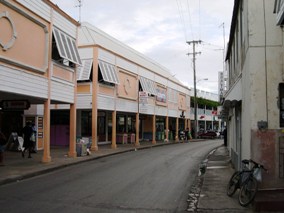
Speightstown Historic Town Centre
13.2310° N · 59.6430° W · Neighborhood
Speightstown Historic Town Centre is a neighborhood in Saint Peter, BB. Speightstown's compact waterfront district preserves 17th- and 18th-century colonial architecture along narrow streets lined with restored timber and stone buildings. Most visitors spend 1–2 hours here. The free Lokali audio guide runs 5 minutes.
✓ Verified August 2026 · how we write these guides
Visitor facts
| Time needed | 1–2 hours |
|---|---|
| Lokali audio guide | 5 min · free |
| Type | Neighborhood |
| Best for | Local life |
| Location | Saint Peter, BB |
| Coordinates | 13.2310, -59.6430 |
| Languages | 45, in the Lokali app |
The story
Morning light lands on painted shopfronts, pink, cream, and sea green. Fishing boats swing at anchor a stone's throw from the main street. Somewhere a radio plays, and the smell of the sea mixes with wood smoke and baking. This is Speightstown, the second town of Barbados, and it wakes up slowly.
The town sits on the island's northwest coast, where the water is calm and the reef lies close. It was founded in the 1630s, in the first years of English settlement, on land that belonged to William Speight. He was a member of the island's earliest Assembly, and his name has outlived almost everything else about him.
For its first two centuries, this was a serious port. Sugar from the plantations of the north was rolled down to the wharves here and loaded onto ships bound for England. So much of that trade ran to one city, Bristol, that people called the town Little Bristol. Money moved through these streets, and the buildings still show it.
A port full of sugar needed defending. Small forts once stood along this shore, their guns facing the sea against raiders and rival fleets. The forts are mostly gone now, absorbed by the town they protected. Here and there, an old cannon survives as a marker of that watchful age.
Walk Queen Street and look up. The shop houses here are two storeys of stone and timber, and many carry wooden galleries that overhang the pavement, held up on posts. Owners lived above and traded below. The style came from Britain and was adjusted for heat, rain, and hurricanes, and it survives here better than almost anywhere on the island.
A block from the shops stands St. Peter's Parish Church, the town's anchor since the first years of settlement. Its Georgian stone body dates from 1837, after hurricanes took its predecessors, and its churchyard holds the town's merchants and mariners. Church, market, wharf, and main street sit within a few minutes' walk. The whole anatomy of a colonial port town, complete and compact.
The paint peels in places, and not every building stands straight. That is part of the truth of Speightstown. This is a working town, not a restored stage set. Hardware stores, rum shops, and salons occupy buildings that are two and three hundred years old, and daily life gives the old walls their purpose.
For the fuller story, find Arlington House. It is a restored townhouse of the eighteenth century, tall and white, three floors once home to a merchant family. Today it is a museum. Its exhibits move floor by floor, from the life of the town, to the plantations inland, to the wharf and the sea trade that paid for it all.
That trade had a foundation, and honesty requires naming it. The sugar that made Speightstown rich was grown and processed by enslaved African people, generation after generation, on the plantations behind this coast. Their labor built the wharves and the fine houses. Their descendants are the town today. Keep that in mind as you admire the architecture.
Down on the waterfront, the fish market is the town's daily theater. Boats come in through the afternoon, and the catch is cleaned and sold within sight of the water it came from. Flying fish, mahi mahi, snapper. Buy something to eat nearby, or just stand back and watch the work.
Give the side streets a few minutes too. Vendors sell fruit from trays, and conversations run long across doorways. If you stop to ask a question, expect a real answer, and possibly a story with it. The pace of the north is different, and people here have time in a way the resort coast does not.
Why did all this survive, when so many old towns were rebuilt into blandness? Partly because commerce moved elsewhere. Bridgetown and the south coast drew the banks, the malls, and the crowds, and Speightstown was left alone with its bones. Neglect, for once, worked as preservation. The town kept its shape because nobody was in a hurry to change it.
End your walk on the Esplanade, the small seafront promenade near the center of town. A wooden jetty runs out over clear water. Benches face west, which is the right direction here, because sunset is the town's nightly event. Fishermen cast lines from the jetty as the light goes gold. Stay for that sunset if you can. The shopfronts turn amber, the sea flattens to glass, and the town settles into evening the way it has for close to four hundred years. Speightstown does not perform for visitors. It simply continues. That, more than anything, is what you came to see.
Key facts
What to look for
Practical tips
Common questions
How long do you need at Speightstown Historic Town Centre?
Plan 1–2 hours. That is the time most visitors spend at Speightstown Historic Town Centre. The free Lokali audio guide adds about 5 minutes of narration you can listen to as you walk, so it fits inside your visit rather than adding to it.
Is there a free audio guide to Speightstown Historic Town Centre?
Yes — the Lokali app narrates Speightstown Historic Town Centre free of charge in 50+ languages. It covers the history, what to look for on site and practical tips, and it works offline once downloaded.
Where is Speightstown Historic Town Centre?
Speightstown Historic Town Centre is in Saint Peter, BB, at 13.2310, -59.6430. Tap the map link on this page for directions from where you are.
What should you know before visiting Speightstown Historic Town Centre?
Visit the museum first for the town's full story.
What is Speightstown Historic Town Centre known for?
Barbados's second town, founded in the 1630s.
What is the best time to visit Speightstown Historic Town Centre?
Walk the streets early morning or late afternoon when cruise-ship crowds thin.
On the map
Opens directions to Speightstown Historic Town Centre from your location.
More to see in Saint Peter

Hear Speightstown Historic Town Centre in your language
The full story, narrated, in 50+ languages. Download it before you go and it plays offline, at your own pace, with no ticket and no tour group.