Photo: No machine-readable author provided. Urban~commonswiki assumed (based on copyright claims) · CC BY-SA 3.0 · Wikimedia Commons
Hearst Castle is a National Historic Landmark and California Historical Landmark located on the Central Coast of California, United States. Architect Julia Morgan worked on the estate for nearly three decades. The free Lokali audio guide runs 7 minutes.
✓ Published October 2026 · how we write these guides
Visitor facts
| Lokali audio guide | 7 min · free |
|---|---|
| Type | Memorial |
| Location | San Luis Obispo County, United States |
| Coordinates | 35.6853, -121.1678 |
| Official website | hearstcastle.org |
| Languages | 50+, in the Lokali app |
The story
Listen first. Up here, the wind comes off the Pacific and moves through cypress and oak. Somewhere below, cattle graze on hills that turn gold in summer and green after the winter rains. The air smells of salt, dry grass and warm stone. Then you turn a corner, and two pale towers rise above the slope. Carved wood, painted tile and white walls catch the coastal light. You have arrived at the place its owner called La Cuesta Encantada, the Enchanted Hill.
The owner was William Randolph Hearst, the newspaper publisher who built one of the largest media empires in American history. His family had owned ranch land along this stretch of the San Simeon coast since the nineteenth century. As a boy, Hearst came up this hill on camping trips with his family. The family slept in tents and looked out over the ocean. Years later, when the land passed to him, he decided to build something more permanent on the same spot.
Here is the first surprise. Hearst almost never called this place a castle. To him, it was simply the ranch. The word castle came later, from visitors and the press, who could not find a smaller word for what they saw. The estate is a cluster of buildings: the main house, three guest houses, terraces, gardens and pools, all linked by stairways and paths. It feels less like a single palace and more like a small hilltop town.
The person who turned Hearst's ideas into buildings was Julia Morgan. She was one of the first women to study architecture at the École des Beaux-Arts in Paris, a famous school of art and design. She became the first woman licensed as an architect in California. Morgan worked on this hill for close to three decades, starting around 1919. She travelled up the coast again and again to manage the work, and she oversaw almost every detail.
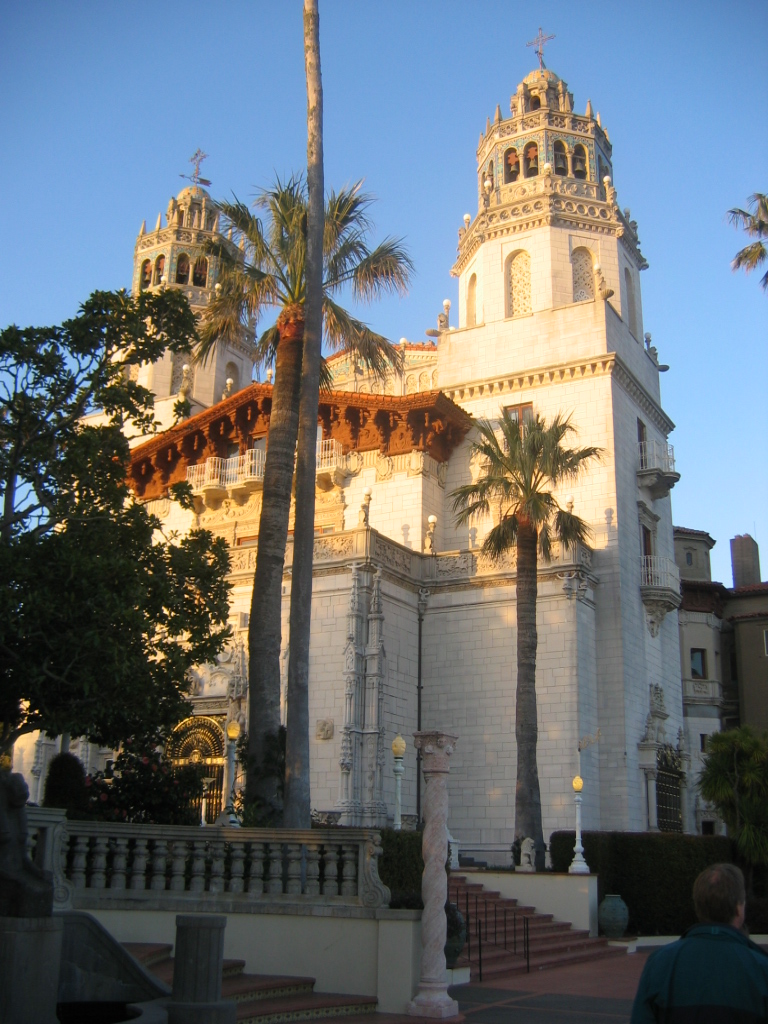
Look at the main house, Casa Grande, the Spanish name for big house. Its twin bell towers draw on the churches of southern Spain. But the structure behind that old-world face is modern. Morgan built in reinforced concrete, a material that could resist California's earthquakes. Onto this concrete frame, she and her crews attached ceilings, doorways, choir stalls and fireplaces. Many of these pieces came from old buildings in Europe. So the building is new in its bones and centuries old on its surface.
Hearst collected on a scale that is hard to imagine. He bought tapestries, ancient Greek vases, Spanish ceilings, Italian sculpture and whole rooms of carved panelling. Crates arrived by ship at the small harbour of San Simeon below. Mule teams and trucks then carried them up the winding road. Many objects waited for years in storage before Morgan found a place for them. Some never found a place at all. Hearst kept changing his mind. Rooms were built, torn out and built again.
This is the second surprise. In all those years, the estate was never truly finished. Construction continued, with pauses, from the late 1910s until 1947. In that year, Hearst's failing health forced him to leave the hill for good. Scaffolding and unfinished wings remained. As you walk, notice the places where the decoration stops, or where a wall looks plainer than its neighbours. These are traces of plans that were never completed.
Now picture the evenings here in the 1920s and 1930s. Hearst invited politicians, writers and many stars from Hollywood. The actress Marion Davies, Hearst's long-time companion, often acted as hostess. Guests gathered in the Refectory, a long dining hall lined with carved wooden choir stalls. Silk banners from the Palio, the historic horse race of Siena in Italy, hang from the ceiling. Yet on the long table sat ordinary bottles of ketchup and jars of mustard. Hearst liked a ranch-style informality, even among treasures.
Outside, the Neptune Pool sits on the edge of the hill and faces the sea. White marble frames water of a deep, clear blue. Behind it stands the front of a Roman-style temple. Hearst had the pool enlarged and rebuilt more than once over the years. Indoors, the Roman Pool feels completely different. Small glass tiles in blue and gold cover the walls, floor and ceiling. On a dim day, the room glows like the inside of a jewel box.
The estate once had another kind of guest. Hearst kept a private zoo and let animals roam the hills, including bison, deer and zebras. Most of the zoo is gone today. But keep watching the pastures on the drive along Highway 1 below. Zebras still graze among the cattle. They are descendants of Hearst's original herd, and they surprise many drivers who do not know the story.
After Hearst died in 1951, his family and the Hearst Corporation considered the future of the hill. Running such a place privately was not practical. In the late 1950s, the estate was given to the State of California. It opened to the public as a state historical monument, and California State Parks still cares for it. The furniture, art and gardens stay much as the Hearst years left them. Because of this, you see a home, not a museum built from scratch.
The gardens deserve slow attention. Morgan and Hearst planned terraces with citrus trees, roses and palms, along with statues and fountains placed at the ends of paths. Many walkways frame a view on purpose. One frames a tower, another a statue, another the blue line of the Pacific far below. Hearst liked to see the ocean, the mountains and his own ranch land all at once. From here, on a clear day, the land seems to roll away in every direction.
The estate also became part of American culture in another way. Many people saw the 1941 film Citizen Kane as a portrait of Hearst. In the film, the newspaper owner builds a vast, lonely palace called Xanadu. Hearst's newspapers fought the film hard. Today, standing among the guest houses and the laughter of tour groups, the place feels far less lonely than the film suggests. It was built for guests, for noise and for long dinners.
Before you leave, stand still for a moment on one of the terraces. Feel the sun on the stone and the wind from the sea. Listen to the footsteps on the stairs, the murmur of other visitors and the call of a hawk over the hills. As your bus winds back down toward the coast, look back once. The two towers will catch the light. Somewhere in the pastures beside the road, a zebra might lift its head.
Key facts
What to look for
Practical tips
Common questions
Is there a free audio guide to Hearst Castle?
Yes — the Lokali app narrates Hearst Castle free of charge in 50+ languages. The guide runs about 7 minutes, covers the history, what to look for on site and practical tips, and works offline once downloaded.
Where is Hearst Castle?
Hearst Castle is near San Luis Obispo County, United States, at 35.6853, -121.1678. Tap the map link on this page for directions from where you are.
What is Hearst Castle known for?
Architect Julia Morgan worked on the estate for nearly three decades. Hearst called the estate the ranch, not a castle.
What should you look for at Hearst Castle?
Twin bell towers on the front of Casa Grande. Siena Palio banners hanging in the Refectory. Ketchup and mustard bottles on the long dining table.
What should you know before visiting Hearst Castle?
Reserve your tour ahead, especially on weekends and holidays. Wear comfortable shoes for many stairs and steep paths.
On the map
Opens directions to Hearst Castle from your location.
Hear Hearst Castle in your language
The full story, narrated, in 50+ languages. Download it before you go and it plays offline, at your own pace, with no ticket and no tour group.