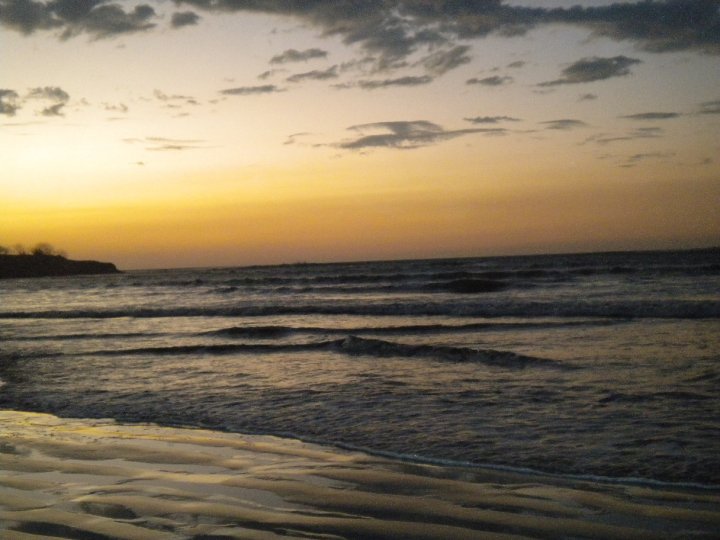
Tamarindo Beach is a long sandy crescent backed by palms and lined with beach bars, Tamarindo is Costa Rica's most developed Pacific beach town. It is in Santa Cruz, Costa Rica. Most visitors spend 2–4 hours here. The free Lokali audio guide runs 5 minutes.
✓ Verified August 2026 · how we write these guides
Visitor facts
| Time needed | 2–4 hours |
|---|---|
| Lokali audio guide | 5 min · free |
| Type | Beach |
| Best for | Photography |
| Location | Santa Cruz, Costa Rica |
| Coordinates | 10.2958, -85.8393 |
| Languages | 45, in the Lokali app |
The story
The first thing you notice is the sound. Waves fold onto the sand in a slow, steady rhythm. Behind you, music drifts from the open-air bars along the street. The air is warm and salty on your skin. Tamarindo Beach faces west, straight into the Pacific Ocean. The water stretches out to a wide, flat horizon. For many people, this is the first beach they ever see in Costa Rica.
The beach sits on the Nicoya Peninsula, in the province of Guanacaste. It belongs to the district of Santa Cruz. The Guanacaste International Airport lies about one hour away by road. The road from the airport runs through dry, golden hills dotted with low trees. In the dry season the land turns brown and dusty. In the green season the rains return, and the hills come alive again. You can land in the morning and have your feet in this sand by lunch.
It was not always this busy. For most of its life, Tamarindo was a small fishing village. Only a few families lived here. They depended on the sea for food and for work. Their boats went out in the early morning and came back with the day's catch. The pace of life was slow, quiet, and local.
Change began in 1985. A businessman from Texas named Russell Wenrich bought land in the village. He started to build small cabanas near the beach. Bit by bit, the idea of Tamarindo as a place worth visiting began to take shape. Few people then could have guessed how far it would go.
Around 1990, Wenrich met a surfer named Robert August. August was already known to surfers. He had starred in a famous surfing film from 1966 called The Endless Summer. He moved to Tamarindo. The bond between this beach and the sport of surfing grew tighter.
Then came the film that changed everything. In 1994, a sequel was released. It was called The Endless Summer Two. The movie opened with scenes filmed right here on this shore. People all over the world saw these waves on the screen. Many of them decided to come and ride them. The quiet village began to fill with visitors.
Today Tamarindo is one of the centers of surfing in Costa Rica. The waves here suit almost every level of skill. Beginners take their first lessons in the gentle white water close to the shore. Stronger surfers paddle further out, where the waves rise higher. Surf schools and board rentals line the edge of the sand. The water stays warm all year, so you do not need a thick wetsuit. Most people surf in just shorts or a light shirt. That comfort is one more reason beginners feel at ease here.
The sea still feeds the town, though in a new way. Tamarindo is known for sport fishing. Captains take small boats out past the bay in search of large fish. The old link between the village and the ocean has never really broken. It has only changed its shape over time.
Walk along the beach and you feel the sand shift under your feet. Near the water it is firm, dark, and cool. Higher up it turns soft, pale, and dry. Pelicans glide low over the waves in long, single lines. Small crabs dart sideways into their holes as your shadow passes over them.
The west-facing shore gives Tamarindo its most loved moment of the day. Each evening the sun sinks slowly toward the ocean. The sky turns gold, then orange, then a deep pink. People stop walking. They turn their bodies to face the water. For a few minutes, the whole beach falls quiet together.
At the north end of the beach, the sand meets a wide estuary. Mangrove trees grow there in still, brown water. The estuary separates Tamarindo from the next beach, called Playa Grande. It also marks the edge of a protected national park, where sea turtles come ashore to nest.
Look closely and you can read the town's whole story from this one beach. The fishing boats still rest on the water. The surfers still wait for the next set of waves. The visitors still gather for the evening light. Three different worlds share the same stretch of sand.
Tamarindo holds two lives at once. One is the old fishing village, small and calm. The other is the lively beach town of today. Stand at the waterline as the light fades, and you can feel them both. The ocean that once fed a handful of families is the same ocean that draws the whole world now.
Key facts
What to look for
Practical tips
Common questions
How long do you need at Tamarindo Beach?
Plan 2–4 hours. That is the time most visitors spend at Tamarindo Beach. The free Lokali audio guide adds about 5 minutes of narration you can listen to as you walk, so it fits inside your visit rather than adding to it.
Is there a free audio guide to Tamarindo Beach?
Yes — the Lokali app narrates Tamarindo Beach free of charge in 50+ languages. It covers the history, what to look for on site and practical tips, and it works offline once downloaded.
Where is Tamarindo Beach?
Tamarindo Beach is in Santa Cruz, Costa Rica, at 10.2958, -85.8393. Tap the map link on this page for directions from where you are.
What should you know before visiting Tamarindo Beach?
Arrive before sunset to watch the western sky change.
What is Tamarindo Beach known for?
Russell Wenrich bought village land here in 1985.
What is the best time to visit Tamarindo Beach?
Arrive at sunrise to see the beach quiet and golden before the restaurants open.
On the map
Opens directions to Tamarindo Beach from your location.
More to see in Santa Cruz

Hear Tamarindo Beach in your language
The full story, narrated, in 50+ languages. Download it before you go and it plays offline, at your own pace, with no ticket and no tour group.