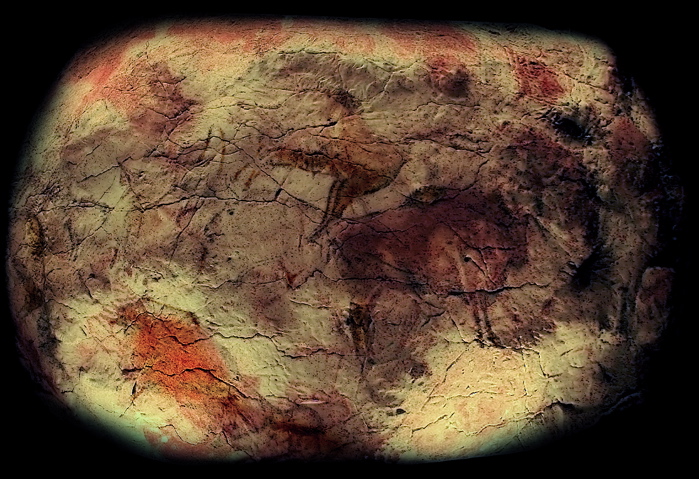
Cave of Altamira
43.3769° N · 4.1197° W · Archaeological Site
Photo: José-Manuel Benito · Public domain · Wikimedia Commons
Cave of Altamira is a cave with prehistoric paintings in Spain. A local hunter found the cave entrance in the late 1860s. The free Lokali audio guide runs 6 minutes.
✓ Published October 2026 · how we write these guides
Visitor facts
| Lokali audio guide | 6 min · free |
|---|---|
| Type | Archaeological Site |
| Location | Santillana del Mar, Spain |
| Coordinates | 43.3769, -4.1197 |
| Languages | 50+, in the Lokali app |
The story
Listen for a moment. Up here on the green hillside above Santillana del Mar, the air carries cut grass, damp earth, and sometimes a breath of salt from the Cantabrian coast. Cows graze in the fields nearby. Somewhere beneath your feet, though, the ground changes. Inside the limestone there is a cool, still darkness. In that darkness, people painted animals so well that, centuries later, experts refused to believe them.
This is the Cave of Altamira, in the region of Cantabria in northern Spain. The name means something like 'high view', and the hill gives one. From here the land rolls toward the sea in soft green folds. The cave itself is not a vast cathedral of rock. It is a fairly modest passage of a few hundred metres. Yet it holds some of the finest painting to survive from the last Ice Age.
The story of its discovery begins quietly. In the late 1860s, a local hunter found an opening in the hillside. Most accounts say his dog had become trapped among the rocks. A landowner and amateur scholar, Marcelino Sanz de Sautuola, later began to explore the cave. At first he looked at the floor, searching for bones and stone tools. He did not think to look up.
That changed in 1879. Sautuola brought his young daughter, María, who was about eight years old. According to the family story, she wandered into a low side chamber while her father worked. She raised her lamp, looked at the ceiling, and called out that there were oxen painted there. They were not oxen. They were bison — dozens of them — in red, black and ochre, spread across the rock above her head.
Here is the first surprise. Sautuola published his findings in 1880, and the scientific world largely mocked him. Many leading experts said the paintings were too skilled, too fresh, too alive to be prehistoric. Some suggested they were a modern forgery. Sautuola died in 1888, still not believed. His reputation stayed under a cloud for years after his death.
The tide turned only after similar painted caves were found in southern France. In 1902, the French prehistorian Émile Cartailhac, one of the early sceptics, published an article admitting his mistake. Its title translates roughly as 'Mea culpa of a sceptic'. Mea culpa is Latin for 'my fault'. It was a public apology, and a rare one in science. Altamira became, at last, the proof that Ice Age people made real art.
So what did they paint? The heart of the cave is a chamber often called the Polychrome Ceiling. Polychrome simply means 'many colours'. Here, bison stand, lie curled, and turn their heads. There are horses, deer, and a large female deer stretching across the rock. The artists used red ochre, an iron-rich earth pigment, and black from charcoal or manganese. They worked by the flicker of animal-fat lamps.
And now the second surprise. The painters did not treat the ceiling as a flat canvas. They chose natural bulges and swellings in the rock. Then they painted bison onto them, so the stone itself gives the animals their rounded bellies and heavy shoulders. In moving firelight, those shapes would have seemed to breathe. Some of the curled bison follow the curve of a single boulder almost exactly.
The paintings were not made in a single season. People returned to this cave over thousands of years. The famous bison belong to the later part of the Ice Age. But scientific dating has shown that some simpler red marks here are far older — more than 35,000 years old. A rockfall eventually sealed the entrance, roughly thirteen thousand years ago. That collapse protected the art in stable, quiet darkness for millennia.
Which brings us to a modern problem. Once the cave became famous, visitors arrived in large numbers through the twentieth century. Their breath, body heat and the lights changed the air inside. Humidity and temperature shifted, and the paintings began to suffer. The cave was closed in 1977, reopened with strict limits a few years later, and then closed again in 2002. Microscopic growths, including green colonies on the walls, had appeared.
Today, the original cave is protected above almost everything else. In recent years, a very small number of people have been allowed inside as part of a research programme, chosen by lottery. For nearly everyone else, the experience is the museum here on the hillside. Its centrepiece is a careful full-scale reproduction of the cave, often called the Neocave. Artists and scientists recreated the rock surfaces and the paintings using detailed study of the original.
It is worth taking your time inside that replica. Notice how low the painted ceiling sits, close enough to understand why a child noticed it first. Notice how the lighting picks out the bumps in the rock. In 1985, Altamira was listed as a UNESCO World Heritage Site. Later the listing grew to include many other painted caves across northern Spain, showing this was part of a wider Ice Age culture.
When you head back down toward Santillana del Mar, look at the town with fresh eyes. Locals like to joke that it is the town of three lies. It is not quite holy, it is not flat, and it does not sit on the sea, even though 'Santillana del Mar' suggests all three. Its stone houses and cobbled streets are medieval. Yet just up the hill sits art made many thousands of years before them.
Before you go, stand still for a moment outside. Feel the wind across the hill, and look at the grazing animals in the fields. People who lived here also watched animals move across this landscape. They carried that image into the dark, held up a small flame, and made it last. The cave is closed now, resting quietly under the grass. And the bison are still there, waiting in the dark.
Key facts
What to look for
Practical tips
Common questions
Is there a free audio guide to Cave of Altamira?
Yes — the Lokali app narrates Cave of Altamira free of charge in 50+ languages. The guide runs about 6 minutes, covers the history, what to look for on site and practical tips, and works offline once downloaded.
Where is Cave of Altamira?
Cave of Altamira is near Santillana del Mar, Spain, at 43.3769, -4.1197. Tap the map link on this page for directions from where you are.
What is Cave of Altamira known for?
A local hunter found the cave entrance in the late 1860s. Eight-year-old María first spotted the ceiling bison in 1879.
What should you look for at Cave of Altamira?
Bison painted over natural bulges in the rock. Curled bison following the curve of single boulders. Red ochre and black charcoal used together on one ceiling.
What should you know before visiting Cave of Altamira?
Visit the museum's full-scale replica cave. Spend time in the museum galleries before the replica.
On the map
Opens directions to Cave of Altamira from your location.
Hear Cave of Altamira in your language
The full story, narrated, in 50+ languages. Download it before you go and it plays offline, at your own pace, with no ticket and no tour group.