
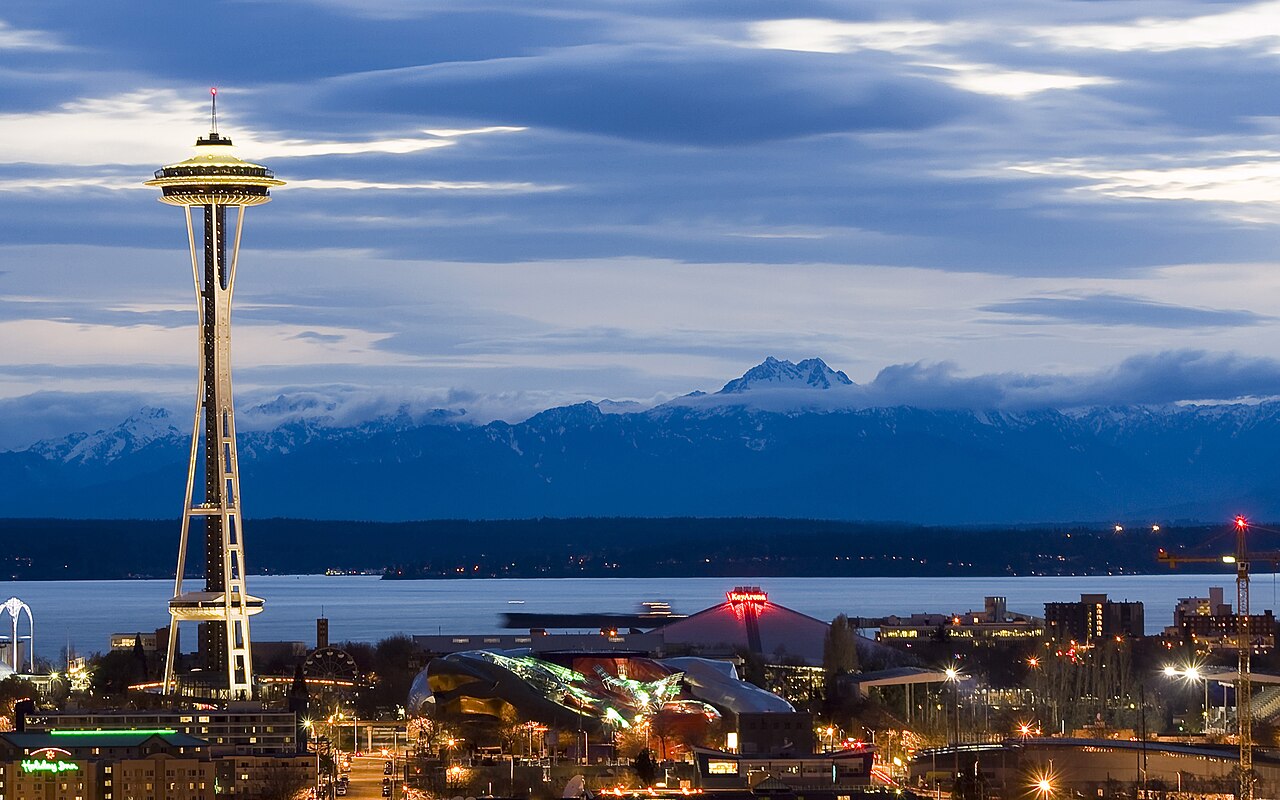
Photo: EMP|SFM · CC BY-SA 3.0 · Wikimedia Commons
Museum of Pop Culture is a museum in Seattle, Washington, USA. Opened in 2000 as the Experience Music Project. The free Lokali audio guide runs 7 minutes.
✓ Published October 2026 · how we write these guides
Visitor facts
| Lokali audio guide | 7 min · free |
|---|---|
| Type | Museum |
| Location | Seattle, United States |
| Coordinates | 47.6215, -122.3486 |
| Official website | mopop.org |
| Languages | 50+, in the Lokali app |
The story
Listen first. Somewhere above you, a low electric hum builds, then fades, as the monorail glides straight through the building. Look up at the walls. They do not stand still. Sheets of metal ripple and fold in crimson, gold, silver and a deep, shifting purple. In the morning they look almost soft. By late afternoon they flash like the body of a freshly polished guitar. You are standing beside the Museum of Pop Culture, the building Seattle calls MoPOP.
This museum began with one man's love of music. Paul Allen, the co-founder of Microsoft, grew up in Seattle and loved rock and roll. He especially admired Jimi Hendrix, who was born in this city. Allen wanted a place that celebrated the music he loved and the people who made it. The museum opened in 2000 under the name Experience Music Project. Many locals still call it by its old initials, EMP. In 2016 it took its current name.
The new name matters. It shows how the museum grew. It started as a temple to rock music. Over the years it widened its view to include science fiction, fantasy, horror, video games and film. Today the idea is simple. Popular culture is the shared language of ordinary life. The songs on the radio, the films we quote and the games we played as children all belong here. They are treated as seriously as paintings in an art gallery.
Now look again at that wild exterior. The architect was Frank Gehry, the Canadian-American designer famous for buildings that seem to bend and melt. A story is often told about how he began this project. According to that popular tale, Gehry bought several electric guitars, cut them into pieces, and used the fragments as building blocks for his early models. Whether every detail is true or not, you can see the idea in the finished shape.
The skin of the building is made from thousands of metal panels, aluminium and stainless steel. Each one is shaped and placed so the surface curves in several directions at once. Different finishes catch the light in different ways. That is why the colours seem to change as you walk around. Take a few steps to your left, then to your right. Watch how the purple turns almost blue, and how the gold warms or cools with the clouds.
Not everyone loved it at first. When the museum opened, some critics compared it to a crushed pile of scrap or a smashed instrument. Others called it joyful and brave. That argument is part of its story. Gehry designed buildings that make people react. In a city of grey skies and glass towers, this one refuses to be quiet. Love it or not, you will not forget its outline.
Here is a detail many visitors miss. The monorail is not simply passing nearby. Its track runs right through a gap in the building itself. The monorail has served this area since the 1962 World's Fair, the event that also gave Seattle the Space Needle just next door. Gehry chose to wrap his museum around the old line. The result is a meeting of two eras. Sixties futurism slides through the curves of a much later dream.
The whole neighbourhood around you is called Seattle Center. It was built for that World's Fair, when America was fascinated by space travel and the future. Fountains, lawns, theatres and the tall white Space Needle remain from that time. On a warm day, children run through the spray of the big fountain nearby. Families picnic on the grass. The museum sits right in the middle of this playground, which suits a place about fun and imagination.
Step inside, and the scale changes. One of the largest rooms is called the Sky Church. The name comes from Jimi Hendrix, who dreamed of a space where people of every kind could gather through music. The ceiling rises high above you. A huge video screen fills one wall. Concerts, films and events take place here. Even when the room is empty, it feels like a stage waiting for the lights to drop.
In another space, look for one of the museum's most surprising objects. It is a towering sculpture made from hundreds of real guitars and other instruments. They twist upward in a great spiral, like a tornado of strings and wood. The work was created by the sound artist Trimpin, who builds machines that play music. Some of the instruments in this sculpture can actually play by themselves. Stand under it quietly and listen for a moment.
Music here is not only something to look at. The museum has long offered hands-on spaces where visitors can pick up guitars, sit behind drum kits, or try a keyboard in small soundproof rooms. You do not need any skill. Many people who have never played anything make their first loud, happy noise here. For a place built around rock stars, it is a warm reminder that every musician once began as a beginner.
Seattle's own sound runs through the collection. Displays have explored Hendrix and the grunge movement of the late 1980s and 1990s, when local bands such as Nirvana and Pearl Jam changed rock music around the world. Exhibitions rotate, so what you see today may differ from what a friend saw last year. Galleries on science fiction, fantasy and horror sit beside the music halls. Costumes, props and original artwork from well-known films and series often appear.
That mix is the real surprise of this museum. In one room you may stand before a battered guitar from a Seattle garage band. In the next, you may face a creature from a famous film. The museum asks a simple question. Why do these stories and sounds stay with us for decades? The answer seems to be that they belong to everyone. You do not need special training to love them. You only need memory.
When you step back outside, pause for a moment. Let the monorail pass overhead once more. Listen to the fountain and the voices across the lawn. Then look at the metal walls one last time, and notice how the light has already changed since you arrived. The colour you saw at the start is gone. This building was made to keep moving, like a song you cannot quite stop humming as you walk away.
Key facts
What to look for
Practical tips
Common questions
Is there a free audio guide to Museum of Pop Culture?
Yes — the Lokali app narrates Museum of Pop Culture free of charge in 50+ languages. The guide runs about 7 minutes, covers the history, what to look for on site and practical tips, and works offline once downloaded.
Where is Museum of Pop Culture?
Museum of Pop Culture is in Seattle, United States, at 47.6215, -122.3486. Tap the map link on this page for directions from where you are.
What is Museum of Pop Culture known for?
Opened in 2000 as the Experience Music Project. Renamed the Museum of Pop Culture in 2016.
What should you look for at Museum of Pop Culture?
The monorail track passing through the building's gap. Purple panels that turn nearly blue as you move. The spiral tower of guitars by artist Trimpin.
What should you know before visiting Museum of Pop Culture?
Ride the monorail from downtown to arrive dramatically. Circle the exterior slowly to watch the colours shift.
When is the best time to visit Museum of Pop Culture?
Visit late afternoon for the warmest light on the metal.
On the map
Opens directions to Museum of Pop Culture from your location.
More to see in Seattle


Hear Museum of Pop Culture in your language
The full story, narrated, in 50+ languages. Download it before you go and it plays offline, at your own pace, with no ticket and no tour group.