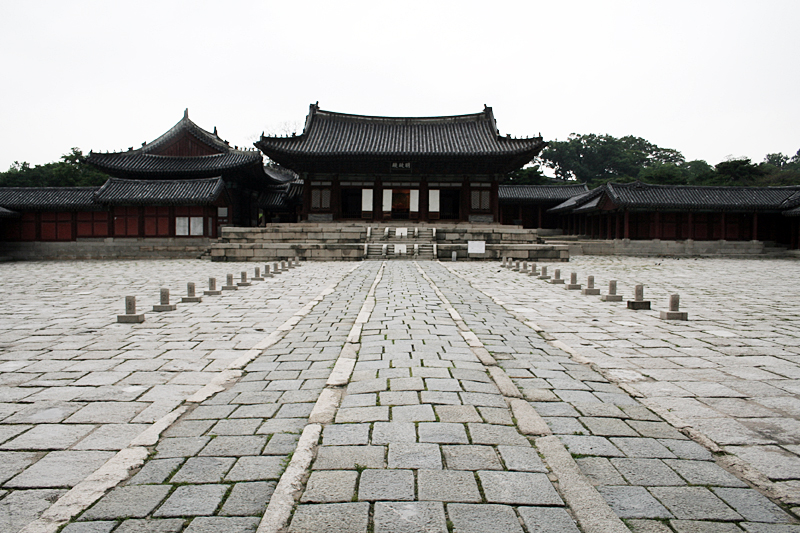
Photo: d'n'c (a flickr user) · CC BY-SA 2.0 · Wikimedia Commons
Changgyeonggung Palace is a palace. It is in Seoul, South Korea. King Sejong built the first residence here in 1418. The free Lokali audio guide runs 7 minutes.
✓ Published October 2026 · how we write these guides
Visitor facts
| Lokali audio guide | 7 min · free |
|---|---|
| Type | Palace |
| Location | Seoul, South Korea |
| Coordinates | 37.5784, 126.9960 |
| Official website | cgg.cha.go.kr |
| Languages | 50+, in the Lokali app |
The story
Listen for a moment. Beyond the gate, the traffic of central Seoul fades into a softer sound. You hear gravel under shoes, magpies calling from the pines, and wind moving through old trees. The air smells of earth and cut grass. Ahead, a wide courtyard opens under a pale sky, and the curved roofs of a royal palace rise above it. This is Changgyeonggung, and it has a quieter, more personal story than its larger neighbours.
Changgyeonggung is one of the Five Grand Palaces built in Seoul during the Joseon dynasty, the kingdom that ruled Korea for about five centuries. Most visitors know Gyeongbokgung, the grand main palace. This one was different from the start. It was not built as a centre of government. It was built as a home for family, and especially for the women of the royal court.
The story begins in 1418. King Sejong, the ruler later remembered for creating the Korean alphabet, built a residence here for his father, the retired King Taejong. Later in the fifteenth century, King Seongjong expanded the site and gave it the name Changgyeonggung. He wanted a place for three senior queens of the court to live in comfort. So from its earliest years, this palace held grandmothers, widowed queens, and the private life of the royal household.
You entered through Honghwamun, the main gate. Now here is the first detail most visitors miss. Look at the direction the gate faces. It faces east. In Korean palace tradition, the main gate and throne hall usually face south, following old principles of good fortune. Changgyeonggung breaks that rule. The palace follows the shape of the land, with hills behind it to the west, rather than forcing a perfect plan onto the ground.
Walk forward and you cross Okcheongyo, a stone bridge with arched spans. In Joseon palaces, a stream and bridge often marked the line between the outside world and the royal space. Crossing water was a symbolic act of purification before you came near the king. Look over the sides. Carved faces of guardian creatures watch the water below, meant to keep bad spirits away from the court.
Now the throne hall stands in front of you. This is Myeongjeongjeon, the main hall, where formal ceremonies took place. Like much of the palace, it burned during the Japanese invasions of the late sixteenth century and was rebuilt in the early seventeenth century. Here is the second surprise. That rebuilt hall has survived since then, and it is often described as the oldest surviving throne hall among all of Seoul's palaces.
Study the courtyard in front of the hall. Two rows of small stone markers run across the ground. These are rank stones. On ceremonial days, officials stood beside them in order of their position, civil officials on one side and military officials on the other. The ground stones are uneven and worn. Imagine hundreds of men in silk robes standing in silence here, each one knowing exactly where he belonged.
Look up at the eaves. The wooden beams carry bright painted patterns in green, red, and blue. This style is called dancheong, a traditional Korean way of painting buildings. It made the wood beautiful, but it also protected it from insects and weather. The colours also had meaning, linked to old ideas about balance in nature. Under the roofs, the wooden brackets fit together without nails, joined like a careful puzzle.
This palace also holds one of the darkest stories of the Joseon court. In 1762, King Yeongjo ordered his son, Crown Prince Sado, into a wooden rice chest. The prince died there after several days. The event happened near Munjeongjeon, the hall used for royal business, close to where you are now. The prince's wife, Lady Hyegyeong, later wrote memoirs about her life at court. Her writing still gives readers a rare, personal view inside these walls.
In the early twentieth century, the palace changed in a way that shocked many Koreans. During the Japanese colonial period, the site was turned into a zoo and a botanical garden. Its name was changed to Changgyeongwon, using a word that meant a park, not a palace. Many buildings were removed. Cherry trees were planted, and crowds came for picnics. For generations of Seoul families, this was simply the place to see animals.
That history is still here if you know where to look. Walk north toward the large pond called Chundangji. Beyond it stands Daeonsil, a white greenhouse of wood, iron, and glass. It was built in 1909 and is often called the first Western-style greenhouse in Korea. It looks almost Victorian, very different from the palace roofs. Near the pond you can also find a slender stone pagoda in a style that does not match the Korean buildings around it.
In the 1980s, the zoo moved out to a new site south of the city. Restoration work began, the old name came back, and several buildings were rebuilt. Today the palace is part of a larger royal landscape. It connects with Changdeokgung, the neighbouring palace, and together they were once called the Eastern Palace. To the south lies Jongmyo, the royal shrine where the kings' ancestors were honoured.
The gardens give the palace much of its character now. In spring, blossoms cover the paths. In autumn, the maples near the pond turn deep red and gold. On some evenings, the palace opens after dark, and soft lighting shines on the eaves and the water. At any season, the wooded paths behind the halls feel calm and far from the city, even though the city is only a few steps away.
As you walk back toward the gate, look once more at the roofs against the sky. This place has been a family home, a ceremonial court, a scene of tragedy, a zoo, and now a palace again. Notice the quiet. Notice the old stones under your feet, worn smooth by centuries of steps. Then step back into Seoul, carrying a little of this calm with you.
Key facts
What to look for
Practical tips
Common questions
Is there a free audio guide to Changgyeonggung Palace?
Yes — the Lokali app narrates Changgyeonggung Palace free of charge in 50+ languages. The guide runs about 7 minutes, covers the history, what to look for on site and practical tips, and works offline once downloaded.
Where is Changgyeonggung Palace?
Changgyeonggung Palace is in Seoul, South Korea, at 37.5784, 126.9960. Tap the map link on this page for directions from where you are.
What is Changgyeonggung Palace known for?
King Sejong built the first residence here in 1418. Renamed Changgyeonggung by King Seongjong in the fifteenth century.
What should you look for at Changgyeonggung Palace?
Main gate and throne hall facing east, not south. Carved guardian faces on the Okcheongyo stone bridge. Two rows of rank stones in the throne hall courtyard.
What should you know before visiting Changgyeonggung Palace?
Combine your visit with neighbouring Changdeokgung Palace. Walk the northern paths to Chundangji pond and the greenhouse.
When is the best time to visit Changgyeonggung Palace?
Come in autumn for red maples around the pond.
On the map
Opens directions to Changgyeonggung Palace from your location.
More to see in Seoul


Hear Changgyeonggung Palace in your language
The full story, narrated, in 50+ languages. Download it before you go and it plays offline, at your own pace, with no ticket and no tour group.