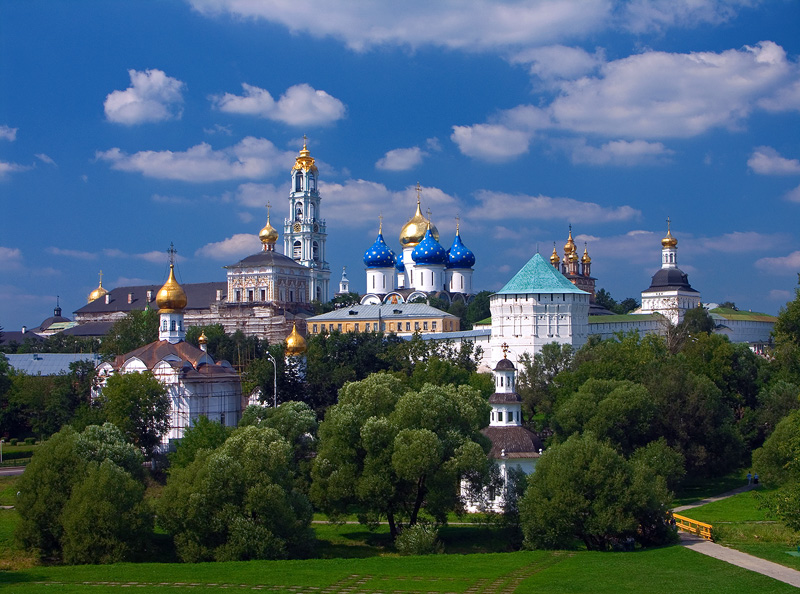
Trinity Lavra of Saint Sergius
56.3103° N · 38.1307° E · World Heritage Site
Photo: Александр Гришин · CC BY-SA 3.0 · Wikimedia Commons
Trinity Lavra of Saint Sergius is a Russian monastery and the spiritual centre of the Russian Orthodox Church. Founded by Saint Sergius of Radonezh in the fourteenth century. The free Lokali audio guide runs 7 minutes.
✓ Published October 2026 · how we write these guides
Visitor facts
| Lokali audio guide | 7 min · free |
|---|---|
| Type | World Heritage Site |
| Location | Sergiyev Posad, Russia |
| Coordinates | 56.3103, 38.1307 |
| Official website | stsl.ru |
| Languages | 50+, in the Lokali app |
The story
Pass under the painted arch of the main gate, and the noise of the town falls away behind you. The air smells faintly of beeswax and cold stone. Somewhere ahead, a bell strikes once, and the sound rolls across the courtyard. Then you see the domes. Some are gold. Some are deep blue, scattered with golden stars. Almost everyone stops here for a moment, at the edge of the cobbles, and simply looks.
You are standing inside the Trinity Lavra of Saint Sergius, the most important monastery in Russia. A lavra is the highest rank a Russian Orthodox monastery can hold. This one received that title in the eighteenth century. Today it is still a working monastery, with monks in black robes crossing the yard, a theological academy within its walls, and a steady stream of pilgrims who come for one reason above all others.
That reason is a man. In the first half of the fourteenth century, a young monk named Sergius came to this wooded hill with his brother. They built a small wooden church and dedicated it to the Holy Trinity. The forest around them was thick and empty. Sergius chopped wood, carried water, and lived in deep simplicity. His reputation for humility spread, and others came to join him. Slowly, a community grew where there had been only trees.
Sergius of Radonezh became more than a holy man. He became a moral voice for a divided land. Russian principalities at the time lived under the power of the Golden Horde, the Mongol state that collected tribute from them. According to tradition, Prince Dmitry of Moscow came here for a blessing before the Battle of Kulikovo in 1380. The Russian victory that followed was the first great challenge to Horde rule. Ever since, this monastery has carried a weight far beyond religion.
Now walk toward the small white church with a single golden dome. This is the Trinity Cathedral, the oldest stone building in the monastery, raised in the 1420s over the grave of Sergius. It looks modest beside its neighbours. Look closely at the white limestone walls and the carved bands near the top. This is early Moscow architecture at its most restrained... solid, quiet, and built to last.
Inside, the relics of Saint Sergius rest in a silver shrine. Expect a line. Pilgrims wait patiently, some for a long time, to bow and kiss the reliquary. Monks keep a continuous cycle of prayer here. And here is the first surprise for many visitors. The great icon painter Andrei Rublev worked on the icons of this church. His famous icon of the Old Testament Trinity, three angels seated around a table, was painted for this very cathedral.
That icon became one of the best-known works of Russian art. For most of the twentieth century it hung in a Moscow museum, far from the church it was made for. The icon screen you see today still holds work from Rublev's circle, painted in the same spirit. Stand for a moment in the half-light. Notice how the candle smoke softens the gold. Notice the hush, broken only by low singing.
Step back outside and turn toward the largest building in the courtyard. The Assumption Cathedral, with its five domes, was ordered by Tsar Ivan the Terrible and completed in the late sixteenth century. Its model was the Assumption Cathedral inside the Moscow Kremlin. Those blue domes with golden stars are the image most people carry home from this place. They represent the heavens, a sky brought down to earth.
Near the northwest corner of this cathedral, look for a small, low tomb. Here lies Boris Godunov, the tsar who ruled after Ivan's son, along with members of his family. His reign ended in turmoil, and his remains were moved here after his death. It is a second surprise for many visitors. A tsar of Russia rests not inside a grand cathedral, but in a quiet spot by its wall.
The walls themselves tell another story. Walk toward them and notice their thickness and their towers. In the early seventeenth century, during the chaos Russians call the Time of Troubles, Polish and Lithuanian forces besieged the monastery for about sixteen months. The defenders, including monks, held out against hunger and disease. The monastery never fell. That long siege turned these walls into a symbol of national endurance.
Now lift your eyes to the tall bell tower, the highest point in the ensemble. It was built in the eighteenth century in the Baroque style, with tiers that grow lighter as they rise. It is one of the tallest bell towers in Russia. Across the yard, look at the long refectory with its church of Saint Sergius. Its walls are painted in a bright checkered pattern, a playful contrast to the white stone of the older buildings.
The twentieth century nearly ended all of this. After the revolution, the Soviet authorities closed the monastery in 1920 and turned parts of it into a museum. The town itself was renamed Zagorsk. Monastic life returned in the 1940s, and the town took back a version of its old name in 1991. In 1993, the ensemble joined the UNESCO World Heritage List. The monks you see today are the inheritors of that unlikely return.
Before you leave, find the small chapel over the holy spring near the Assumption Cathedral. Pilgrims fill bottles with its water and carry it home. Watch for a moment. A grandmother ties her headscarf tighter. A young father lifts a child to see the icons. A monk walks past without hurry. This is not a museum frozen in the past. It is a living place.
So take one last look across the courtyard. The gold and blue domes, the white stone church, the tall bell tower against the sky. Seven centuries ago, there was only forest here, and a monk with an axe. As you walk back through the gate, listen. If the bells are ringing, let them follow you down the hill into town.
Key facts
What to look for
Practical tips
Common questions
Is there a free audio guide to Trinity Lavra of Saint Sergius?
Yes — the Lokali app narrates Trinity Lavra of Saint Sergius free of charge in 50+ languages. The guide runs about 7 minutes, covers the history, what to look for on site and practical tips, and works offline once downloaded.
Where is Trinity Lavra of Saint Sergius?
Trinity Lavra of Saint Sergius is near Sergiyev Posad, Russia, at 56.3103, 38.1307. Tap the map link on this page for directions from where you are.
What is Trinity Lavra of Saint Sergius known for?
Founded by Saint Sergius of Radonezh in the fourteenth century. Trinity Cathedral was built in the 1420s over Sergius's grave.
What should you look for at Trinity Lavra of Saint Sergius?
Gold stars scattered across the blue domes. Boris Godunov's low tomb beside the Assumption Cathedral. Carved stone bands on the Trinity Cathedral walls.
What should you know before visiting Trinity Lavra of Saint Sergius?
Women should bring a headscarf and wear a skirt. Men should remove hats before entering any church.
When is the best time to visit Trinity Lavra of Saint Sergius?
Arrive early on weekdays to avoid long relic queues.
On the map
Opens directions to Trinity Lavra of Saint Sergius from your location.
Hear Trinity Lavra of Saint Sergius in your language
The full story, narrated, in 50+ languages. Download it before you go and it plays offline, at your own pace, with no ticket and no tour group.