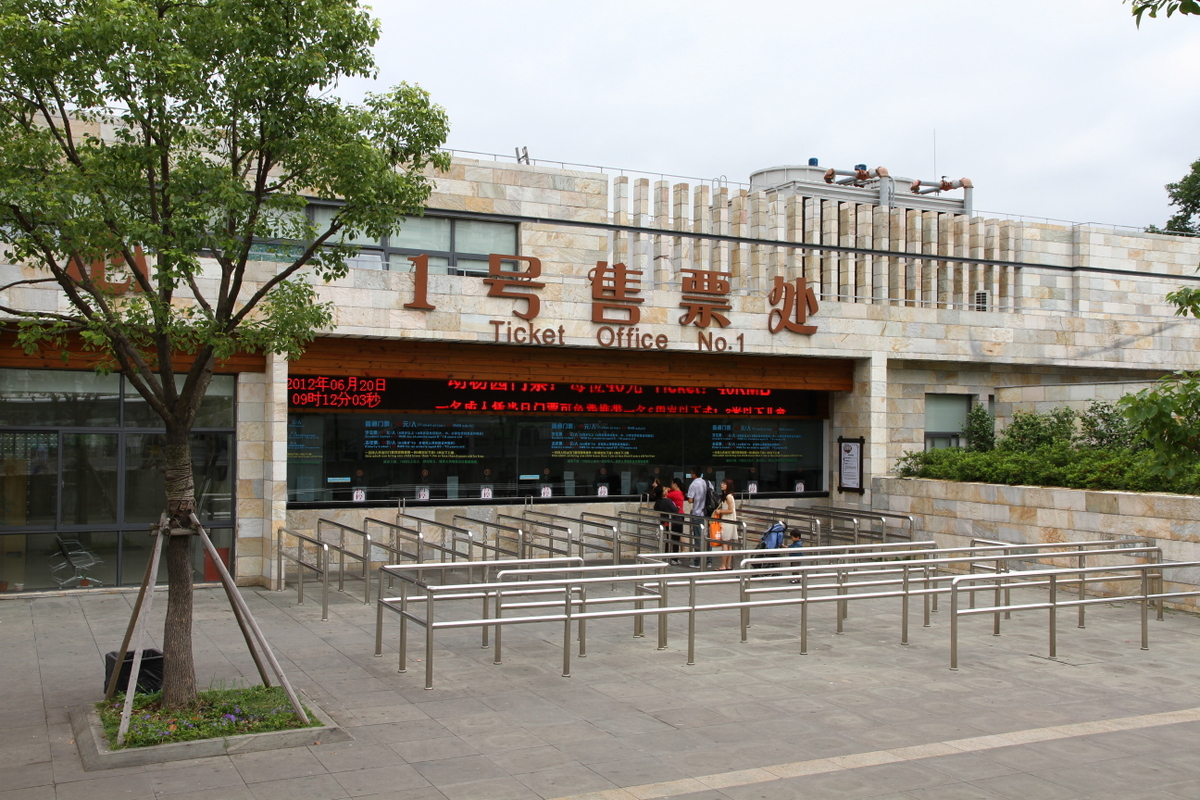
Photo: Ctny · CC BY-SA 3.0 · Wikimedia Commons
Shanghai Zoo is a zoo in Shanghai, China. The site was a British golf course in the early twentieth century. The free Lokali audio guide runs 7 minutes.
✓ Published October 2026 · how we write these guides
Visitor facts
| Lokali audio guide | 7 min · free |
|---|---|
| Type | Zoo |
| Location | Shanghai, China |
| Coordinates | 31.1955, 121.3588 |
| Official website | shanghaizoo.cn |
| Languages | 50+, in the Lokali app |
The story
Listen for a moment. Under the traffic hum of western Shanghai there is another layer of sound. Birds call from tall trees, leaves move overhead, and somewhere ahead a peacock lets out a sharp, almost human cry. The air is a little cooler here than on the avenues outside. The ground is soft lawn instead of concrete. For a city of tall towers and fast trains, this is a surprisingly green and quiet place to stand.
You are in Shanghai Zoo, in the Changning District, not far from Hongqiao Airport. On a clear day you may hear a plane climbing out to the west. That contrast belongs to the place. The zoo sits on the edge of one of the busiest transport hubs in China. Yet inside the gates, the main things moving are animals, families with strollers, and older residents taking a slow morning walk.
Here is the first thing most visitors never learn. Long before it held animals, this land was a golf course. In the early twentieth century, when foreign communities had a large presence in Shanghai, British residents laid out greens and fairways here on the western fringe of the city. It was a private leisure ground for a small foreign community, far from the crowded lanes of the old town.
After 1949 and the founding of the People's Republic, the land took on a new public purpose. In the 1950s it opened to ordinary citizens as a park in the western suburbs, with animals gradually added. In later decades it took the name Shanghai Zoo. So the ground under your feet has moved from an exclusive club to a place where anyone in the city could come and spend an afternoon. Keep that in mind as you look at the wide, open grass.
That grass is the second surprise. Look at the large central lawn, with its gentle rises and long open views. Many people believe that this broad sweep of green is a trace of the old golf course. The fairway shapes are gone. But the feeling of open, rolling space is very different from a typical Chinese garden, with its rockeries, small pavilions and winding paths. On weekends, families spread out blankets here, children run in circles, and kites sometimes rise above the trees.
Now turn your attention to the trees themselves. The zoo is planted with a great number of them, and in summer they make deep shade along the paths. In a city where land is precious, this canopy is valuable. Many residents come here as much for the greenery as for the animals. Early in the morning you may see people practising tai chi, the slow, flowing Chinese exercise, or simply sitting on benches with a thermos of tea.
Of course, most visitors come to see the animals, and the giant panda is usually the first stop. Pandas are China's best-known national symbol, and they are native to the mountain forests of the southwest, far from Shanghai. Watch how they eat. A panda sits upright, holds bamboo with its front paws, and strips the leaves with careful, steady bites. They spend a large part of each day eating, and much of the rest resting. Patience is rewarded here.
Look out also for animals that are less famous abroad but very important in China. The golden snub-nosed monkey has thick orange-gold fur and a pale blue face with a small upturned nose. It lives wild in cold mountain forests in central and western China. Its colours are striking against green leaves. If the monkeys are active, watch how they move as a group, grooming each other and calling softly.
Another animal with a close link to this region is the Chinese alligator. It is much smaller than its American cousin and lives in the lower Yangtze River area, the great river basin around Shanghai. In the wild it is very rare. When you see one lying still at the water's edge, it may look like a log. That stillness is a survival skill. It is a quiet reminder that the wetlands around this city once held wildlife very different from today's streets.
The zoo also keeps big cats, including tigers. China has a special connection with the South China tiger, a subspecies that is now thought to be extinct in the wild. Its survival depends on animals kept in zoos and breeding centres. When you stand at a tiger enclosure, notice the pacing, the pauses, the sudden turn of the head toward a sound. These are powerful animals, and even behind barriers they hold the attention of everyone nearby.
As you walk, pay attention to the human side of the zoo too. You will hear grandparents explaining animals to small children, often in the Shanghainese dialect, which sounds softer and quicker than standard Mandarin. Vendors sell drinks, snacks and small toys. School groups move in lines, each child wearing the same coloured cap. For many local families, a trip here is a childhood memory passed from one generation to the next.
A word on the best way to enjoy the visit. The grounds are large, and the paths loop in several directions, so a map helps. Mornings are usually cooler, and many animals are more active before the midday heat. Shanghai summers are hot and humid, so water and a hat make a real difference. In spring and autumn, the light through the trees is soft, and the lawns are at their best.
Before you leave, find a quiet spot near the trees or at the edge of the lawn. Look around you. A century ago, men in white shirts may have walked this ground with golf clubs. Today a child is pointing at a bird, and a grandmother is resting on a bench. Listen again to the leaves, the birdsong, the distant plane. Then, as you walk back toward the gate and the traffic, notice the exact moment the city sound returns.
Key facts
What to look for
Practical tips
Common questions
Is there a free audio guide to Shanghai Zoo?
Yes — the Lokali app narrates Shanghai Zoo free of charge in 50+ languages. The guide runs about 7 minutes, covers the history, what to look for on site and practical tips, and works offline once downloaded.
Where is Shanghai Zoo?
Shanghai Zoo is in Shanghai, China, at 31.1955, 121.3588. Tap the map link on this page for directions from where you are.
What is Shanghai Zoo known for?
The site was a British golf course in the early twentieth century. Opened to the public as a park in the 1950s.
What should you look for at Shanghai Zoo?
The wide rolling central lawn from the golf course era. Pandas holding bamboo upright in their front paws. Blue faces on the golden snub-nosed monkeys.
What should you know before visiting Shanghai Zoo?
Arrive in the morning when animals are most active. Take Metro Line 10 to Shanghai Zoo station.
When is the best time to visit Shanghai Zoo?
Bring water and a hat during humid summer months.
On the map
Opens directions to Shanghai Zoo from your location.
More to see in Shanghai


Hear Shanghai Zoo in your language
The full story, narrated, in 50+ languages. Download it before you go and it plays offline, at your own pace, with no ticket and no tour group.