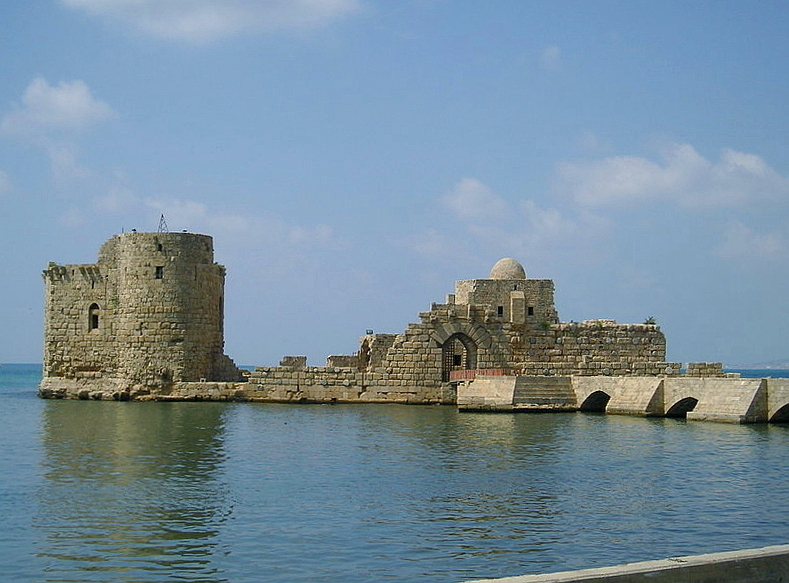
Photo: Heretiq · CC BY-SA 2.5 · Wikimedia Commons
Sidon Sea Castle is a fortress of the Holy Land (13th Century). Crusaders built the castle in the early thirteenth century. The free Lokali audio guide runs 6 minutes.
✓ Published October 2026 · how we write these guides
Visitor facts
| Lokali audio guide | 6 min · free |
|---|---|
| Type | Castle |
| Location | Sidon, Lebanon |
| Coordinates | 33.5670, 35.3711 |
| Languages | 50+, in the Lokali app |
The story
Listen first. Small waves strike the rocks below the causeway, and the spray leaves a faint taste of salt in the air. Fishing boats knock against each other in the harbour. Gulls call overhead. Under your feet, the stone path is warm and worn smooth by centuries of footsteps. Ahead, a squat fortress of pale, sea-stained stone sits on a small island, a short walk from the shore of Sidon.
This is the Sea Castle of Sidon, called Qal'at al-Bahr in Arabic, which simply means the Castle of the Sea. It is small. You can walk around it in less than an hour. But almost every stone here has a story about who held this coast, who lost it, and who came back to build again. And many of those stones are much older than the castle itself.
Start with the setting. Sidon is one of the oldest cities on the eastern Mediterranean. In ancient times, it was one of the great Phoenician ports. The Phoenicians were a seafaring people of this coast, famous for trade, shipbuilding, and a purple dye made from sea snails. Sidon's harbours made it rich. This little island once helped to protect one of those harbours from the open sea.
Many historians believe that a temple stood on this island long before the castle. It is often linked to Melqart, a Phoenician god connected with the sea and with the city of Tyre to the south. The evidence is not complete, so treat this as a likely story, not a certain one. But it makes sense. Sailors leaving the harbour would have passed this rock first, and a shrine here would have watched over them.
The castle you see today began in the early thirteenth century. It was built by the Crusaders — European knights who had come east and set up states along this coast. They chose the island because the sea itself was a defence. An enemy could not easily bring siege machines across the water. The narrow causeway was the only dry way in, and it was easy to guard.
Now look closely at the outer walls. You will see round stone shapes sticking out of the masonry, like the ends of logs in a woodpile. These are not logs. They are ancient columns, most likely from Roman-era buildings in the city. The builders laid them sideways through the walls. This was a clever trick. The columns tied the inner and outer faces of the wall together, and made the structure stronger against waves and attack.
That is the first surprise most visitors miss. You are looking at recycled architecture. Pieces of an older, classical Sidon are locked inside a medieval fortress. In a way, the castle is a kind of storage box for the city's past. Walk slowly along the wall, and count how many column ends you can find. Some are cracked. Some are smooth. A few still show a clean, round profile after hundreds of years in the salt air.
The Crusaders did not hold the castle for long. In 1291, the Mamluks took control of this coast. The Mamluks were a powerful dynasty based in Egypt and Syria. As the last Crusader strongholds fell, many coastal forts were damaged or pulled down on purpose, so that no European army could use them again. The Sea Castle suffered badly in those years, and large parts of it were lost.
Yet it did not disappear. Over the following centuries, the castle was repaired more than once. Many accounts link one major restoration to Fakhr al-Din, a seventeenth-century emir who ruled much of the region under the Ottoman Empire and invested heavily in Sidon. You can see the result as layers. Older stones sit low in the walls. Newer patches, often in a slightly different colour or cut, sit above them.
Here is the second surprise. The causeway you crossed is not the original Crusader entrance in its present form. The arches under the path were rebuilt in later periods. In the past, a section of this crossing could be removed or blocked, so attackers could not simply walk in. Stand in the middle of the causeway, look down at the water through the gaps, and imagine that missing link.
Inside, the castle has two main towers joined by a wall. The rooms are plain and partly ruined, with heavy vaults and thick stone. Climb to the upper level carefully, because the steps are uneven. At the top, you will find a small domed structure, often described as a little mosque from the Ottoman period. From here, the view opens in every direction: the harbour, the old city, and the long line of the coast.
Turn back toward the town. Behind the harbour lies Sidon's old city, a maze of covered souks, stone arches, and narrow lanes. Somewhere in there you can hear hammers from workshops, the call to prayer, and traders arranging their stalls. Nearby stands Khan al-Franj, an old caravanserai, which is a traditional inn built around a courtyard for merchants. Together with the castle, it shows how much of Sidon's life has always faced the sea.
Before you leave, stand still for a moment on the top of the wall. Feel the wind come straight off the Mediterranean. Watch a fishing boat slide out past the island, the same way boats have passed this rock for thousands of years. As you walk back along the causeway, glance once more at those sideways columns in the stone. Temples, knights, emirs, and fishermen — they all left something here. And now, for a few minutes, so have you.
Key facts
What to look for
Practical tips
Common questions
Is there a free audio guide to Sidon Sea Castle?
Yes — the Lokali app narrates Sidon Sea Castle free of charge in 50+ languages. The guide runs about 6 minutes, covers the history, what to look for on site and practical tips, and works offline once downloaded.
Where is Sidon Sea Castle?
Sidon Sea Castle is in Sidon, Lebanon, at 33.5670, 35.3711. Tap the map link on this page for directions from where you are.
What is Sidon Sea Castle known for?
Crusaders built the castle in the early thirteenth century. Arabic name Qal'at al-Bahr means Castle of the Sea.
What should you look for at Sidon Sea Castle?
Round column ends sticking out of the outer walls. Arches beneath the causeway framing the sea below. Different stone colours showing later repair layers.
What should you know before visiting Sidon Sea Castle?
Come early morning for calmer light and fewer visitors. Wear shoes with grip for the uneven inner stairs.
When is the best time to visit Sidon Sea Castle?
Come early morning for calmer light and fewer visitors.
On the map
Opens directions to Sidon Sea Castle from your location.
More to see near Sidon Sea Castle


Hear Sidon Sea Castle in your language
The full story, narrated, in 50+ languages. Download it before you go and it plays offline, at your own pace, with no ticket and no tour group.