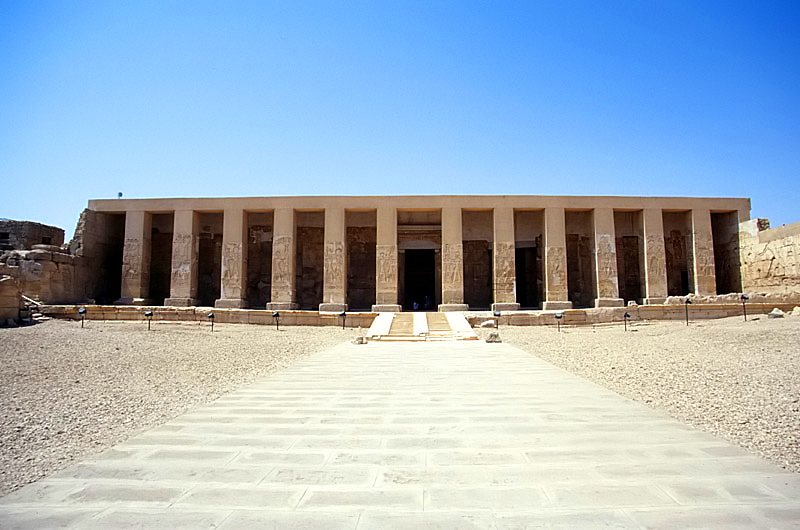
Photo: Roland Unger · CC BY-SA 3.0 · Wikimedia Commons
Abydos is a city in ancient Egypt. It is near Sohag Governorate, Egypt. Abydos was the main cult centre of the god Osiris. The free Lokali audio guide runs 7 minutes.
✓ Published October 2026 · how we write these guides
Visitor facts
| Lokali audio guide | 7 min · free |
|---|---|
| Type | Archaeological Site |
| Location | Sohag Governorate, Egypt |
| Coordinates | 26.1852, 31.9189 |
| Languages | 50+, in the Lokali app |
The story
Start with the light. Inside the Temple of Seti the First, the sun does not pour in. It enters in thin bands through the roof and the doorways and falls across walls of pale limestone. Where it lands, colour appears: a band of blue, a flash of yellow ochre, the red-brown skin of a painted god. The air is cool and still. Somewhere outside, a dog barks in the village, and then it is quiet again.
You are standing in Abydos, in the Sohag Governorate of Upper Egypt, near the town of El Balyana. For the ancient Egyptians, this was one of the holiest places in the whole country. It was the cult centre of Osiris, the god of the dead and of rebirth. People came here as pilgrims for thousands of years. Many hoped to be buried here, and those who could not often left a carved stone tablet, called a stela, so that some part of them would stay.
Why here? The answer lies in a myth. Osiris, the story goes, was murdered by his jealous brother Seth, who cut his body into pieces and scattered them across Egypt. His wife Isis searched the land and gathered him again. One popular tradition held that the head of Osiris rested at Abydos. Whether people believed that literally or not, the idea gave this desert edge a power that no other place could quite match.
The temple around you belongs to the New Kingdom, the age of Egypt's great empire. Seti the First began it in the thirteenth century before Christ, and his son, Ramesses the Second, finished parts of it after his father died. You can see the difference if you look closely. The finest, most delicate carving in the inner rooms is Seti's work. Some of the outer courts, cut more quickly and more deeply, carry the hand of his son.
Here is the first surprise. This temple is not a straight line. Most Egyptian temples run front to back along a single axis, like a corridor toward the sanctuary. This one turns a corner and forms an L-shape. Scholars have suggested several reasons, including the presence of older sacred structures behind it, but the plan is unusual. As you walk deeper, notice how the building quietly redirects you.
The heart of the temple is a row of seven chapels side by side. Each was dedicated to a different deity: Osiris, Isis and Horus, the divine family of Abydos, and also Amun, Ptah and Re-Horakhty, the great state gods of Egypt. The seventh chapel honours Seti himself, as a king who became divine. Step inside one and look up. The ceilings are carved in a curve that imitates a vaulted roof, and the colours on the reliefs are some of the best preserved in Egypt.
Now find a long corridor known as the Gallery of the Kings. On one wall, Seti and the young Ramesses stand before a list of names. Each name sits inside an oval frame called a cartouche, which held the name of a pharaoh. Together they form the Abydos King List, a roll call of royal ancestors going back to the first rulers of a united Egypt. For historians, this wall is an important source for the order of the early kings.
But the list is also careful about who it leaves out. Certain rulers are missing. Hatshepsut, a woman who ruled as pharaoh, does not appear. Neither does Akhenaten, the king who tried to replace the old gods with the worship of the sun disc, nor his close successors. So this is not a neutral record. It is a statement of who Seti considered a proper king — history edited in stone.
The second surprise is up on a ceiling beam in the first hypostyle hall, a hall filled with columns. Visitors sometimes point at a group of signs that seem to show a helicopter, a submarine, even an aeroplane. The explanation is far more ordinary, and more interesting. The original carving was filled with plaster and recut with a new royal title. Over time the plaster fell away, and the two inscriptions now overlap. The strange shapes are simply old words sitting on top of newer ones.
Behind the temple, and lower down, lies one of the strangest structures in Egypt: the Osireion. It is built from huge blocks of granite and sandstone, with heavy square pillars, and it was designed as a symbolic tomb for Osiris. It sits low enough that groundwater often fills its central area. On a calm day, the water reflects the stone, and you may see plants growing between the blocks. The setting suggests the myth of an island rising from the first waters of creation.
Abydos is much older than this temple. Out in the desert to the west lies a site called Umm el-Qa'ab, an Arabic name meaning roughly "mother of pots", because of the countless broken offering jars scattered there. This is where some of Egypt's earliest kings were buried, around five thousand years ago. Much later, one of these royal tombs came to be honoured as the tomb of Osiris himself. Pilgrims left offerings there for centuries.
The twentieth century added a human story of its own. An Englishwoman named Dorothy Eady came to live in the village here and worked with archaeologists at the site. Locals knew her as Omm Sety. She believed she had served at this temple in a past life, as a young priestess in the time of Seti. People still argue about what to make of her story. Few dispute how deeply she knew these walls, or how much she loved them.
Before you leave, stand still for a moment in one of the halls. Look at the columns rising into the shadows, at the faint blue that has survived on the stone since the age of the pharaohs. Listen to the quiet. Then, as you step back out into the heat and the bright desert light, notice the green fields at the edge of the village. Life here still runs along the same line between the river and the sand.
Key facts
What to look for
Practical tips
Common questions
Is there a free audio guide to Abydos?
Yes — the Lokali app narrates Abydos free of charge in 50+ languages. The guide runs about 7 minutes, covers the history, what to look for on site and practical tips, and works offline once downloaded.
Where is Abydos?
Abydos is near Sohag Governorate, Egypt, at 26.1852, 31.9189. Tap the map link on this page for directions from where you are.
What is Abydos known for?
Abydos was the main cult centre of the god Osiris. Seti the First began the temple; Ramesses the Second completed it.
What should you look for at Abydos?
The vivid blue and ochre paint inside the seven chapels. Curved carved ceilings that imitate vaulted roofs. The long rows of royal cartouches in the Gallery of the Kings.
What should you know before visiting Abydos?
Arrive early to enjoy cooler air and quieter halls. Bring a small torch for viewing the darker inner chapels.
When is the best time to visit Abydos?
Arrive early to enjoy cooler air and quieter halls.
On the map
Opens directions to Abydos from your location.
Hear Abydos in your language
The full story, narrated, in 50+ languages. Download it before you go and it plays offline, at your own pace, with no ticket and no tour group.