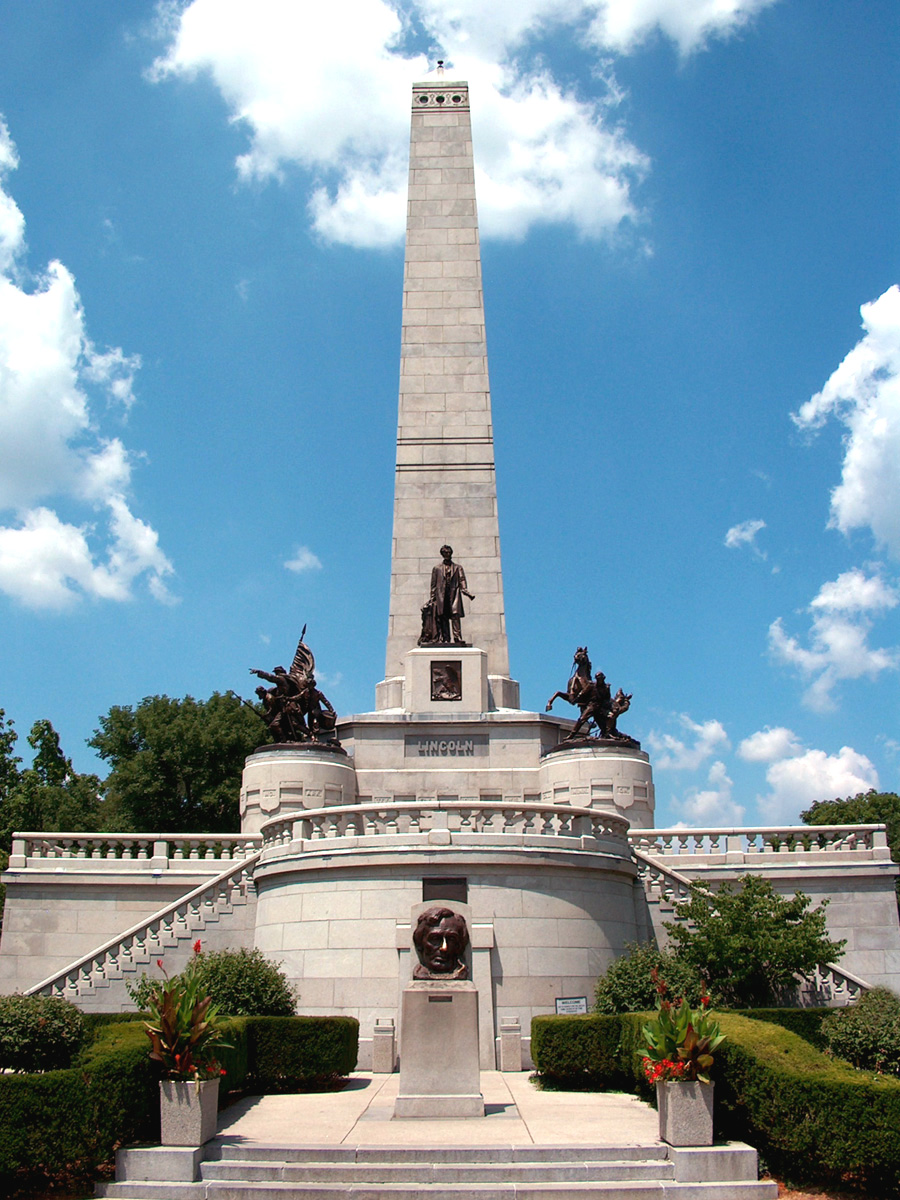
Photo: David Jones · CC BY-SA 2.5 · Wikimedia Commons
Lincoln Tomb is a tomb of U.S. president Abraham Lincoln in Springfield, Illinois, United States. Lincoln was first placed here in a receiving vault in 1865. The free Lokali audio guide runs 7 minutes.
✓ Published October 2026 · how we write these guides
Visitor facts
| Lokali audio guide | 7 min · free |
|---|---|
| Type | Monument |
| Location | Springfield, United States |
| Coordinates | 39.8232, -89.6557 |
| Official website | lincolntomb.org |
| Languages | 50+, in the Lokali app |
The story
Listen for a moment. Gravel shifts under your shoes, and wind moves through old oaks on the slope around you. Ahead, a pale granite obelisk rises from a grassy rise in Oak Ridge Cemetery. At its base, a small crowd often gathers around one object: a bronze head, its nose polished to a bright gold by thousands of hands. This is the final resting place of Abraham Lincoln, sixteenth President of the United States. And the story of how he came to rest here is stranger than most visitors expect.
It begins in April 1865. Lincoln was shot at Ford's Theatre in Washington and died the next morning. The war that had defined his presidency was only days from its close. His body then began a long journey home to Springfield, the Illinois city where he had practised law, raised his family, and launched his political life. A funeral train carried him through city after city, with stops for public mourning along the way. Crowds lined the tracks at night, holding lanterns and bonfires.
He did not travel alone. On the same train was the coffin of his son Willie, who had died of illness in the White House in 1862. Father and son arrived in Springfield together. In early May 1865, they were placed in a receiving vault, a temporary stone tomb built into the hillside at the foot of this cemetery. That vault still exists. If you walk downhill from the monument, you can find its small doorway set into the slope.
Here is a detail many visitors miss. Springfield's leaders did not want Lincoln buried here at all. They had prepared a site closer to the centre of town. Mary Todd Lincoln, his widow, refused. She insisted on Oak Ridge, a quiet cemetery on what was then the edge of the city. She had her way. Today, the grounds around you still carry that sense of distance from the streets, with mature trees and long, curving lanes.
The monument you see was designed by the sculptor Larkin Mead and dedicated in 1874. The obelisk is a tall, tapering stone pillar, a form borrowed from ancient Egypt that Americans of the era used for their most solemn memorials. At its base stands a bronze statue of Lincoln. Around the corners are bronze groups of soldiers and sailors, representing the branches of the Union forces. Together, they tie the man to the war he led the country through.
Now for the part of the story that sounds like fiction... but is documented history. In 1876, a gang of counterfeiters plotted to steal Lincoln's body. Their plan was to hold it for ransom and demand the release of a jailed engraver who made their fake money. On election night, they broke into the tomb and began to pull the coffin out. But an informer had warned the authorities, and agents were waiting nearby. The plot collapsed, and the thieves were later caught.
That attempt changed everything about how Lincoln's remains were protected. For years afterward, his coffin was moved and hidden within the monument, sometimes in secret, guarded by a small group of devoted local men. The structure itself also had problems. Its foundation was settling unevenly, and around the turn of the twentieth century the tomb was largely taken down and rebuilt. During that work, the coffin was moved again.
In 1901, Lincoln's eldest son, Robert, made a final decision. His father's coffin would be placed in a steel cage and sunk deep beneath the floor, then sealed in concrete. Before it was lowered, a small group of witnesses opened the coffin to confirm who lay inside. Accounts from those present say his features were still recognisable. Since then, the President has not been moved. Several metres of concrete keep him exactly where he is.
Step inside, and the mood changes. The air is cooler, and voices drop almost without anyone deciding to lower them. A curving corridor of polished marble leads you around to the burial chamber. Along the way, you pass smaller bronze versions of well-known Lincoln statues from across the country. Each one shows him differently: the young lawyer, the seated statesman, the tall figure standing in thought. Notice how varied the faces are, even though they show the same man.
The burial chamber is simple and quiet. A large block of reddish granite sits at its centre. This is a cenotaph, a memorial marker, not the coffin itself. Lincoln lies below it, far beneath the floor. Behind the marker, flags stand in a row. Carved nearby are the words, "Now he belongs to the ages," which tradition attributes to Edwin Stanton, Lincoln's Secretary of War, at the moment of the President's death.
Lincoln is not alone in this chamber. In the wall across from the cenotaph are the crypts of Mary Todd Lincoln and three of their four sons: Eddie, Willie, and Tad. Eddie died as a small child, Willie in the White House, and Tad as a teenager a few years after his father. Only Robert, who lived into old age, is buried elsewhere, at Arlington National Cemetery near Washington. So this room holds most of a family that knew a great deal of grief.
Back outside, you will likely see people reaching out to rub the nose of the bronze bust by the entrance. The bust is the work of Gutzon Borglum, the sculptor who later carved Mount Rushmore. Locals say that touching the nose brings good luck, and the habit has worn that one spot bright against the darker bronze. It is a small ritual, half playful and half respectful. Feel free to join in... most people do.
Before you leave, take a slow walk around the outside of the monument. Look up at the obelisk from different sides and watch how the light moves across the granite. Then look out across Oak Ridge itself. Many other Springfield residents rest here too, beneath plain headstones and old family monuments. Lincoln chose to make his life in this city, among these people. In a quiet way, he is still among them.
As you walk back down the path, listen again to the gravel and the trees. The crowds come and go, but the hillside stays calm. Somewhere below your feet, under steel and concrete, lies the man whose face is on the coins in your pocket. Take one last look at that bright bronze nose... and carry a little of that luck with you.
Key facts
What to look for
Practical tips
Common questions
Is there a free audio guide to Lincoln Tomb?
Yes — the Lokali app narrates Lincoln Tomb free of charge in 50+ languages. The guide runs about 7 minutes, covers the history, what to look for on site and practical tips, and works offline once downloaded.
Where is Lincoln Tomb?
Lincoln Tomb is in Springfield, United States, at 39.8232, -89.6557. Tap the map link on this page for directions from where you are.
What is Lincoln Tomb known for?
Lincoln was first placed here in a receiving vault in 1865. Sculptor Larkin Mead designed the monument, dedicated in 1874.
What should you look for at Lincoln Tomb?
The gleaming nose on Borglum's bronze bust of Lincoln. The reddish granite cenotaph at the burial chamber's centre. Small bronze copies of famous Lincoln statues in the corridor.
What should you know before visiting Lincoln Tomb?
Walk downhill afterward to find the original receiving vault. Visit early morning for a quieter burial chamber.
When is the best time to visit Lincoln Tomb?
Visit early morning for a quieter burial chamber.
On the map
Opens directions to Lincoln Tomb from your location.
Hear Lincoln Tomb in your language
The full story, narrated, in 50+ languages. Download it before you go and it plays offline, at your own pace, with no ticket and no tour group.