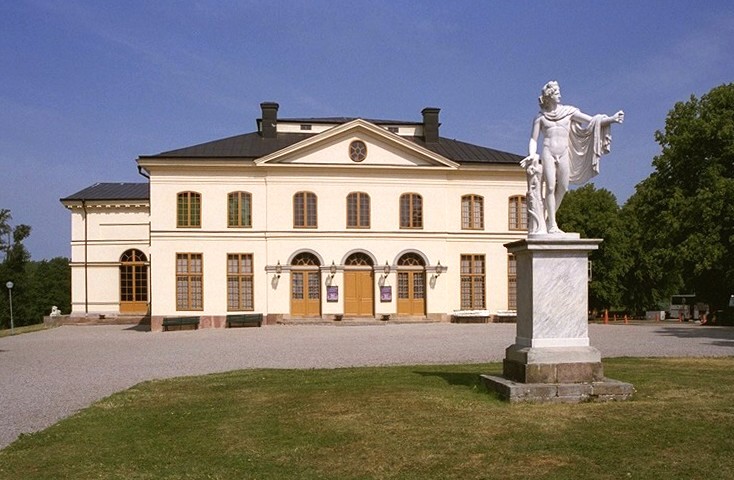
Drottningholm Palace Theatre
59.3231° N · 17.8850° E · Opera House
Photo: Ernmuhl at lb.wikipedia · CC BY-SA 3.0 · Wikimedia Commons
Drottningholm Palace Theatre is the opera house is one of the few 18th century theatres in Europe that is still used as a theatre with its original stage machinery. It is in Stockholm, Sweden. Completed in 1766 for Queen Lovisa Ulrika. The free Lokali audio guide runs 7 minutes.
✓ Published October 2026 · how we write these guides
Visitor facts
| Lokali audio guide | 7 min · free |
|---|---|
| Type | Opera House |
| Location | Stockholm, Sweden |
| Coordinates | 59.3231, 17.8850 |
| Official website | dtm.se |
| Languages | 50+, in the Lokali app |
The story
Step inside, and the first thing you notice is the smell. Old wood, dry and faintly sweet, like the inside of a violin case. The light is low and warm. The floor gives slightly underfoot. Around you, painted columns and pale marble walls frame a stage that seems almost too deep for the room. Take a breath here. You are standing in one of the very few eighteenth-century theatres in the world that still works the way it did when it opened.
From the outside, you might have walked right past it. The building sits beside Drottningholm Palace, on the island of Lovön in Lake Mälaren, just west of central Stockholm. Its facade is modest and calm, with plain walls and simple windows. Nothing announces the treasure inside. That restraint is part of the surprise. The real show was always meant to happen within these walls, by candlelight, for a small and very privileged audience.
The theatre was completed in 1766 for Queen Lovisa Ulrika of Sweden. She was a sister of Frederick the Great of Prussia, and she brought a love of learning, music and the arts to the Swedish court. An earlier theatre on this site had burned down a few years before. For the new one, the architect Carl Fredrik Adelcrantz designed a building that was practical, elegant and, above all, built for illusion.
Look closely at the walls around you. Much of what seems to be marble is painted wood. Some of the fine ornaments are papier-mâché, a light material made from paper and glue. This was not cheap shortcutting. It was theatre logic. The whole room is a stage set in itself, designed to look grand by flickering light. In daylight you can see the trick. By candlelight, it becomes a palace.
The theatre had its golden age under Lovisa Ulrika's son, King Gustav III. He was passionate about drama. He wrote plays, supported Swedish-language theatre and opera, and filled the court with performances. Courtiers took roles on stage alongside professional performers. For a few decades in the late eighteenth century, this little building on an island was one of the most active cultural rooms in Sweden.
Then everything stopped. In 1792, Gustav III was shot at a masked ball at the opera house in Stockholm and died of his wounds. After his death, interest in court theatre faded. The building at Drottningholm was used less and less. Eventually it was closed up and largely forgotten. And here is the twist that saved it... nobody modernised it.
For well over a century, the theatre simply waited. Other European court theatres were rebuilt, burned or fitted with new technology. This one kept its original machinery, its painted scenery and its wooden structure. Then, in the early 1920s, the theatre historian Agne Beijer came here and recognised what he had found. He began the work of bringing the theatre back to life. Today it is among the best preserved theatres of its age anywhere.
Now turn your attention to the stage itself. Notice how deep it is, stretching far back into the building. Along each side stand flat painted panels called wings, arranged in pairs, one behind the other. Together with painted backdrops, they create perspective. A forest, a temple or a palace hall seems to stretch into the distance, even though everything is flat canvas and wood.
Here is the detail most visitors miss. These wings can change in seconds, all at once, while the audience watches. Beneath the stage, the wings sit on wooden carriages connected to a large shaft. Stagehands turn a capstan, a kind of wooden winch, and every wing slides out while a new set slides in. In the eighteenth century, an audience would gasp at this transformation. It still works today, with the same basic mechanism.
The theatre also keeps its original sound-effect machines. There is a wave machine, made of shaped wooden rollers that turn to make painted seas rise and fall. There is a wind machine that makes a rushing sound when fabric rubs against wood. There is a thunder machine that rolls heavy weight across the boards above. Trapdoors let gods and spirits rise from below, and flying gear lets them descend from above. Nothing here uses electricity to move.
The collection of original stage scenery is just as remarkable. Many painted sets from the eighteenth century survive and are kept with care. Each one was made for a type of scene that could be reused across many plays: a palace, a prison, a garden, a harbour. If you take a guided tour, you may see examples, and you can begin to imagine how a single evening could move through several worlds.
The theatre is part of the Royal Domain of Drottningholm, which UNESCO listed as a World Heritage Site in 1991. The palace next door is still a home of the Swedish royal family. In summer, the theatre comes alive again with performances of eighteenth-century opera and ballet. Musicians often play period instruments. The lighting imitates the warm, uneven glow of candles. Audiences sit close, much as the court once did.
If you are visiting outside a performance, the guided tour is the way inside. Take your time in the auditorium. Imagine the king and queen seated near the front, with rows of courtiers arranged behind them by rank. Where you sat said who you were. Even the view of the stage was a sign of status. The best perspective of the painted scenery was meant for royal eyes.
Before you leave, pause for a moment and look back at the stage. Notice the quiet. Notice how the old wood holds the sound of your own steps. When you walk out into the open air, past the palace and toward the water, the plain little building behind you will look ordinary again. But now you know what waits inside... a whole world of waves, thunder and painted skies, still ready for its next cue.
Key facts
What to look for
Practical tips
Common questions
Is there a free audio guide to Drottningholm Palace Theatre?
Yes — the Lokali app narrates Drottningholm Palace Theatre free of charge in 50+ languages. The guide runs about 7 minutes, covers the history, what to look for on site and practical tips, and works offline once downloaded.
Where is Drottningholm Palace Theatre?
Drottningholm Palace Theatre is in Stockholm, Sweden, at 59.3231, 17.8850. Tap the map link on this page for directions from where you are.
What is Drottningholm Palace Theatre known for?
Completed in 1766 for Queen Lovisa Ulrika. Architect Carl Fredrik Adelcrantz designed the theatre.
What should you look for at Drottningholm Palace Theatre?
Painted wood made to look like marble. Papier-mâché ornaments decorating the auditorium. Deep stage with paired painted wings receding back.
What should you know before visiting Drottningholm Palace Theatre?
Join a guided tour to see the auditorium and stage. Book summer opera performances well in advance.
When is the best time to visit Drottningholm Palace Theatre?
Book summer opera performances well in advance.
On the map
Opens directions to Drottningholm Palace Theatre from your location.
More to see in Stockholm


Hear Drottningholm Palace Theatre in your language
The full story, narrated, in 50+ languages. Download it before you go and it plays offline, at your own pace, with no ticket and no tour group.