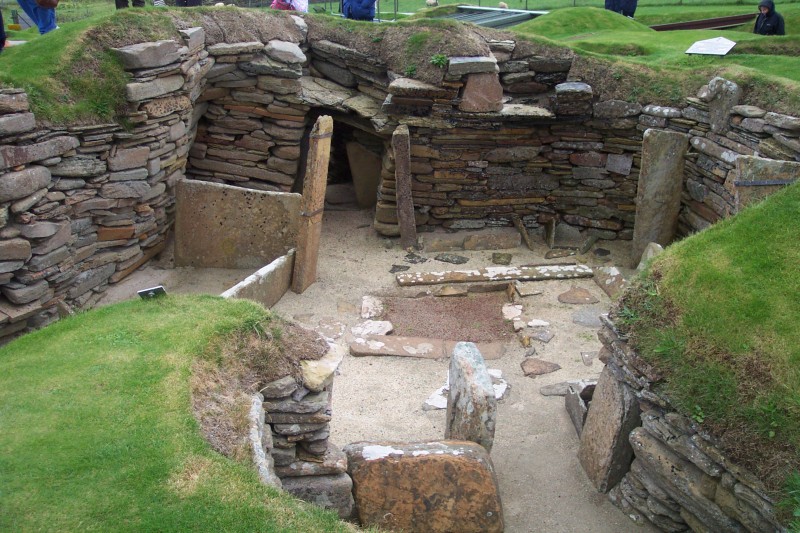
Skara Brae
59.0487° N · 3.3418° W · Archaeological Site
Photo: Dr. John F. Burka · CC BY-SA 3.0 · Wikimedia Commons
Skara Brae is a neolithic archaeological site in Scotland. Village occupied roughly 3100 to 2500 BCE. The free Lokali audio guide runs 7 minutes.
✓ Published October 2026 · how we write these guides
Visitor facts
| Lokali audio guide | 7 min · free |
|---|---|
| Type | Archaeological Site |
| Location | Stromness, United Kingdom |
| Coordinates | 59.0487, -3.3418 |
| Languages | 50+, in the Lokali app |
The story
Listen first. Wind comes in hard off the Atlantic, and beneath it you can hear the long hiss of waves dragging across the sand of the Bay of Skaill. The grass is short and springy underfoot. Ahead of you, sunk into the turf, are grey stone walls with no roofs. From a distance they look like hollows in a green blanket. Up close, they are rooms. People lived in them five thousand years ago.
This is Skara Brae, a Neolithic village on the west coast of Orkney's Mainland, a short drive north of Stromness. Neolithic simply means the New Stone Age, when people in this part of the world had begun to farm, keep animals and build permanent homes. Radiocarbon dating shows the village was occupied for several centuries, from around 3100 BCE to around 2500 BCE. That makes these houses older than Stonehenge in its completed form, and older than the Great Pyramids of Giza.
For most of the last four thousand years, nobody knew the village was here. Sand blew over it and grass grew on top. Then, in the winter of 1850, a violent storm tore the turf from a high dune on this shore. When the wind dropped, stone walls were showing through the sand. The local laird, William Watt of nearby Skaill House, began to dig. What he found was strange. These were not ruins in the usual sense. They were whole rooms, still furnished.
The first big surprise is the furniture. Look down into any of the better-preserved houses. You will see a stone dresser standing against the back wall, facing the doorway. It has shelves made of thin flat slabs. Orkney has very few trees, but it has plenty of flagstone, a stone that splits cleanly into sheets. So the people here built their furniture from stone. Because of that, it is still standing after five thousand years.
Each house follows a similar plan, and once you learn it you can read every room. A square hearth sits in the centre of the floor. Box beds, framed by upright slabs, sit on either side. The dresser faces the entrance, so it was the first thing a visitor saw. Some archaeologists think it worked as a display, a place to show valued objects. It is a little like a modern living room arranged around a television.
Set into some floors are small stone-lined boxes, sealed at the joints with clay. Archaeologists usually call them tanks. One common idea is that they held water to keep shellfish fresh, perhaps limpets used as fishing bait. This is a careful guess, not a certainty. But it reminds you how close the sea was to daily life here. When the village was lived in, the shoreline was further away. The bay you see today has slowly moved inland and eaten into the land.
Now notice how the houses sit in the ground. They are not freestanding. The villagers packed them round with midden, a thick mix of household rubbish, ash, shells and bones. Over time this material became firm and earthy. It held the walls in place and kept out the wind. The houses were linked by low, roofed passages, so a person could move between homes without stepping out into the weather. On a day like this, you will understand why.
The second big surprise is how the village was first understood. After the early digging, the site was damaged by another storm in the 1920s. A sea wall was built to protect it. Then the archaeologist Vere Gordon Childe excavated here in the late 1920s. Early investigators believed the village was much younger than it is. Only when radiocarbon dating arrived in the twentieth century did the true age become clear. The houses were far older than anyone had imagined.
One house stands apart from the rest. It is usually called House 8, and it has no beds and no dresser. Instead, archaeologists found signs of work — stone tools, and traces of making things. Many think it served as a workshop. It suggests a community that shared tasks and perhaps skills. Elsewhere, people here made a style of decorated pottery known as Grooved Ware, and carved stone balls whose purpose is still debated.
Skara Brae does not stand alone. It belongs to a wider landscape of Neolithic monuments on this island. Together with the Ring of Brodgar, the Standing Stones of Stenness and the chambered tomb of Maeshowe, it forms a UNESCO World Heritage Site called the Heart of Neolithic Orkney. The village gives that landscape a human scale. The great stone circles show what these people believed. Here you see where they slept and cooked.
On the way in from the visitor centre, take a moment with the reconstructed house. It is a full-size model of one of the dwellings, with a roof in place. Step inside and stand by the hearth. Notice how dark it is, and how quickly the noise of the wind fades. Then walk out to the real village. The empty stone rooms make more sense once you have felt how warm and enclosed they once were.
The sea that uncovered this village is now its biggest threat. Storms still batter this coast, and rising sea levels make them more dangerous. The sea wall below the houses is part of a long effort to keep the site from washing away. The paths keep visitors above the houses, looking down. This protects the fragile floors and walls. It also gives you the best view into each room.
Before you leave, stand at the edge of the walls for a moment. Look into one house and find the hearth, the beds, the dresser. Then lift your eyes to the bay — the same water, the same wind, the same pale light that the people here knew. As you walk back along the path, listen again to the waves. They buried this village, and then, one winter night, they gave it back.
Key facts
What to look for
Practical tips
Common questions
Is there a free audio guide to Skara Brae?
Yes — the Lokali app narrates Skara Brae free of charge in 50+ languages. The guide runs about 7 minutes, covers the history, what to look for on site and practical tips, and works offline once downloaded.
Where is Skara Brae?
Skara Brae is near Stromness, United Kingdom, at 59.0487, -3.3418. Tap the map link on this page for directions from where you are.
What is Skara Brae known for?
Village occupied roughly 3100 to 2500 BCE. Older than the Great Pyramids of Giza.
What should you look for at Skara Brae?
Stone dressers facing each house doorway. Box beds framed by upright flagstone slabs. Clay-sealed stone tanks set into floors.
What should you know before visiting Skara Brae?
Visit the reconstructed house before walking to the village. Bring a windproof layer even on sunny days.
On the map
Opens directions to Skara Brae from your location.
More to see near Skara Brae


Hear Skara Brae in your language
The full story, narrated, in 50+ languages. Download it before you go and it plays offline, at your own pace, with no ticket and no tour group.