Photo: 8mobili · CC BY-SA 3.0 de · Wikimedia Commons
Porsche Museum is an automobile museum in Germany. The museum opened in Zuffenhausen in 2009. The free Lokali audio guide runs 7 minutes.
✓ Published October 2026 · how we write these guides
Visitor facts
| Lokali audio guide | 7 min · free |
|---|---|
| Type | Museum |
| Location | Stuttgart, Germany |
| Coordinates | 48.8345, 9.1519 |
| Official website | porsche.com |
| Languages | 50+, in the Lokali app |
The story
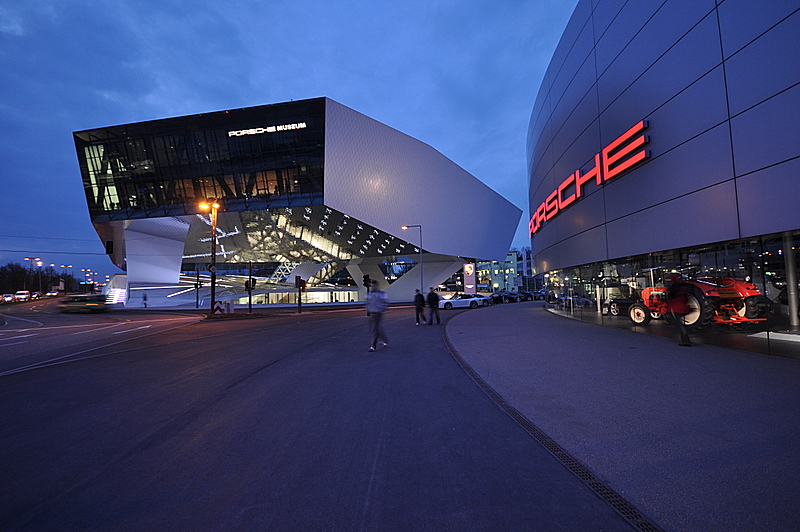
Listen for a moment before you go inside. Somewhere close by, an engine turns over. It is a deep, flat, mechanical sound, and in this part of Stuttgart it is part of everyday life. You are standing in Zuffenhausen, an industrial district on the northern edge of the city. Across the road is the Porsche factory, where cars are still built today. The museum stands directly in front of it, white and angular, as if it has landed here.
Look at the building itself. The main exhibition hall does not sit on the ground the way most buildings do. It rests on a few heavy concrete supports, and the rest of the structure seems to hang in the air above the plaza. You can walk underneath it. The faceted white surfaces catch the daylight differently on each side. On a grey day the building looks cool and sharp. In low evening sun it turns warm and almost pale gold.
The museum opened in 2009. The design came from a Viennese practice, Delugan Meissl Associated Architects, and they set themselves a clear idea. A car is about movement, so the building should look as if it is moving too. There are very few right angles here. Lines lean, walls tilt, and the whole volume points forward like the nose of a car. Keep that idea in mind when you go inside, because the interior follows the same logic.
Before you leave the plaza, glance at the traffic circle nearby. Several white Porsche 911s are lifted high on slender columns, raised far above the road. Most visitors photograph it on the way in and never think about it again. But it says something about this company. The 911 is not just one model here. It is the shape that people in this district have built, tuned and argued about for more than half a century.
Inside, a long escalator carries you up from the bright foyer into the exhibition. It feels a little like entering a different world. The noise of the street disappears. The space opens into one large, flowing hall, mostly white, with ramps and levels that slide into each other. There are no small rooms and no heavy doors. You can see from one era to the next, and the cars almost seem to float on the pale floor.
The story begins long before the first sports car. Ferdinand Porsche was an engineer from Bohemia, in today's Czech Republic. Around 1900 he was already designing vehicles, including early electric cars. Here is the first surprise for many visitors. One of the oldest machines in the collection is not a roaring petrol car at all. It is an electric carriage from the very end of the nineteenth century, built for an Austrian coachbuilder, long before electric cars became a modern subject again.
In 1931, Ferdinand Porsche opened his own engineering office in Stuttgart. At first, the company did not build cars under its own name. It designed them for others. The most famous of these projects was the car that became the Volkswagen Beetle. Look for the early streamlined prototypes in this section. Their smooth, rounded bodies were shaped to cut through the air, and you can see a clear family line leading to the later sports cars.
The first car to carry the Porsche name was the 356, which appeared in 1948. It was first produced in a small town in Austria, in a former sawmill, before production moved back to Stuttgart. Walk around one of these cars slowly. It is small, low and soft in shape, with almost no sharp edges. Many people expect something big and aggressive. Instead, the 356 looks modest — almost gentle.
Then comes the car that defined everything after it. The 911 was presented in 1963, but it was first shown under a different name, the 901. A French carmaker held the rights to three-digit model names with a zero in the middle. So the number changed, and the 911 was born. That small legal dispute gave the world one of its most recognised model names. Notice how the basic outline, with round headlights and a sloping back, has changed less than you might expect over the decades.
Now look for the racing cars. Many of them sit together, and some still show the marks of hard use. Racing has always been central to this company. The long-tail 917 is one to find. A 917 gave Porsche its first overall victory at the Le Mans 24-hour race in France in 1970. Le Mans is an endurance race that runs through a full day and night, so a win there tests reliability as much as speed.
Here is another detail many visitors miss. The museum is not a frozen display. Cars from the collection are maintained in a working state, and many leave the building to appear at events and historic races around the world. That means the line-up you see today may be different from the line-up a few months ago. There is also a museum workshop where specialists care for these machines, and depending on the day you may be able to look in.
Take a moment to notice how the cars are shown. There are few barriers and few glass cases. The lighting is even and bright, so the paint colours stay true — silver, white, racing red, and the deep greens and blues of older models. The designers wanted you to look at shape and surface, not at decoration. Try crouching to the height of a headlight. From that angle the curves of a body make far more sense.
When you leave, walk out under the building again and look back up at it. Across the road, the factory continues its work. New cars leave the gates, and test drivers pull out into ordinary Stuttgart traffic. The museum tells a long story, but the story is still being written a few metres away. You may hear that same flat engine sound from earlier.
This time, perhaps, it sounds a little more familiar. Stand still for a second. Feel the cool air under the raised hall, look at the white cars lifted above the traffic circle, and listen to the district around you. This is not a place that only remembers machines. It is a place that still makes them.
Key facts
What to look for
Practical tips
Common questions
Is there a free audio guide to Porsche Museum?
Yes — the Lokali app narrates Porsche Museum free of charge in 50+ languages. The guide runs about 7 minutes, covers the history, what to look for on site and practical tips, and works offline once downloaded.
Where is Porsche Museum?
Porsche Museum is near Stuttgart, Germany, at 48.8345, 9.1519. Tap the map link on this page for directions from where you are.
What is Porsche Museum known for?
The museum opened in Zuffenhausen in 2009. Designed by Viennese firm Delugan Meissl Associated Architects.
What should you look for at Porsche Museum?
The exhibition hall resting on a few concrete supports. White 911s raised high on columns at the traffic circle. An electric carriage from the late nineteenth century.
What should you know before visiting Porsche Museum?
Walk underneath the raised hall before heading inside. Ride the long escalator and pause at the top.
On the map
Opens directions to Porsche Museum from your location.
More to see in Stuttgart


Hear Porsche Museum in your language
The full story, narrated, in 50+ languages. Download it before you go and it plays offline, at your own pace, with no ticket and no tour group.