Sukhothai Historical Park
17.0131° N · 99.7023° E · Archaeological Site
Sukhothai Historical Park is an archaeological site in Sukhothai, Thailand. Founded 1238 as first independent Thai capital. Covers seventy square kilometres of ruins and temples. Most visitors spend 3-4 hours here. The free Lokali audio guide runs 6 minutes.
✓ Verified October 2026 · how we write these guides
Visitor facts
| Time needed | 3-4 hours |
|---|---|
| Lokali audio guide | 6 min · free |
| Type | Archaeological Site |
| Best for | History |
| Location | Sukhothai, Thailand |
| Coordinates | 17.0131, 99.7023 |
| Languages | 45, in the Lokali app |
The story
The ground beneath your feet is reddish laterite, warm even in shade, the same stone these builders quarried eight centuries ago. Around you, stupas and chedis rise from manicured lawns, their brick cores exposed where stucco has fallen away, revealing the bones of a kingdom that ruled northern Thailand for nearly two hundred years.
Sukhothai means "Dawn of Happiness", and this was the first capital of an independent Thai state, founded in 1238 when local chieftains threw off Khmer overlords from Angkor. For a brief, brilliant window — roughly 1238 to 1438 — this was the political and spiritual centre of a new culture, the place where the Thai script was invented, where Theravada Buddhism took root as the state religion, where a distinctive architectural language emerged that would shape temple-building across the region for centuries.
The park covers nearly seventy square kilometres, though most visitors focus on the central zone where you are now. Within these walls once stood the royal palace, major monasteries, dozens of smaller shrines. What you see today is partly original ruin, partly careful reconstruction — the Fine Arts Department began restoration work in the nineteen-sixties, and UNESCO declared the site a World Heritage area in 1991. The line between authentic decay and modern repair is not always obvious, but the scale and ambition of the original city remain clear.
Wat Mahathat, the largest temple complex here, sits at the heart of the old royal quarter. Its central prang — a Khmer-style corn-cob tower — is surrounded by nearly two hundred smaller chedis, each marking a donation or memorial. Walk the raised platforms and you will find rows of Buddha images, some intact, some headless, their gestures frozen mid-blessing. The Sukhothai Buddha has a distinctive profile: oval face, arched brows, a flame-like ushnisha on the crown of the head. Sculptors here developed what art historians call the "walking Buddha" pose, one foot lifted, the body in gentle motion, a departure from the static seated figures of earlier traditions.
To the west of Wat Mahathat stands Wat Si Sawai, its three Khmer-style prangs predating the Thai city — this was likely a Hindu shrine before Sukhothai's founders converted it to Buddhist use. The towers are squat, powerful, their surfaces pocked with centuries of monsoon rains. Look closely at the lintels above doorways and you can still make out faint carvings, apsaras and nagas, remnants of the Angkorian world this kingdom displaced.
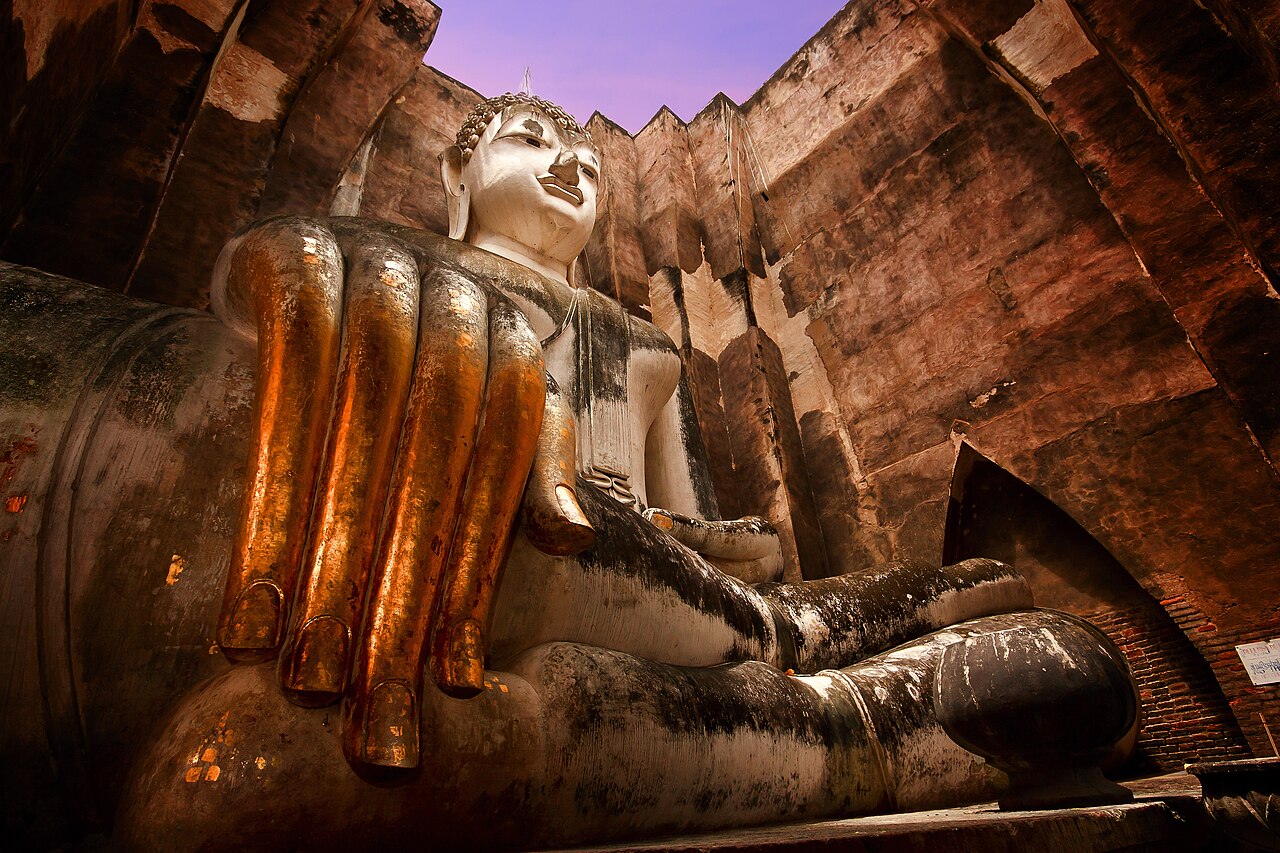
North of the central zone, Wat Si Chum holds one of the park's most arresting images: a massive seated Buddha, fifteen metres tall, wedged into a square mondop so tight that only the figure's face and hands are visible from the entrance. The effect is theatrical, almost cinematic — you approach through a narrow corridor and suddenly the Buddha's serene face fills your vision, fingers raised in abhaya mudra, the gesture of fearlessness. Pilgrims have been gold-leafing those fingers for generations; they gleam even in low light.
The best light for photography arrives early, just after dawn, when mist clings to the lotus ponds and the brick stupas glow pale orange. By mid-morning the sun is high and harsh, flattening detail. Late afternoon brings softer angles again, long shadows stretching across the grass, and the park empties of tour groups. If you rent a bicycle at the entrance, you can cover the central zone in two hours, though the outer zones — east, north, west — require more time and a tolerance for rough paths.
King Ramkhamhaeng, Sukhothai's third and most celebrated ruler, is credited with inventing the Thai script in 1283, adapting Khmer and Mon alphabets into a new phonetic system. A stone inscription attributed to him, now in Bangkok's National Museum, describes a kingdom where "there are fish in the water and rice in the fields", a place of prosperity and justice. Modern scholars debate the inscription's authenticity — some argue it was carved centuries later to legitimize Bangkok's claims to Thai heritage — but the myth of Sukhothai as a golden age persists in national memory.
By the early fifteenth century, power had shifted south to Ayutthaya, a newer, more strategically located capital with access to maritime trade routes. Sukhothai became a provincial backwater, its temples abandoned to jungle and weather. For five hundred years, the ruins lay mostly forgotten, known to locals but ignored by the outside world. Restoration began in earnest only in the nineteen-sixties, a project tied to Thailand's post-war nation-building and tourism development.
As you walk these grounds, you are moving through layers: the original Khmer shrines, the Thai city built over them, the twentieth-century reconstruction that made the site legible again, and now the daily flow of visitors, Thai and foreign, each projecting their own meanings onto these stones. The laterite is warm underfoot. The chedis catch the light. The Buddhas sit in their gestures of teaching and protection, weathered but still present, still watching.
Key facts
What to look for
Practical tips
Common questions
How long do you need at Sukhothai Historical Park?
Plan 3-4 hours. That is the time most visitors spend at Sukhothai Historical Park. The free Lokali audio guide runs 6 minutes and is made to listen to while you walk.
Is there a free audio guide to Sukhothai Historical Park?
Yes — the Lokali app narrates Sukhothai Historical Park free of charge in 50+ languages. No ticket, tour group or subscription, and it works offline once downloaded.
Where is Sukhothai Historical Park?
Sukhothai Historical Park is in Sukhothai, Thailand, at 17.0131, 99.7023. Tap the map link on this page for directions.
What should you know before visiting Sukhothai Historical Park?
Arrive at dawn for mist and soft light on stupas
What is Sukhothai Historical Park known for?
Founded 1238 as first independent Thai capital
What is the best time to visit Sukhothai Historical Park?
Arrive at dawn for mist and soft light on stupas
On the map
Opens directions to Sukhothai Historical Park from your location.
More to see in Sukhothai


Hear Sukhothai Historical Park in your language
The full story, narrated, in 50+ languages. Download it before you go and it plays offline, at your own pace, with no ticket and no tour group.