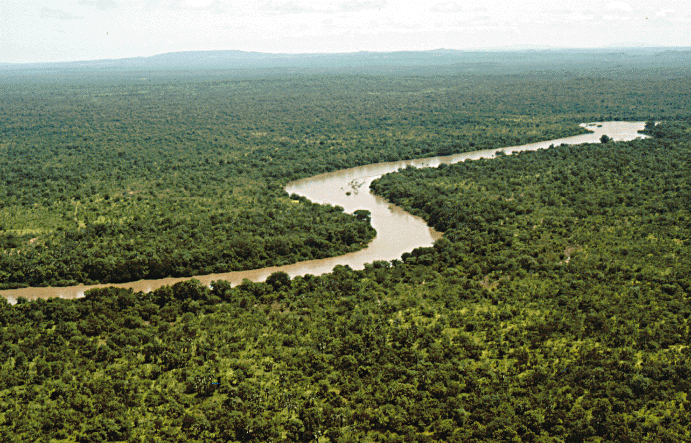
Niokolo-Koba National Park
13.0742° N · 12.7222° W · National Park
Photo: United States government · Public domain · Wikimedia Commons
Niokolo-Koba National Park is a national park of Senegal and UNESCO World Heritage Site. UNESCO World Heritage Site since 1981. The free Lokali audio guide runs 7 minutes.
✓ Published October 2026 · how we write these guides
Visitor facts
| Lokali audio guide | 7 min · free |
|---|---|
| Type | National Park |
| Location | Tambacounda Region, Senegal |
| Coordinates | 13.0742, -12.7222 |
| Languages | 50+, in the Lokali app |
The story
Listen first. Before you see any animal, you will hear the park. Dry grass ticks and rustles in the heat. A francolin calls from the scrub, sharp and repeated. Somewhere beyond the trees, the Gambia River moves slowly, brown and patient. The air smells of dust, warm leaves, and woodsmoke from a distant village. This is Niokolo-Koba, in the far southeast of Senegal. It is one of the largest protected areas in West Africa, and it holds a wilderness that has almost vanished from this part of the continent.
The scale is hard to picture from one viewpoint. The park covers more than nine thousand square kilometres of savanna, woodland, gallery forest and low hills. It stretches toward the border with Guinea, far from the coast and the Atlantic breezes of Dakar. Here the climate is continental and strongly seasonal. Long dry months turn the grass gold and grey. Then the rains arrive, the rivers swell, and the whole landscape turns green almost overnight.
Water is the reason this place exists as it does. The Gambia River runs through the park on its long journey west to the sea. Two tributaries join it here, the Niokolo Koba and the Koulountou, and the park takes its name from the first of them. Along their banks, the trees grow tall and close together. This is gallery forest — a narrow strip of shade and moisture that follows the rivers through the open savanna like a green corridor.
Protection here began in the colonial period, during the first half of the twentieth century, when the area was set aside as a hunting reserve. Its status grew over the following decades, and Senegal later made it a full national park. In 1981, UNESCO added Niokolo-Koba to its World Heritage List. In the same year, it was also recognised as a biosphere reserve, a label for places where conservation and local human life are meant to be studied together.
Now for the animals, and for the one that surprises many visitors. The western giant eland, also called the Derby eland, lives in these woodlands. It is the largest antelope in the world. A big male can stand taller than a person at the shoulder, with spiralled horns and pale vertical stripes on its sides. The western form of this animal is now rare, and this park is one of its last real strongholds. Seeing one is a privilege, not a guarantee.
Other large mammals share the park. Lions still live here, part of the small and threatened West African population. Leopards move through the woodland, though they are rarely seen. Buffalo, roan antelope, hartebeest, warthogs and several kinds of smaller antelope graze the open areas. Troops of baboons and other monkeys cross the tracks. In the rivers, hippos rest in the deeper pools, and Nile crocodiles lie on the sandbanks in the morning sun.
Here is a second surprise. Niokolo-Koba is home to chimpanzees. They live near the northwestern edge of their range here, in a landscape much hotter and drier than the rainforests most people imagine for them. Scientists have studied them around Mont Assirik, the highest point in the park. These chimpanzees must travel long distances for food and water. Their life in the savanna has helped researchers think about how early humans may have adapted to open country.
Look up as often as you look ahead. The park records more than three hundred bird species. Bee-eaters flash green and red along the riverbanks. Kingfishers hover and drop into the water. Hornbills, with their heavy curved bills, call from the treetops. Vultures circle high on the warm air in the middle of the day. Near the water, herons and storks stand very still and wait. For many visitors, the birds become the most constant pleasure of the trip.
The story of this park is not only one of abundance. For many years, poaching, cattle grazing, bushfires and pressure from roads and development reduced its wildlife sharply. The elephants that once lived here have almost disappeared. In 2007, UNESCO placed Niokolo-Koba on its List of World Heritage in Danger. It was a serious warning that the park might lose the very values that made it important.
Then came a slow recovery. Senegal increased patrols and worked with conservation partners to protect key species and habitats. Animal counts began to improve, especially for some antelope and for the lions. In 2024, UNESCO removed the park from the danger list. That decision does not mean the work is finished. It means that steady effort over many years made a real difference — and that the landscape around you is still being defended today.
People have always lived around this land. The wider region includes many communities, including Mandinka, Fulani and Bassari groups, whose villages, farms and cattle routes border the park. To the south, near Kédougou, Bassari country has its own World Heritage listing for its cultural landscape. Local guides often come from these communities. Ask them about the plants, the seasons and the animal tracks. Their knowledge of this land is often deeper than any written guide.
The best way to read the park is slowly. Early morning and late afternoon bring the most movement, when the heat eases and animals come to drink. The dry season makes wildlife easier to find, because animals gather near the remaining water and the grass is lower. In the rainy season, some tracks can become difficult or closed. Bring patience, binoculars, and a hat. Long silences in a vehicle or on a riverbank are often rewarded.
So pause for a moment where you are. Notice the colour of the grass, the shade under the trees, the line of the river if you can see it. Listen again for the birds and the wind. Somewhere nearby, an eland may be standing perfectly still among the trees, watching you before you notice it. As you move on, keep your eyes on the edges — the riverbank, the treeline, the tall grass. That is where this park keeps its quietest surprises.
Key facts
What to look for
Practical tips
Common questions
Is there a free audio guide to Niokolo-Koba National Park?
Yes — the Lokali app narrates Niokolo-Koba National Park free of charge in 50+ languages. The guide runs about 7 minutes, covers the history, what to look for on site and practical tips, and works offline once downloaded.
Where is Niokolo-Koba National Park?
Niokolo-Koba National Park is near Tambacounda Region, Senegal, at 13.0742, -12.7222. Tap the map link on this page for directions from where you are.
What is Niokolo-Koba National Park known for?
UNESCO World Heritage Site since 1981. Removed from UNESCO's danger list in 2024.
What should you look for at Niokolo-Koba National Park?
Pale vertical stripes on a giant eland's flanks. Hippos surfacing in deep pools of the Gambia River. Crocodiles basking on sandbanks in morning light.
What should you know before visiting Niokolo-Koba National Park?
Go out at dawn when animals visit the water. Visit in the dry season for easier wildlife viewing.
When is the best time to visit Niokolo-Koba National Park?
Check track conditions before travelling in rainy season.
On the map
Opens directions to Niokolo-Koba National Park from your location.
Hear Niokolo-Koba National Park in your language
The full story, narrated, in 50+ languages. Download it before you go and it plays offline, at your own pace, with no ticket and no tour group.