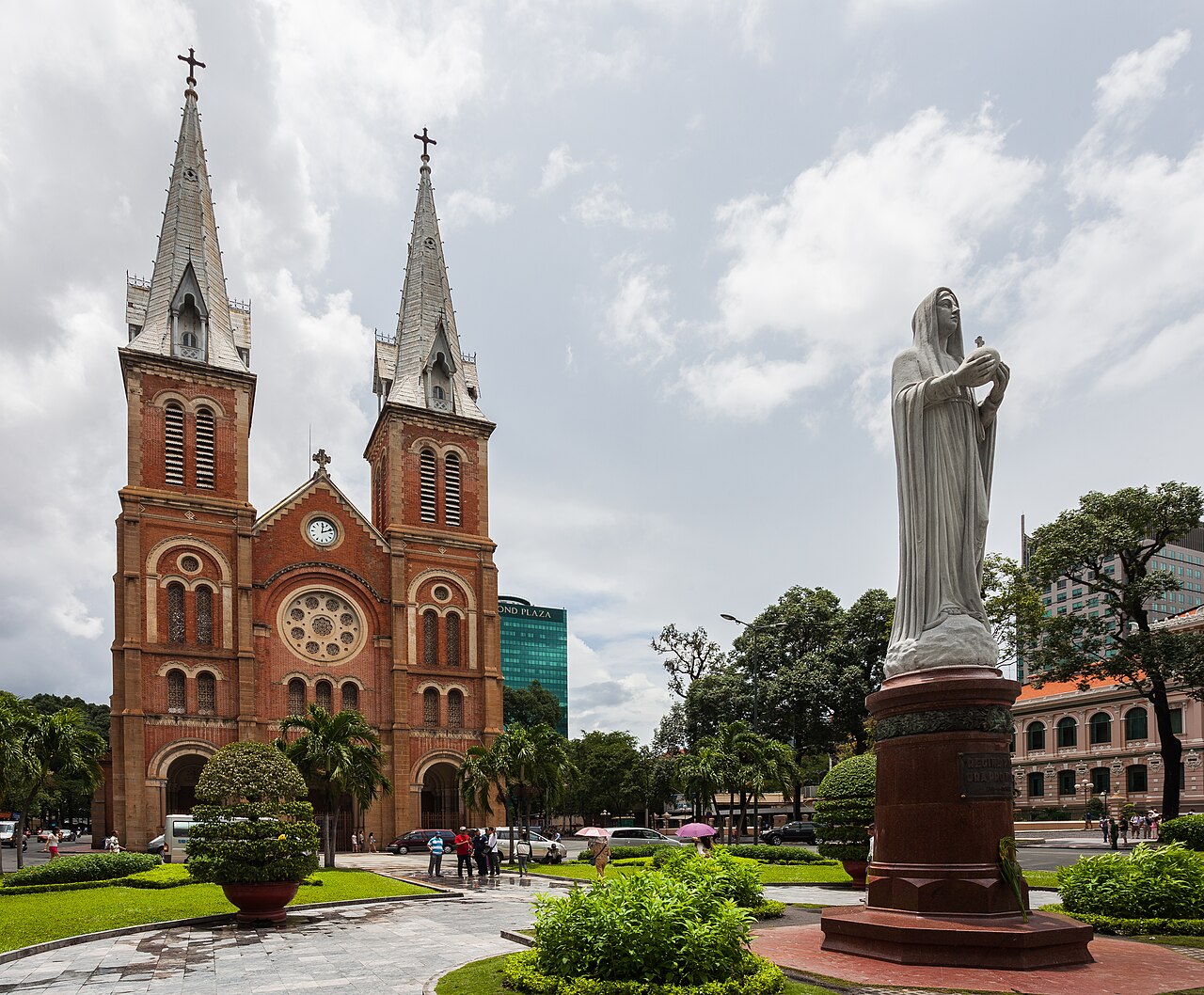
Saigon Notre-Dame Cathedral
10.7794° N · 106.6982° E · Cathedral
Saigon Notre-Dame Cathedral is a cathedral in Thủ Đức, Vietnam. Built by French colonists between 1877 and 1883, this red-brick Gothic cathedral dominates central Ho Chi Minh City. Most visitors spend 30–45 min here. The free Lokali audio guide runs 5 minutes.
✓ Verified August 2026 · how we write these guides
Visitor facts
| Time needed | 30–45 min |
|---|---|
| Lokali audio guide | 5 min · free |
| Type | Cathedral |
| Best for | History |
| Location | Thủ Đức, Vietnam |
| Coordinates | 10.7794, 106.6982 |
| Languages | 45, in the Lokali app |
The story
Two square towers rise above the trees in the center of the city. Their brick is a deep, warm red, the color of dried clay baked in the sun. This is the Notre-Dame Cathedral of Saigon. Around its feet, cars circle a small open square. High above, the bells hang quiet for most of the day, waiting.
French builders raised this church in the years after they took control of the city. The main work ran from 1877 to 1880. They wanted a grand church standing in the heart of their new colonial capital. So they chose a wide, open spot where several roads meet, where it could not be missed.
Almost everything came by ship from France. The red bricks were carried all the way from Marseille. They were never once painted. More than a hundred years later they still hold their color, bright and even across the entire face of the building. The stone, the iron, the roof tiles, much of it crossed the sea to reach this spot.
The two bell towers stand about fifty-eight meters tall. The pointed iron spires set on top of them were added later, in 1895. They lift the towers higher still into the sky. From far down the street, they mark the church long before you reach its doors. The clock and the cross at the very top complete the long climb of the stone toward the sky.
In front of the main entrance stands a pale stone statue. It shows the Virgin Mary, her hands open, her gaze turned out over the square. It was placed here in 1959. People know her as Our Lady of Peace. Many travelers and locals alike stop to stand before her for a quiet moment.
Step inside and the air turns cool and dim at once. The noise of the traffic drops away behind you the moment the door closes. The ceiling lifts high overhead. Rows of slim pillars run in lines toward the altar. Light falls through panes of colored glass and lays soft patches of color on the stone floor. The pews are dark wood, smoothed by countless hands over the years.
The plan is the old shape of a cross, long down the middle with two short arms reaching out. Side chapels line the walls along its length. Candles burn in small red cups, flickering in the dim air. The space feels both very large and deeply calm. Voices drop to a whisper without anyone needing to ask.
This is a working church, not only a sight for visitors. Mass is held here through the week and again on Sunday. Local people fill the wooden pews. Among them sit travelers who slipped quietly inside to rest and to look. The two groups share the very same silence, side by side. A choir sometimes sings, and the sound lifts up into the high ceiling and lingers there.
The square outside the doors has a life all its own. Young couples come to take their wedding photographs. The deep red brick makes a fine backdrop behind them. Sellers offer cold drinks from the shade of the trees. Pigeons rise and settle again around the feet of the stone statue.
Right next door stands the old central post office, from the same years and the same hands of empire. The two buildings face the world together as a pair. They speak of a time when a foreign power tried hard to build a piece of Europe here, in the heat of the tropics.
The church has watched the city change around it many times over. New rulers, new flags, new crowds in the streets. War, then peace, and then war once more. Through all of it, the red towers have stood in the very same spot, holding their ground while everything else moved and shifted. Yet the prayers inside have never truly stopped.
Step back out into the bright light. The towers climb above the noise of the traffic once more. The brick glows warm and rich in the sun. Whatever first brought it here, and whoever once paid for it, the church now belongs to this street, this square, and this city. It simply stands, and waits, and lets the people come to it.
Listen, and you may catch the bells. They do not ring often, but when they do, the sound rolls out across the rooftops. For a moment the old church speaks, and the whole square seems to pause and listen along with you.
Key facts
What to look for
Practical tips
Common questions
How long do you need at Saigon Notre-Dame Cathedral?
Plan 30–45 min. That is the time most visitors spend at Saigon Notre-Dame Cathedral. The free Lokali audio guide adds about 5 minutes of narration you can listen to as you walk, so it fits inside your visit rather than adding to it.
Is there a free audio guide to Saigon Notre-Dame Cathedral?
Yes — the Lokali app narrates Saigon Notre-Dame Cathedral free of charge in 50+ languages. It covers the history, what to look for on site and practical tips, and it works offline once downloaded.
Where is Saigon Notre-Dame Cathedral?
Saigon Notre-Dame Cathedral is in Thủ Đức, Vietnam, at 10.7794, 106.6982. Tap the map link on this page for directions from where you are.
What should you know before visiting Saigon Notre-Dame Cathedral?
Visit early morning for cooler air and fewer crowds.
What is Saigon Notre-Dame Cathedral known for?
Built by the French between 1877 and 1880.
What is the best time to visit Saigon Notre-Dame Cathedral?
The cathedral sits directly across from the Central Post Office.
On the map
Opens directions to Saigon Notre-Dame Cathedral from your location.
More to see in Thủ Đức


Hear Saigon Notre-Dame Cathedral in your language
The full story, narrated, in 50+ languages. Download it before you go and it plays offline, at your own pace, with no ticket and no tour group.