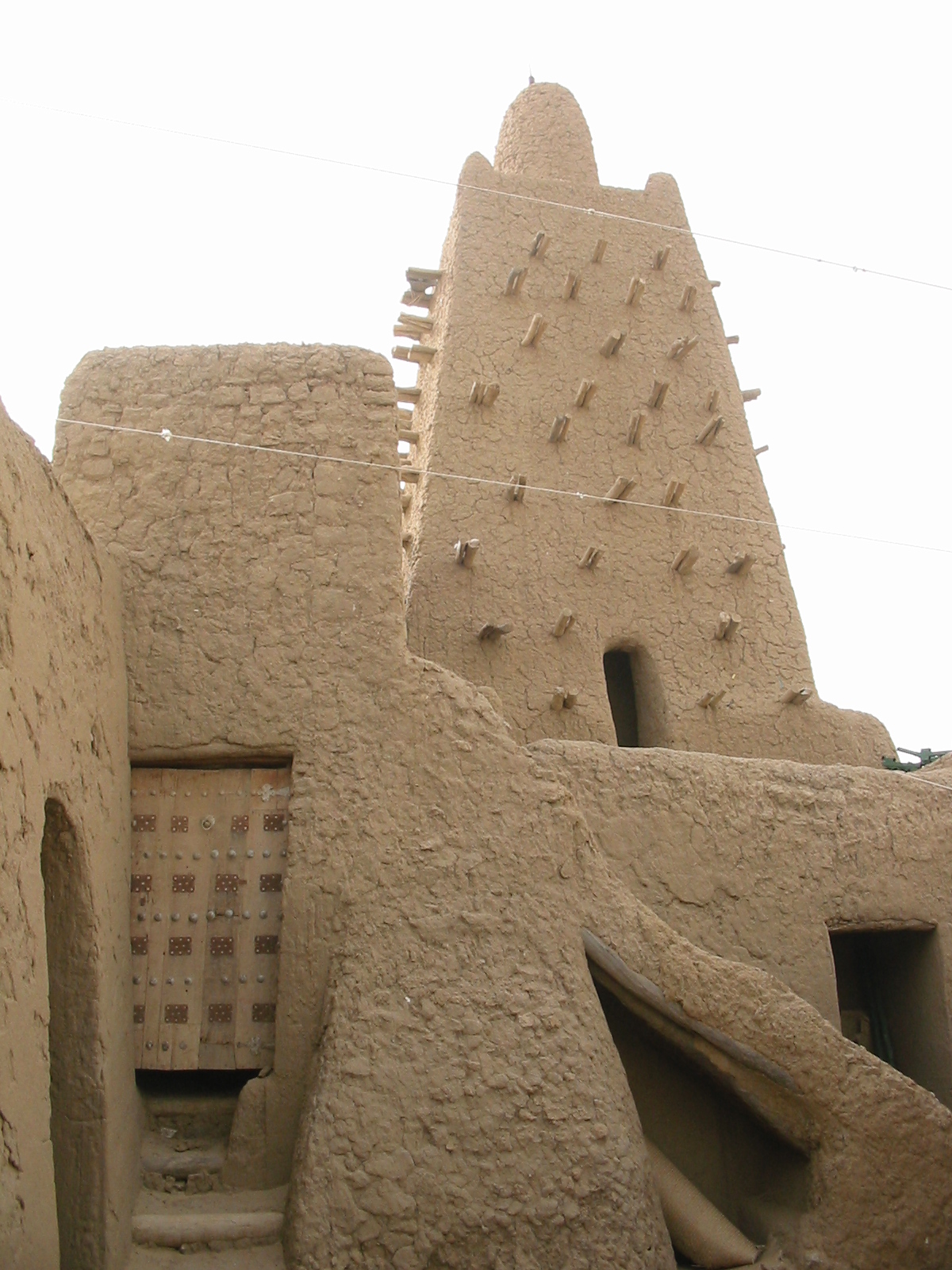
Photo: KaTeznik · CC BY-SA 2.0 fr · Wikimedia Commons
Djinguereber Mosque is a mosque in Timbuktu, Mali. Construction is generally dated to around 1327. The free Lokali audio guide runs 7 minutes.
✓ Published October 2026 · how we write these guides
Visitor facts
| Lokali audio guide | 7 min · free |
|---|---|
| Type | Mosque |
| Location | Timbuktu, Mali |
| Coordinates | 16.7714, -3.0100 |
| Languages | 50+, in the Lokali app |
The story
Listen first. A dry wind moves across the open ground, carrying fine sand that settles on your sleeves. The walls in front of you are the colour of the earth under your feet, because they are that earth. Run your eyes along the surface and you can see it is not smooth. It carries hand marks, soft ridges, small cracks that have been patched again and again. This is the Djinguereber Mosque, and it is built almost entirely from mud.
The building stands on the southwestern side of Timbuktu's old town. Timbuktu sits near the southern edge of the Sahara, close to the Niger River. For centuries, that position made the city a meeting point. Camel caravans arrived from the north with salt. Boats came along the river with gold, grain and other goods from the south. Merchants, scholars and pilgrims passed through. This mosque grew up at the centre of that traffic, and it has served the city's Muslim community for roughly seven hundred years.
The story usually begins with Mansa Musa, ruler of the Mali Empire in the fourteenth century. Mali was a vast West African state, and Mansa Musa is remembered above all for his pilgrimage to Mecca in the 1320s. Accounts from that journey describe a huge travelling party and so much gold that prices in Cairo were affected. When he returned, he brought scholars and craftsmen with him. Construction of this mosque is generally dated to around 1327, soon after his return.
Tradition credits the design to a poet and architect from Muslim Spain, known as Abu Ishaq es-Saheli, who travelled back with the emperor. How much of today's building reflects his original plan is hard to say. Here is the first surprise for many visitors. The mosque you see is not a single fourteenth century structure. It has been extended, rebuilt and repaired across many generations, so it carries the work of many hands.
One of the most important rebuilding phases came in the sixteenth century. A respected local judge, the qadi al-Aqib, directed major works on the mosque during that period. By then, Timbuktu had become one of the great centres of learning in the Islamic world. Scholars taught law, theology, astronomy and grammar. Families collected manuscripts and copied them by hand. This mosque, together with the Sankore and Sidi Yahia mosques, formed part of that world of study and prayer.
Now look at the building itself. The main material is banco, a local mix of earth, water and straw or other plant fibre. Builders shape it into bricks, lay the walls, and then coat them with a smooth layer of the same mud. Limestone was also used in parts of the structure. The result is thick, heavy walls that stay cool inside during the hottest hours. In a desert climate, that thickness is not decoration. It is a practical answer to the sun.
You will notice wooden beams sticking out from the walls and the tower, like rows of short spikes. They are called toron. A visitor might think they are decorative, and in a way they are. But their main job is practical. They act as a permanent scaffold. When masons need to repair the walls, they climb on these beams and reach every part of the surface. The building is designed to be maintained, not simply finished.
This leads to the second surprise. A mud building cannot be left alone. Rain, wind and heat wear the surface away every year. So the community renews it. Masons, often from families who have passed the craft down for generations, lead the work. Local people help carry mud and water. In a real sense, the mosque survives because the city keeps rebuilding it by hand. The building and its caretakers are part of the same story.
In 1988, UNESCO listed Timbuktu as a World Heritage Site. The listing covers this mosque, the Sankore and Sidi Yahia mosques, and a group of saints' mausoleums, or tombs, around the city. The site has faced serious threats. Sand from the desert has pressed against the walls. Changes in rainfall have also damaged the earthen surfaces. For long periods, the site has appeared on UNESCO's list of World Heritage in Danger.
The most painful chapter came in 2012. Armed groups took control of northern Mali, including Timbuktu. They destroyed many of the city's mausoleums, which local people had honoured for centuries. Some tombs connected to this mosque were among those damaged. After the occupation ended, local masons worked with UNESCO and other partners to rebuild what had been lost. They used traditional materials and methods, guided by the memory and skill of the community.
If you are visiting, remember that this is first a working place of worship. Access to the interior for non-Muslim visitors may be limited, and rules can change. Ask a local guide or the mosque's caretakers before you approach any entrance. Dress modestly, and keep your voice low near prayer times. Security conditions in this region also change, so travellers should follow current official advice and local guidance closely.
Even from outside, there is a lot to see. Notice the tapering tower, wider at the base and narrower at the top. Notice how the walls lean slightly inward as they rise, which helps them carry their own weight. Look at the corners and buttresses, softened and rounded by repeated layers of plaster. In the late afternoon, low sunlight brings out every ridge and hand mark. The colour moves from pale sand towards a warmer brown as the day goes on.
As you stand here, think about the materials around you. The same earth lies in the streets, in the walls of nearby houses, and in the dust on your shoes. Nothing in this mosque came from very far away, except perhaps the ideas. When you walk away, look back once at the tower and the rows of wooden beams. Someone will climb them again soon, with a basket of mud, to keep this place standing.
Key facts
What to look for
Practical tips
Common questions
Is there a free audio guide to Djinguereber Mosque?
Yes — the Lokali app narrates Djinguereber Mosque free of charge in 50+ languages. The guide runs about 7 minutes, covers the history, what to look for on site and practical tips, and works offline once downloaded.
Where is Djinguereber Mosque?
Djinguereber Mosque is in Timbuktu, Mali, at 16.7714, -3.0100. Tap the map link on this page for directions from where you are.
What is Djinguereber Mosque known for?
Construction is generally dated to around 1327. Commissioned by Mansa Musa after his pilgrimage to Mecca.
What should you look for at Djinguereber Mosque?
Rows of wooden toron beams projecting from the walls. Hand marks and ridges in the mud plaster surface. The tapering earthen tower, wider at its base.
What should you know before visiting Djinguereber Mosque?
Ask a local guide before approaching any mosque entrance. Check current official travel advice before visiting northern Mali.
When is the best time to visit Djinguereber Mosque?
Visit in late afternoon for softer, warmer light.
On the map
Opens directions to Djinguereber Mosque from your location.
Hear Djinguereber Mosque in your language
The full story, narrated, in 50+ languages. Download it before you go and it plays offline, at your own pace, with no ticket and no tour group.