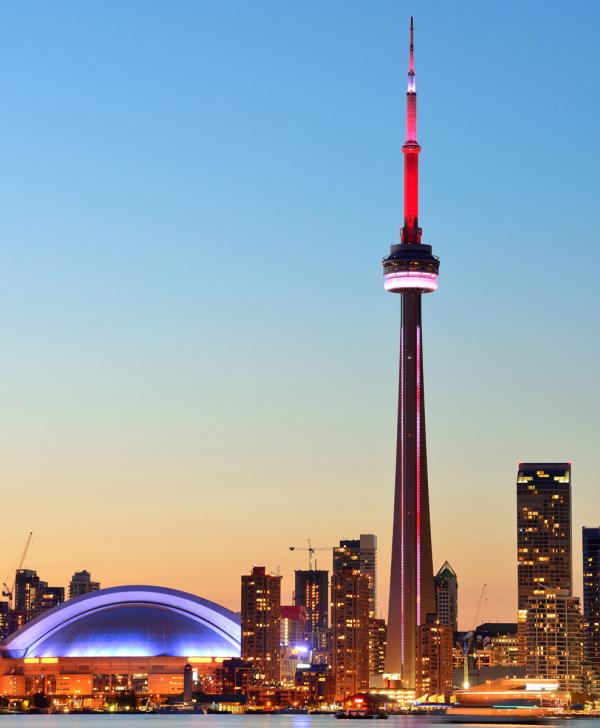
CN Tower is a landmark in Toronto, Canada. Canada's most recognizable structure, this 553-metre communications tower dominates Toronto's skyline. Most visitors spend 1–2 hours here. The free Lokali audio guide runs 5 minutes.
✓ Verified August 2026 · how we write these guides
Visitor facts
| Time needed | 1–2 hours |
|---|---|
| Lokali audio guide | 5 min · free |
| Type | Landmark |
| Best for | Photography |
| Location | Toronto, Canada |
| Coordinates | 43.6426, -79.3871 |
| Languages | 45, in the Lokali app |
The story
From almost anywhere in the city, one slender tower draws the eye, a tapering concrete shaft topped by a bulge of decks and a long needle, rising far above the downtown towers by the lake. This is the CN Tower, the landmark and symbol of Toronto, and for decades the tallest free-standing structure in the world.
It was completed in the mid-1970s, in 1976, as a communications tower, built to lift broadcast antennas above the city's growing cluster of skyscrapers. Its height, well over five hundred metres, made it a record-holder for some three decades.
The main draw is the climb to the observation levels high up the tower, reached by glass-fronted lifts that race up the outside of the shaft, the city dropping away beneath you in seconds. The view from the top runs over the city, the lake, and, on a clear day, far across the water.
One floor has a glass floor, a panel of thick glass set into the deck through which you can look straight down to the ground far below. Standing on it is a small test of nerve, and a favourite, slightly unsettling, photograph.
Higher still is a second, smaller deck near the top of the tower, giving an even wider view, and for the truly bold there is a walk, harnessed and hands-free, around an open ledge outside the main pod, high above the city.
A revolving restaurant turns slowly near the top, completing a full circle over the course of a meal, so diners see the whole city pass by without leaving their table, a classic, if pricey, way to take in the view.
At night the tower is lit, its colours changing to mark holidays, events, and causes, a signal visible across the city, much as other great towers around the world mark the night sky.
The tower stands by the lakeshore at the foot of downtown, beside the stadium, the aquarium, and the convention district, so it anchors a whole quarter of attractions easily combined on foot.
It is, like many such towers, as much a feat of engineering and a symbol as a sight, but the view and the glass floor genuinely reward the trip, especially on a clear day or at sunset.
The experience is well organised and busy, through ticketed lifts and decks, so booking ahead and choosing a clear day matter more than the exact hour, though sunset is the most popular and beautiful.
A few practical notes. Book online ahead to save time, especially in summer; check the forecast, as cloud hides the view; and decide in advance whether you want the higher deck, the restaurant, or the outdoor walk. Allow for security and lift queues.
Stand on the glass floor with the city far beneath your feet, then look out across the lake to the horizon, and the scale of Toronto and its setting on the water comes clear. When the lift drops you back to the ground, the tower stays overhead, the needle you can find from anywhere in the city.
Key facts
What to look for
Practical tips
Common questions
How long do you need at CN Tower?
Plan 1–2 hours. That is the time most visitors spend at CN Tower. The free Lokali audio guide adds about 5 minutes of narration you can listen to as you walk, so it fits inside your visit rather than adding to it.
Is there a free audio guide to CN Tower?
Yes — the Lokali app narrates CN Tower free of charge in 50+ languages. It covers the history, what to look for on site and practical tips, and it works offline once downloaded.
Where is CN Tower?
CN Tower is in Toronto, Canada, at 43.6426, -79.3871. Tap the map link on this page for directions from where you are.
What should you know before visiting CN Tower?
Book online ahead to save time.
What is CN Tower known for?
The landmark tower and symbol of Toronto.
What is the best time to visit CN Tower?
Visit at sunset to watch the city lights ignite below you.
On the map
Opens directions to CN Tower from your location.
More to see in Toronto


Hear CN Tower in your language
The full story, narrated, in 50+ languages. Download it before you go and it plays offline, at your own pace, with no ticket and no tour group.