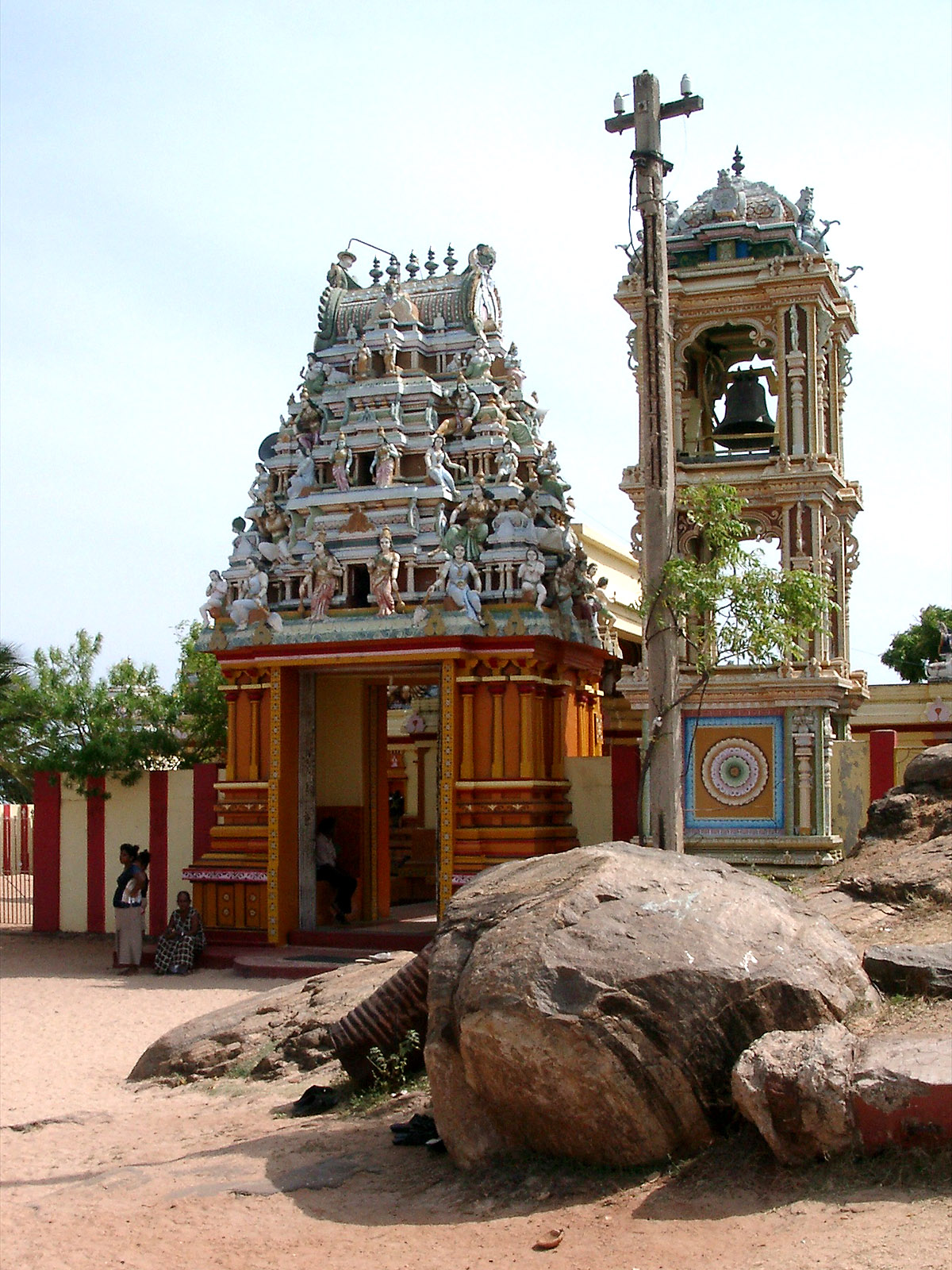
Photo: Dschen Reinecke · CC BY-SA 3.0 · Wikimedia Commons
Koneswaram Temple is a temple. It is near Trincomalee, Sri Lanka. Dedicated to Shiva, one of Hinduism's principal gods. The free Lokali audio guide runs 7 minutes.
✓ Published October 2026 · how we write these guides
Visitor facts
| Lokali audio guide | 7 min · free |
|---|---|
| Type | Temple |
| Location | Trincomalee, Sri Lanka |
| Coordinates | 8.5825, 81.2456 |
| Languages | 50+, in the Lokali app |
The story
Feel the stone under your bare feet first. It is warm, almost hot, polished smooth by many thousands of soles before yours. Somewhere behind you, a bell rings once and fades. In front of you, the land simply ends. A cliff drops straight into the Indian Ocean, and the water below shifts from green to a deep, inky blue. The wind comes in off the sea, carrying salt, incense, and the faint smell of crushed flowers. You are standing at Koneswaram.
This is a Hindu temple dedicated to Shiva, one of the great gods of Hinduism, often worshipped as the destroyer and renewer of the world. It sits on a rocky headland known as Swami Rock, at the tip of a narrow peninsula in Trincomalee, on Sri Lanka's eastern coast. To reach it, you passed through the gates of an old colonial fort. That route is no accident. The fort and the temple share a long and painful history, and we will come to it shortly.
First, consider how old the devotion here is. Koneswaram is counted among the Pancha Ishwarams — five ancient shrines to Shiva spread around the coast of the island. Tamil poet-saints praised this place in devotional hymns more than a thousand years ago. Those hymns belong to a collection called the Tevaram, which is still sung in Shiva temples today. When pilgrims chant those verses here, they repeat words written about this exact headland, above this same sea.
The early temple was famous across the region. Old accounts describe a large complex of halls and shrines spread across the rock, with many carved pillars. People sometimes called it the temple of a thousand pillars. Whether there were truly a thousand is hard to know — the phrase may describe size rather than an exact count. What is clear is that this was one of the most important sacred sites on the island. Ships passing the harbour could see it from far out at sea.
Then, in the early seventeenth century, everything changed. Portuguese forces had taken control of parts of Sri Lanka's coast. They saw the headland as a strategic military position, guarding one of the finest natural harbours in Asia. They tore down the temple. Much of the stone was reused to build the fortifications you walked through on your way here. So the walls of the fort carry pieces of the old sanctuary inside them. Some visitors notice carved blocks set into the masonry.
Here is something many visitors never hear. Before the destruction, according to tradition, priests carried some sacred images away and hid them. For centuries the old temple existed mostly in memory and in poetry. Then, in the twentieth century, bronze statues were found buried in the area. These finds helped to inspire a rebuilding. The temple you see today was reconstructed in the mid-twentieth century, on the same rock, and ancient objects were brought back into worship here.
A second surprise lies under the water. In the 1950s, divers explored the sea at the foot of this cliff. Among them was the science-fiction writer Arthur C. Clarke, who lived in Sri Lanka for many years. The divers reported carved stones and fragments resting on the seabed. Clarke later wrote about these dives in a book about the reefs of the island. When you look down from the cliff edge, remember that part of the old temple may lie somewhere below those waves.
Now look at the building in front of you. The style is Dravidian, the temple architecture of South India and northern Sri Lanka. Its gateway tower is covered with painted figures of gods, guardians, and animals. The colours are bright — reds, yellows, greens, and blues. Inside, the light is dimmer, and oil lamps flicker in front of the shrine. Priests move quietly through rituals that follow a fixed daily rhythm, and the sound of bells and chanting fills the halls.
The headland also carries older stories. Legend has it that Ravana, the demon king from the Hindu epic the Ramayana, worshipped Shiva on this rock. A deep, narrow crack in the cliff nearby is linked to him by tradition. Locals say he split the rock with his sword. These are sacred stories, not historical records, but they matter deeply to pilgrims. For many people here, the landscape itself is part of the scripture.
Near the edge you may see a different kind of memorial. Swami Rock is also known as Lover's Leap. According to a popular tale from the Dutch colonial period, a young woman jumped from this cliff after her lover sailed away. Historians have questioned how much of that story is true. Still, the name has stayed. It shows how many cultures — Tamil, Portuguese, Dutch, and British — have left their own marks on this single piece of rock.
Look also at the trees around the temple grounds. You may see small wooden cradles and bundles of cloth tied to the branches. Many of these are offerings from people praying for a child, or for help with a family wish. Each cradle is a private hope, left out in the sea wind. It is one of the quietest and most human details here, and it is easy to walk past without noticing.
The journey to the temple is part of the experience too. The fort area is still used by the military, so you will see soldiers and barracks beside the colonial walls. Spotted deer often wander along the road, quite calm around people. As you climb, the views open over the harbour on one side and the open ocean on the other. In the right season, some visitors watch for whales and dolphins far out on the water.
Before you leave, walk to the railing one last time. Feel the wind push against you. Listen to the bells behind you and the sea below. Notice how the old fort stones, the bright temple tower, and the empty blue horizon all sit together in one view. Then, as you walk back down the hill, look closely at the walls you pass. Some of those stones once stood here, inside a temple, above the same sea.
Key facts
What to look for
Practical tips
Common questions
Is there a free audio guide to Koneswaram Temple?
Yes — the Lokali app narrates Koneswaram Temple free of charge in 50+ languages. The guide runs about 7 minutes, covers the history, what to look for on site and practical tips, and works offline once downloaded.
Where is Koneswaram Temple?
Koneswaram Temple is near Trincomalee, Sri Lanka, at 8.5825, 81.2456. Tap the map link on this page for directions from where you are.
What is Koneswaram Temple known for?
Dedicated to Shiva, one of Hinduism's principal gods. One of the Pancha Ishwarams, five ancient Shiva shrines.
What should you look for at Koneswaram Temple?
Carved temple blocks reused in Fort Frederick's walls. Wooden cradles tied to trees as wishes for children. The narrow rock cleft linked to the legend of Ravana.
What should you know before visiting Koneswaram Temple?
Remove your shoes before entering the temple grounds. Come early morning before the rock gets hot underfoot.
When is the best time to visit Koneswaram Temple?
Come early morning before the rock gets hot underfoot.
On the map
Opens directions to Koneswaram Temple from your location.
Hear Koneswaram Temple in your language
The full story, narrated, in 50+ languages. Download it before you go and it plays offline, at your own pace, with no ticket and no tour group.